Fiber Features: un software especializado para la caracterización automática de microfibras antropogénicas a partir de muestras ambientales
DOI:
https://doi.org/10.47193/mafis.4012027010107Palabras clave:
Contaminación marina, análisis automatizado de imágenes, distancia esquelética geodésica, caracterización morfométrica, meteorizaciónResumen
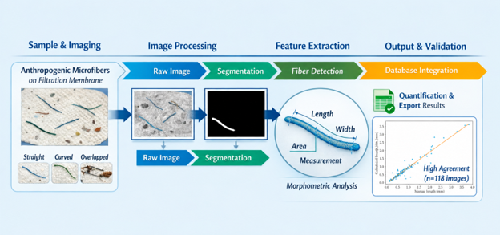
Las microfibras (MF) de origen antropogénico constituyen una de las formas de contaminación más extendidas en el medio ambiente. Los procedimientos estándar para el recuento y la caracterización de las MF suelen incluir la extracción de partículas de la matriz de muestreo, filtración y una inspección detallada de las membranas para identificar, clasificar y caracterizar todos los elementos detectados. La caracterización física a menudo comprende mediciones morfométricas, tales como el área superficial, la longitud y el ancho, lo cual incrementa considerablemente el tiempo de procesamiento. Los avances recientes en la capacidad de cómputo y la imagenología digital han ampliado notablemente el potencial del análisis de imágenes como herramienta para el estudio de las MF en muestras ambientales. No obstante, su adopción generalizada se ha visto limitada por los desafíos que conlleva la automatización del proceso de análisis. En este estudio, presentamos una herramienta de software robusta y fácil de usar para la detección, cuantificación y medición automáticas de MF en imágenes digitales. El método fue desarrollado específicamente para analizar MF retenidas en membranas utilizadas durante los procedimientos de filtración, si bien su aplicabilidad podría extenderse a otros contextos. El enfoque se basa en la obtención de imágenes de alta resolución, a partir de las cuales las MF se segmentan y miden automáticamente en función de su longitud, anchura y otros atributos físicos. Los resultados pueden exportarse en diversos formatos para su posterior análisis. Evaluamos la precisión y la repetibilidad del software comparando sus mediciones con anotaciones manuales en un conjunto de datos compuesto por 118 imágenes. Los resultados mostraron un alto grado de concordancia y robustez, lo que pone de relieve el potencial de este software para agilizar y estandarizar el análisis de MF en la investigación ambiental.
Descargas
Referencias
Alves NM, Rodriguez J, Di Mauro R, Rodríguez JS, Maldonado D, Braverman MS, Temperoni B, Diaz MV. 2024. Like noodles in a soup: anthropogenic microfibers are being ingested by juvenile fish in nursery grounds of the southwestern Atlantic ocean. Mar Pollut Bull. 202: 116368. DOI: https://doi.org/10.1016/j.marpolbul.2024.116368
Andrady AL. 2011. Microplastics in the marine environment. Mar Pollut Bull. 62 (8): 1596-1605. DOI: https://doi.org/10.1016/j.marpolbul.2011.05.030
Barrows APW, Cathey SE, Petersen CW. 2018. Marine environment microfiber contamination: global patterns and the diversity of microparticle origins. Environ Pollut. 237: 275-284. DOI: https://doi.org/10.1016/j.envpol.2018.02.062
Belzagui F, Gutiérrez-Bouzán C, Álvarez-Sánchez A, Vilaseca M. 2020. Textile microfibers reaching aquatic environments: a new estimation approach. Environ Pollut. 265: 114889. DOI: https://doi.org/10.1016/j.envpol.2020.114889
Calabi L, Hartnett WE. 1968. Shape recognition, prairie fires, convex deficiencies and skeletons. Am Math Mon. 75: 335-342.
Cowger W, Booth A, Hamilton B, Primpke S, Munno K, Lusher A, Dehaut A, Vaz VP, Liboiron M, Devriese LI, et al. 2020. Reporting guidelines to increase the reproducibility and comparability of research on microplastics. Appl Spectrosc. 74 (9): 1066-1077. DOI: https://doi.org/10.1177/0003702820930292
Di Mauro R, Alves N, Rodriguez J, Sobrero L, Chiesa I, Hozbor M, Allega L, Antacli J, Diaz MV, Schiariti A. 2025. Assessing anthropogenic microfiber pollution in the southwestern Atlantic Ocean: a large-scale study on spatial distribution, concentration, and physical characterization. Environ Sci Pollut Res. 32: 22458-22478. DOI: https://doi.org/10.1007/s11356-025-36964-6
Di Mauro R, Castillo S, Perez A, Iachetti C, Silva L, Tomba JP, Chiesa I. 2022. Anthropogenic microfibers are highly abundant at the Burdwood Bank seamount, a protected Sub-Antarctic environment in the Southwestern Atlantic Ocean. Environ Pollut. 306. DOI: https://doi.org/10.1016/j.envpol.2022.119364
Dreillard M, Barros C De F, Rouchon V, Emonnot C, Lefebvre V, Moreaud M, Guillaume D, Rimbault F, Pagerey F. 2022. Quantification and morphological characterization of microfibers emitted from textile washing. Sci Total Environ. 832: 154973. DOI: https://doi.org/10.1016/j.scitotenv.2022.154973
Duncan E, Botterell Z, Broderick A, Galloway T, Lindeque P, Nuno A, Godley B. 2017. A global review of marine turtle entanglement in anthropogenic debris: a baseline for further action. Endanger Species Res. 34: 431-448. DOI: https://doi.org/10.3354/esr00865
Elewa A. 2010. Morphometrics for nonmorphometricians. DOI: https://doi.org/10.1007/978-3-540-95853-6
Galloway T, Cole M, Lewis C. 2017. Interactions of microplastic debris throughout the marine ecosystem. Nat Ecol Evol. 1: 0116. DOI: https://doi.org/10.1038/s41559-017-0116
Gauci A, Deidun A, Montebello J, Abela J, Galgani F. 2019. Automating the characterisation of beach microplastics through the application of image analyses. Ocean Coast Manage. 182: 104950. DOI: https://doi.org/10.1016/j.ocecoaman.2019.104950
Hidalgo-Ruz V, Gutow L, Thompson RC, Thiel M. 2012. Microplastics in the marine environment: a review of the methods used for identification and quantification. Environ Sci Technol. 46 (6): 3060-3075. DOI: https://doi.org/10.1021/es2031505
Hufnagl B, Stibi M, Martirosyan H, Wilczek U, Möller JN, Löder MGJ, Laforsch C, Lohninger H. 2022. Computer-assisted analysis of microplastics in environmental samples based on µftir imaging in combination with machine learning. Environ Sci Technol Lett. 9 (1): 90-95. DOI: https://doi.org/10.1021/acs.estlett.1c00851
Koelmans A, Redondo-Hasselerharm P, Hazimah N, Kooi M. 2020. Solving the non-alignment of methods and approaches used in microplastic research in order to consistently characterize risk. Environ Sci Technol. 54 (19): 12307-12315. DOI: https://doi.org/10.1021/acs.est.0c02982
Koelmans AA, Redondo-Hasselerharm PE, Nor NHM, de Ruijter VN, Mintenig SM, Kooi M. 2022. Risk assessment of microplastic particles. Nat Rev Mater. 7 (2): 138-152.
Kooi M, Koelmans AA. 2019. Simplifying microplastic via continuous probability distributions for size, shape, and density. Environ Sci Technol Lett. 6 (9): 551-557. DOI: https://doi.org/10.1021/acs.estlett.9b00379
Lantuéjoul C, Maisonneuve F. 1984. Geodesic methods in image analysis. Pattern Recognit. 17 (2): 177-187.
Li Y, Lu Q, Xing Y, Liu K, Ling W, Yang J, Yang Q, Wu T, Zhang J, Pei Z, Gao Z, Li X, Yang F, Ma H, Liu K, Zhao D. Review of research on migration, distribution, biological effects, and analytical methods of microfibers in the environment. Sci Total Environ. 855: 158922. DOI: https://doi.org/10.1016/j.scitotenv.2022.158922
Lima ARA, Ferreira GVB, Barrows APW, Christiansen KS, Treinish G, Toshack MC. 2021. Global patterns for the spatial distribution of floating microfibers: Arctic Ocean as a potential accumulation zone. J Hazard Mat. 403: 123796. DOI: https://doi.org/10.1016/j.jhazmat.2020.123796
Liu J, Qiang L, An L, Wang M, Qingbo Y, Zhu B, Ding J, Ye C, Xu Y. 2022. Microfiber pollution in the earth system. Rev Environ Contam Toxicol. 260. DOI: https://doi.org/10.1007/s44169-022-00015-9
Liu P, Zhan X, Wu X, Li J, Wang H, Gao S. 2020. Effect of weathering on environmental behavior of microplastics: properties, sorption and potential risks. Chemosphere. 242: 125193. DOI: https://doi.org/10.1016/j.chemosphere.2019.125193
Lorenzo-Navarro J, Castrillón-Santana M, Santesarti E, De Marsico M, Martínez I, Raymond E, Gómez M, Herrera A. 2020. Smacc: a system for microplastics automatic counting and classification. IEEE Access. 8: 25249-25261. DOI: https://doi.org/10.1109/ACCESS.2020.2970498
Masura J, Baker JE, Foster GD, Arthur C, Herring C. 2015. Laboratory methods for the analysis of microplastics in the marine environment: recommendations for quantifying synthetic particles in waters and sediments. NOAA Tech Mem NOS-OR&R. 48. https://repository.library.noaa.gov/view/noaa/10296/noaa_10296_DS1.pdf.
Meyer F. 1989. Skeletons and perceptual graphs. Signal Process. 16 (4): 335-363. DOI: https://doi.org/10.1016/0165-1684(89)90030-3
Mishra S, Singh RP, Rath CC, Das AP. 2020. Synthetic microfibers: source, transport and their remediation. J Water Process Eng. 38: 101612. DOI: https://doi.org/10.1016/j.jwpe.2020.101612
Peng L, Zheng N, Li Y, An Q, Chen C, Xiu Z, Li X, Wei Y. 2026. Dynamic evolution of microbial colonization on indoor microplastics: Polymer diversity-driven co-occurrence networks and health risks. Environ Int. 207: 109994. DOI: https://doi.org/10.1016/j.envint.2025.109994.
Primpke S, Lorenz C, Rascher-Friesenhausen R, Gerdts G. 2017. An automated approach for microplastics analysis using focal plane array (fpa) ftir microscopy and image analysis. Anal Methods. 9 (9): 1499-1511.
Reinhardt I. 2021. Modellierung der partikelcharakteristika von mikroplastik im boden: modelling of features of microplastics in soil [dissertation]. Universität Stuttgart.
Russ JC, Dehoff RT. 2000. Basic stereological procedures. Springer US.
Salvador Cesa F, Turra A, Baruque-Ramos J. 2017. Synthetic fibers as microplastics in the marine environment: a review from textile perspective with a focus on domestic washings. Sci Total Environ. 598: 1116-1129. DOI: https://doi.org/10.1016/j.scitotenv.2017.04.172
Schindelin J, Arganda-Carreras I, Frise E, Kaynig V, Longair M, Pietzsch T, Preibisch S, Rueden C, Saalfeld S, Schmid B, et al. 2012. Fiji: an open-source platform for biological image analysis. Nat Methods. 9: 676-82. DOI: https://doi.org/10.1038/nmeth.2019
Schisterman E, Perkins N, Liu A, Bondell H. 2005. Optimal cut-point and its corresponding youden index to discriminate individuals using pooled blood samples. Epidemiology. 16: 73-81. DOI: https://doi.org/10.1097/01.ede.0000147512.81966.ba
Schnepf U, Lioba von Moers-Meßmer MA, Brümmer F. 2023. A practical primer for image-based particle measurements in microplastic research. Microplast Nanoplast. 3: 16. DOI: https://doi.org/10.1186/s43591-023-00064-4
Suaria G, Achtypi A, Perold V, Lee JR, Pierucci A, Bornman TG, Aliani S, Ryan PG. 2020. Microfibers in oceanic surface waters: a global characterization. Sci Adv. 6 (23): eaay8493. DOI: https://doi.org/10.1126/sciadv.aay8493
Valente T, Ventura D, Matiddi M, Sbrana A, Silvestri C, Piermarini R, Jacomini C, Costantini ML. 2023. Image processing tools in the study of environmental contamination by microplastics: reliability and perspectives. Environ Sci Pollut Res. 30: 298-309. DOI: https://doi.org/10.1007/s11356-022-22128-3
von der Esch E, Kohles AJ, Anger PM, Hoppe R, Niessner R, Elsner M, Ivleva NP. 2020. TUM-ParticleTyper: a detection and quantification tool for automated analysis of (microplastic) particles and fibers. PLoS ONE. 15 (6): e0234766. DOI: https://doi.org/10.1371/journal.pone.0234766
Xiao S, Cui Y, Brahney J, Mahowald NM, Li Q. 2023. Long-distance atmospheric transport of microplastic fibres influenced by their shapes. Nat Geosci. 16 (10): 863-870.
Descargas
Archivos adicionales
Publicado
Número
Sección
Licencia
Derechos de autor 2026 Rosana P. Di Mauro, Rodrigo E. Russo, Nadia M. Alves, Julieta S. Rodríguez, Julieta Rodriguez, Marina V. Diaz, Juan I. Pastore

Esta obra está bajo una licencia internacional Creative Commons Atribución-NoComercial-CompartirIgual 4.0.
Los autores de los artículos publicados en Marine and Fishery Sciences conservan los derechos de autor de sus artículos, a excepción de las imágenes de terceros y otros materiales añadidos por Marine and Fishery Sciences, que están sujetos a los derechos de autor de sus respectivos propietarios. Por lo tanto, los autores son libres de difundir y volver a publicar sus artículos, sujeto a los requisitos de los propietarios de derechos de autor de terceros y sujeto a que la publicación original sea completamente citada. Los visitantes también pueden descargar y reenviar artículos sujetos a los requisitos de citas. La capacidad de copiar, descargar, reenviar o distribuir cualquier material siempre está sujeta a los avisos de derechos de autor que se muestran. Los avisos de copyright deben mostrarse de manera prominente y no pueden borrarse, eliminarse u ocultarse, total o parcialmente. El autoalmacenamiento en servidores y repositorios de preimpresión está permitido para todas las versiones.
Esta revista ofrece a los autores una política de acceso abierto. Los usuarios pueden leer, descargar, copiar, distribuir, imprimir, buscar o vincular los textos completos de los artículos, o usarlos para cualquier otro propósito legal dentro de la licencia Creative Commons 4.0 (BY-NC-SA), sin solicitar permiso previo del editor o del autor. Esto está de acuerdo con la definición BOAI de acceso abierto.