Fiber Features: a dedicated software for the automatic characterization of anthropogenic microfibers from environmental samples
DOI:
https://doi.org/10.47193/mafis.4012027010107Keywords:
Marine pollution, automated image analysis, geodesic skeletal distance, morphometric characterization, weatheringAbstract
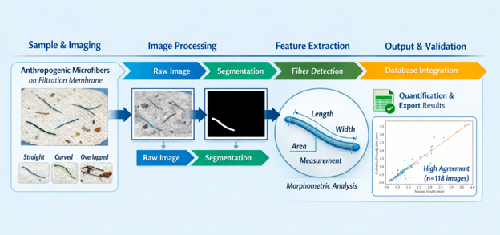
Microfibers (MFs) are among the most widespread forms of pollution in the environment. Standard procedures for counting and characterizing MFs typically involve particle extraction from the sampling matrix, filtration, and detailed inspection of the membranes to identify, classify, and characterize all detected items. Physical characterization often includes morphometric measurements such as surface area, length, and width, which significantly increases processing time. Recent advances in computer performance and digital imaging have greatly expanded the potential of image analysis as a tool for studying MFs from environmental samples. However, its broader adoption has been hindered by the challenges associated with automating the analysis process. In this study, we present a reliable and user-friendly software tool for the automatic detection, quantification, and measurement of MFs in digital images. The method was specifically developed for analyzing MFs retained on membranes used during filtration procedures, although its applicability may extend to other settings. The approach relies on the acquisition of high-resolution images, from which MFs are automatically segmented and measured in terms of length, width, and additional physical attributes. Results can be exported in multiple formats for further analysis. We evaluated the accuracy and repeatability of the software by comparing its measurements with manual annotations across a dataset of 118 images. The results demonstrated a high level of agreement and robustness, highlighting the software’s potential to streamline and standardize MF analysis in environmental research.
Downloads
References
Alves NM, Rodriguez J, Di Mauro R, Rodríguez JS, Maldonado D, Braverman MS, Temperoni B, Diaz MV. 2024. Like noodles in a soup: anthropogenic microfibers are being ingested by juvenile fish in nursery grounds of the southwestern Atlantic ocean. Mar Pollut Bull. 202: 116368. DOI: https://doi.org/10.1016/j.marpolbul.2024.116368
Andrady AL. 2011. Microplastics in the marine environment. Mar Pollut Bull. 62 (8): 1596-1605. DOI: https://doi.org/10.1016/j.marpolbul.2011.05.030
Barrows APW, Cathey SE, Petersen CW. 2018. Marine environment microfiber contamination: global patterns and the diversity of microparticle origins. Environ Pollut. 237: 275-284. DOI: https://doi.org/10.1016/j.envpol.2018.02.062
Belzagui F, Gutiérrez-Bouzán C, Álvarez-Sánchez A, Vilaseca M. 2020. Textile microfibers reaching aquatic environments: a new estimation approach. Environ Pollut. 265: 114889. DOI: https://doi.org/10.1016/j.envpol.2020.114889
Calabi L, Hartnett WE. 1968. Shape recognition, prairie fires, convex deficiencies and skeletons. Am Math Mon. 75: 335-342.
Cowger W, Booth A, Hamilton B, Primpke S, Munno K, Lusher A, Dehaut A, Vaz VP, Liboiron M, Devriese LI, et al. 2020. Reporting guidelines to increase the reproducibility and comparability of research on microplastics. Appl Spectrosc. 74 (9): 1066-1077. DOI: https://doi.org/10.1177/0003702820930292
Di Mauro R, Alves N, Rodriguez J, Sobrero L, Chiesa I, Hozbor M, Allega L, Antacli J, Diaz MV, Schiariti A. 2025. Assessing anthropogenic microfiber pollution in the southwestern Atlantic Ocean: a large-scale study on spatial distribution, concentration, and physical characterization. Environ Sci Pollut Res. 32: 22458-22478. DOI: https://doi.org/10.1007/s11356-025-36964-6
Di Mauro R, Castillo S, Perez A, Iachetti C, Silva L, Tomba JP, Chiesa I. 2022. Anthropogenic microfibers are highly abundant at the Burdwood Bank seamount, a protected Sub-Antarctic environment in the Southwestern Atlantic Ocean. Environ Pollut. 306. DOI: https://doi.org/10.1016/j.envpol.2022.119364
Dreillard M, Barros C De F, Rouchon V, Emonnot C, Lefebvre V, Moreaud M, Guillaume D, Rimbault F, Pagerey F. 2022. Quantification and morphological characterization of microfibers emitted from textile washing. Sci Total Environ. 832: 154973. DOI: https://doi.org/10.1016/j.scitotenv.2022.154973
Duncan E, Botterell Z, Broderick A, Galloway T, Lindeque P, Nuno A, Godley B. 2017. A global review of marine turtle entanglement in anthropogenic debris: a baseline for further action. Endanger Species Res. 34: 431-448. DOI: https://doi.org/10.3354/esr00865
Elewa A. 2010. Morphometrics for nonmorphometricians. DOI: https://doi.org/10.1007/978-3-540-95853-6
Galloway T, Cole M, Lewis C. 2017. Interactions of microplastic debris throughout the marine ecosystem. Nat Ecol Evol. 1: 0116. DOI: https://doi.org/10.1038/s41559-017-0116
Gauci A, Deidun A, Montebello J, Abela J, Galgani F. 2019. Automating the characterisation of beach microplastics through the application of image analyses. Ocean Coast Manage. 182: 104950. DOI: https://doi.org/10.1016/j.ocecoaman.2019.104950
Hidalgo-Ruz V, Gutow L, Thompson RC, Thiel M. 2012. Microplastics in the marine environment: a review of the methods used for identification and quantification. Environ Sci Technol. 46 (6): 3060-3075. DOI: https://doi.org/10.1021/es2031505
Hufnagl B, Stibi M, Martirosyan H, Wilczek U, Möller JN, Löder MGJ, Laforsch C, Lohninger H. 2022. Computer-assisted analysis of microplastics in environmental samples based on µftir imaging in combination with machine learning. Environ Sci Technol Lett. 9 (1): 90-95. DOI: https://doi.org/10.1021/acs.estlett.1c00851
Koelmans A, Redondo-Hasselerharm P, Hazimah N, Kooi M. 2020. Solving the non-alignment of methods and approaches used in microplastic research in order to consistently characterize risk. Environ Sci Technol. 54 (19): 12307-12315. DOI: https://doi.org/10.1021/acs.est.0c02982
Koelmans AA, Redondo-Hasselerharm PE, Nor NHM, de Ruijter VN, Mintenig SM, Kooi M. 2022. Risk assessment of microplastic particles. Nat Rev Mater. 7 (2): 138-152.
Kooi M, Koelmans AA. 2019. Simplifying microplastic via continuous probability distributions for size, shape, and density. Environ Sci Technol Lett. 6 (9): 551-557. DOI: https://doi.org/10.1021/acs.estlett.9b00379
Lantuéjoul C, Maisonneuve F. 1984. Geodesic methods in image analysis. Pattern Recognit. 17 (2): 177-187.
Li Y, Lu Q, Xing Y, Liu K, Ling W, Yang J, Yang Q, Wu T, Zhang J, Pei Z, Gao Z, Li X, Yang F, Ma H, Liu K, Zhao D. Review of research on migration, distribution, biological effects, and analytical methods of microfibers in the environment. Sci Total Environ. 855: 158922. DOI: https://doi.org/10.1016/j.scitotenv.2022.158922
Lima ARA, Ferreira GVB, Barrows APW, Christiansen KS, Treinish G, Toshack MC. 2021. Global patterns for the spatial distribution of floating microfibers: Arctic Ocean as a potential accumulation zone. J Hazard Mat. 403: 123796. DOI: https://doi.org/10.1016/j.jhazmat.2020.123796
Liu J, Qiang L, An L, Wang M, Qingbo Y, Zhu B, Ding J, Ye C, Xu Y. 2022. Microfiber pollution in the earth system. Rev Environ Contam Toxicol. 260. DOI: https://doi.org/10.1007/s44169-022-00015-9
Liu P, Zhan X, Wu X, Li J, Wang H, Gao S. 2020. Effect of weathering on environmental behavior of microplastics: properties, sorption and potential risks. Chemosphere. 242: 125193. DOI: https://doi.org/10.1016/j.chemosphere.2019.125193
Lorenzo-Navarro J, Castrillón-Santana M, Santesarti E, De Marsico M, Martínez I, Raymond E, Gómez M, Herrera A. 2020. Smacc: a system for microplastics automatic counting and classification. IEEE Access. 8: 25249-25261. DOI: https://doi.org/10.1109/ACCESS.2020.2970498
Masura J, Baker JE, Foster GD, Arthur C, Herring C. 2015. Laboratory methods for the analysis of microplastics in the marine environment: recommendations for quantifying synthetic particles in waters and sediments. NOAA Tech Mem NOS-OR&R. 48. https://repository.library.noaa.gov/view/noaa/10296/noaa_10296_DS1.pdf.
Meyer F. 1989. Skeletons and perceptual graphs. Signal Process. 16 (4): 335-363. DOI: https://doi.org/10.1016/0165-1684(89)90030-3
Mishra S, Singh RP, Rath CC, Das AP. 2020. Synthetic microfibers: source, transport and their remediation. J Water Process Eng. 38: 101612. DOI: https://doi.org/10.1016/j.jwpe.2020.101612
Peng L, Zheng N, Li Y, An Q, Chen C, Xiu Z, Li X, Wei Y. 2026. Dynamic evolution of microbial colonization on indoor microplastics: Polymer diversity-driven co-occurrence networks and health risks. Environ Int. 207: 109994. DOI: https://doi.org/10.1016/j.envint.2025.109994.
Primpke S, Lorenz C, Rascher-Friesenhausen R, Gerdts G. 2017. An automated approach for microplastics analysis using focal plane array (fpa) ftir microscopy and image analysis. Anal Methods. 9 (9): 1499-1511.
Reinhardt I. 2021. Modellierung der partikelcharakteristika von mikroplastik im boden: modelling of features of microplastics in soil [dissertation]. Universität Stuttgart.
Russ JC, Dehoff RT. 2000. Basic stereological procedures. Springer US.
Salvador Cesa F, Turra A, Baruque-Ramos J. 2017. Synthetic fibers as microplastics in the marine environment: a review from textile perspective with a focus on domestic washings. Sci Total Environ. 598: 1116-1129. DOI: https://doi.org/10.1016/j.scitotenv.2017.04.172
Schindelin J, Arganda-Carreras I, Frise E, Kaynig V, Longair M, Pietzsch T, Preibisch S, Rueden C, Saalfeld S, Schmid B, et al. 2012. Fiji: an open-source platform for biological image analysis. Nat Methods. 9: 676-82. DOI: https://doi.org/10.1038/nmeth.2019
Schisterman E, Perkins N, Liu A, Bondell H. 2005. Optimal cut-point and its corresponding youden index to discriminate individuals using pooled blood samples. Epidemiology. 16: 73-81. DOI: https://doi.org/10.1097/01.ede.0000147512.81966.ba
Schnepf U, Lioba von Moers-Meßmer MA, Brümmer F. 2023. A practical primer for image-based particle measurements in microplastic research. Microplast Nanoplast. 3: 16. DOI: https://doi.org/10.1186/s43591-023-00064-4
Suaria G, Achtypi A, Perold V, Lee JR, Pierucci A, Bornman TG, Aliani S, Ryan PG. 2020. Microfibers in oceanic surface waters: a global characterization. Sci Adv. 6 (23): eaay8493. DOI: https://doi.org/10.1126/sciadv.aay8493
Valente T, Ventura D, Matiddi M, Sbrana A, Silvestri C, Piermarini R, Jacomini C, Costantini ML. 2023. Image processing tools in the study of environmental contamination by microplastics: reliability and perspectives. Environ Sci Pollut Res. 30: 298-309. DOI: https://doi.org/10.1007/s11356-022-22128-3
von der Esch E, Kohles AJ, Anger PM, Hoppe R, Niessner R, Elsner M, Ivleva NP. 2020. TUM-ParticleTyper: a detection and quantification tool for automated analysis of (microplastic) particles and fibers. PLoS ONE. 15 (6): e0234766. DOI: https://doi.org/10.1371/journal.pone.0234766
Xiao S, Cui Y, Brahney J, Mahowald NM, Li Q. 2023. Long-distance atmospheric transport of microplastic fibres influenced by their shapes. Nat Geosci. 16 (10): 863-870.
Additional Files
Published
Issue
Section
License
Copyright (c) 2026 Rosana P. Di Mauro, Rodrigo E. Russo, Nadia M. Alves, Julieta S. Rodríguez, Julieta Rodriguez, Marina V. Diaz, Juan I. Pastore

This work is licensed under a Creative Commons Attribution-NonCommercial-ShareAlike 4.0 International License.
Authors of articles published in Marine and Fishery Sciences retain copyright on their articles, except for any third-party images and other materials added by Marine and Fishery Sciences, which are subject to copyright of their respective owners. Authors are therefore free to disseminate and re-publish their articles, subject to any requirements of third-party copyright owners and subject to the original publication being fully cited. Visitors may also download and forward articles subject to the citation requirements. The ability to copy, download, forward or otherwise distribute any materials is always subject to any copyright notices displayed. Copyright notices must be displayed prominently and may not be obliterated, deleted or hidden, totally or partially.
This journal offers authors an Open Access policy. Users are allowed to read, download, copy, distribute, print, search, or link to the full texts of the articles, or use them for any other legal purpose within the Creative Commons 4.0 license (BY-NC-SA), without asking prior permission from the publisher or the author. This is in accordance with the BOAI definition of Open Access.