Stock status of Tylosurus imperialis in the İskenderun Bay at the northeastern Mediterranean based on data-limited assessment methods
DOI:
https://doi.org/10.47193/mafis.3932026010708Keywords:
virtual population analysis, biological reference points, Stock assessmentAbstract
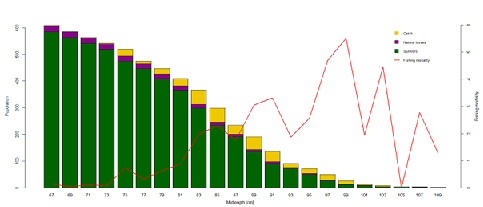
This study evaluated the stock status of Tylosurus imperialis in İskenderun Bay (northeastern Mediterranean Sea) using monthly length-frequency data collected between April and November 2022. Growth parameters were estimated using the Electronic Length Frequency Analysis (ELEFAN) approach implemented in the TropFishR framework. The von Bertalanffy Growth Function parameters were estimated as L∞ = 127 cm, k = 0.56 year-1, and t0 = -0.60 year-1, with a growth performance index (Φ′) of 3.95. Gear selectivity analysis estimated a length at first capture (L50) of 76 cm, corresponding to approximately 1.64 years of age. Length-based cohort analysis indicated considerable variation in fishing mortality among size classes, with the highest exploitation observed around 83 cm. Estimated total mortality (Z = 1.81 year-1) and natural mortality (M = 0.54 year-1) yielded a fishing mortality of F = 1.27 year-1 and an exploitation rate of E = 0.69. Although fishing mortality was below the estimated F0.1 reference point, the exploitation rate exceeded the precautionary threshold (E0.5 = 0.55). Yield-per-recruit analysis suggested an optimal length at first capture close to the current estimate (76 cm) and indicated limited potential yield gains under increased fishing effort. While the results suggest that the stock may be experiencing relatively high exploitation pressure, these findings should be interpreted with caution given the data-limited nature of the assessment. Nevertheless, the study provides the first stock assessment information for T. imperialis in the northeastern Mediterranean and offers a basis for future monitoring and management efforts.
Downloads
References
Carruthers TR, Walters CJ, McAllister MK, Bryan MD. 2014. Evaluating methods for setting catch limits in data-limited fisheries. Fish Res. 153: 48-68.
Collette BB. 2003. National Marine Fisheries Service, National Museum of Natural History. Washington (DC): USA. p. 1104-1115.
Colloca F, Cardinale M, Maynou F, Giannoulaki M, Scarcella G, Jenko K, Fiorentino F. 2013. Rebuilding Mediterranean fisheries: a new paradigm for ecological sustainability. Fish Fish. 14 (1): 89-109.
Ergüden D, Turan C, Ivanova PP, Doğdu SA, Raykov VS, Yankova M, Ergenler A. 2025. Age and growth of the needlefish, Tylosurus imperialis (Rafinesque, 1810) from the Levantine coast, north-eastern Mediterranean. North West J Zool. 21 (1): e251401.
[FAO] Food and Agriculture Organization of the United Nations. 2023. The state of Mediterranean and Black Sea fisheries 2023 - special edition. Rome: General Fisheries Commission for the Mediterranean. 52 p.
Froese R, Demirel N, Coro G, Kleisner KM, Winker H. 2017. Estimating fisheries reference points from catch and resilience. Fish Fish. 18 (3): 506-526.
Froese R, Winker H, Coro G, Demirel N, Tsikliras AC, Dimarchopoulou D, Pauly D. 2018. A new approach for estimating stock status from length frequency data. ICES J Mar Sci. 75 (6): 2004-2015.
Froese R, Pauly D. 2025. FishBase. World Wide Web electronic publication (version 02/2025). https://www.fishbase.org.
Gulland JA. 1985. Fish stock assessment: a manual of basic methods. New York (NY): Wiley and Sons. 223 p.
Hilborn R. 2010. Pretty good yield and exploited fishes. Mar Policy. 34 (1): 193-196.
Hilborn R, Walters CJ, editors. 2013. Quantitative fisheries stock assessment: choice, dynamics and uncertainty. New York (NY): Springer.
Hoggarth DD, Abeyasekera S, Arthur RI, Beddington JR, Burn RW. 2006. Stock assessment for fishery management: a framework guide to the stock assessment tools of the fisheries management science programme. Rome: FAO. 261 p.
Hordyk A, Ono K, Valencia S, Loneragan N, Prince J. 2015. A novel length-based empirical estimation method of spawning potential ratio (SPR), and tests of its performance, for small-scale, data-poor fisheries. ICES J Mar Sci. 72 (1): 217-231.
Isaac VJ. 1990. The accuracy of some length-based methods for fish population studies. ICLARM Tech Rep. 27. 81 p.
Lassen H, Medley P. 2001. Virtual population analysis: a practical manual for stock assessment. Rome. FAO Fish Tech Pap. 400.
Mildenberger TK, Taylor MH, Wolff M. 2017. TropFishR: an R package for fisheries analysis with length-frequency data. Methods Ecol Evol. 8 (11): 1520-1527.
Ogle DH, Wheeler P, Doll JC, Dinno A. 2020. FSA: fisheries stock analysis. R package version 0.8.31.9000. https://cran.r-project.org/web/packages/FSA/FSA.pdf.
Pauly D. 1980. On the interrelationships between natural mortality, growth parameters, and mean environmental temperature in 175 fish stocks. ICES J Mar Sci. 39: 175-192.
Pauly D, David N. 1981. ELEFAN I, a BASIC program for the objective extraction of growth parameters from length-frequency data. Meeresforschung. 28 (4): 205-211.
Pauly D, Morgan GR, editors. 1987. Length-based methods in fisheries research. ICLARM-KISR. Manila: WorldFish.
Prince J, Hordyk A, Valencia SR, Loneragan N, Sainsbury K. 2015. Revisiting the concept of Beverton-Holt life-history invariants with the aim of informing data-poor fisheries assessment. ICES J Mar Sci. 72 (1): 194-203.
Schnute J. 1987. A general fishery model for a size-structured fish population. Can J Fish Aquat Sci. 44 (5): 924-940.
Schwamborn R. 2018. How reliable are the Powell-Wetherall plot method and the maximum‐length approach? Implications for length‐based studies of growth and mortality. Rev Fish Biol Fish. 28: 587-605.
Sparre P, Venema SC. 1999. Introduction to tropical fish stock assessment. Part 2: exercises. Rome: FAO. 94 p.
Taylor MH, Mildenberger TK. 2017. Extending electronic length frequency analysis in R. Fish Manag Ecol. 24 (4): 330-338.
Then AY, Hoenig JM, Hall NG, Hewitt DA. 2015. Evaluating the predictive performance of empirical estimators of natural mortality rate using information on over 200 fish species. ICES J Mar Sci. 72 (1): 82-92. DOI: https://doi.org/10.1093/icesjms/fsu136
Thompson WF, Bell FH. 1934. Effect of changes in intensity upon total yield and yield per unit of gear. Rep Int Fish Comm. 8: 7-49.
TÜİK. 2025. Türkiye İstatistik Kurumu. [date unknown]. https://www.tuik.gov.tr.
Turan C. 2021. Data-limited stock assessment of two horse mackerel species (Trachurus mediterraneus and T. trachurus) from the Mediterranean coast of Turkey. Reg Stud Mar Sci. 44: 101732.
Turan C. 2022. Data-limited stock assessment of red mullet (Mullus barbatus) from the Iskenderun Bay, the north-eastern Mediterranean Sea. J Fish. 10 (2): 102204.
Turan C, Ivanova P, Doğdu S, Ergüden D, Raykov V, Yankova M, Yağlıoğlu D, Ergenler A, Zlateva I, Dzhembekova N. 2024. Population genetic analysis of garfish Belone belone from the Bulgarian and Turkish coasts of the Black Sea. Tethys Environ Sci. 1 (3): 152-163.
Turan C, Ivanova PP, Doğdu SA, Ergüden D, Raykov VS, Yankova M, Yağlioğlu D, Ergenler A. 2025a. Systematic identification of needlefish (Belonidae) species using molecular genetic and morphological markers in the Mediterranean and Black seas. PLoS ONE. 20 (2): e0315401.
Turan C, Ivanova P, Doğdu S, Ergüden D, Raykov V, Yankova M, Yağlıoğlu D, Ergenler A, Zlateva I, Dzhembekova N. 2025b. Population genetics of the short-beaked garfish Belone svetovidovi in Turkish marine waters using mitochondrial DNA markers. Tethys Environ Sci. 2 (3): 138-153.
Uyan A, Doğdu SA, Turan F, Ergenler A, Ergüden D, Turan C. 2025. Bioecological parameters and exploitation status of the short-beaked garfish (Belone svetovidovi Collette & Parin, 1970) in the Aegean Sea. J Black Sea Mediterr Environ. 31 (3): 213-235.
Yaglioglu D, Turan C, Ivanova PP, Erguden D, Dogdu SA, Gurlek M, Tunc A. 2025. Biological and growth parameters of short-beaked garfish Belone svetovidovi from the Black Sea. Thalassas. 41 (1): 37. DOI: https://doi.org/10.1007/s41208-024-00790-3
Published
Issue
Section
License
Copyright (c) 2026 Cemal Turan

This work is licensed under a Creative Commons Attribution-NonCommercial-ShareAlike 4.0 International License.
Authors of articles published in Marine and Fishery Sciences retain copyright on their articles, except for any third-party images and other materials added by Marine and Fishery Sciences, which are subject to copyright of their respective owners. Authors are therefore free to disseminate and re-publish their articles, subject to any requirements of third-party copyright owners and subject to the original publication being fully cited. Visitors may also download and forward articles subject to the citation requirements. The ability to copy, download, forward or otherwise distribute any materials is always subject to any copyright notices displayed. Copyright notices must be displayed prominently and may not be obliterated, deleted or hidden, totally or partially.
This journal offers authors an Open Access policy. Users are allowed to read, download, copy, distribute, print, search, or link to the full texts of the articles, or use them for any other legal purpose within the Creative Commons 4.0 license (BY-NC-SA), without asking prior permission from the publisher or the author. This is in accordance with the BOAI definition of Open Access.