Estado de las poblaciones de Tylosurus imperialis en la Bahía de İskenderun, en el noreste del Mediterráneo, basado en métodos de evaluación con datos limitados
DOI:
https://doi.org/10.47193/mafis.3932026010708Palabras clave:
análisis de poblaciones virtuales, evaluación de poblaciones, puntos de referencia biológicosResumen
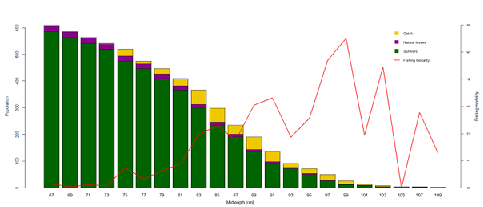
Este estudio evaluó el estado de las poblaciones de Tylosurus imperialis en la Bahía de İskenderun (noreste del Mar Mediterráneo) utilizando datos mensuales de frecuencia de longitud recopilados entre abril y noviembre de 2022. Los parámetros de crecimiento se estimaron utilizando el enfoque de Análisis Electrónico de Frecuencia de Longitud (ELEFAN) implementado en el marco TropFishR. Los parámetros de la función de crecimiento de von Bertalanffy se estimaron como L∞ = 127 cm, k = 0,56 año-1 y t0 = -0,60 año-1, con un índice de rendimiento de crecimiento (Φ′) de 3,95. El análisis de selectividad de artes de pesca estimó una longitud en la primera captura (L50) de 76 cm, correspondiente a aproximadamente 1,64 años de edad. El análisis de cohortes basado en la longitud indicó una variación considerable en la mortalidad por pesca entre las clases de tamaño, con la mayor explotación observada alrededor de los 83 cm. La mortalidad total estimada (Z = 1,81 año-1) y la mortalidad natural (M = 0,54 año-1) arrojaron una mortalidad por pesca de F = 1,27 año-1 y una tasa de explotación de E = 0,69. Aunque la mortalidad por pesca fue inferior al punto de referencia estimado F0.1, la tasa de explotación superó el umbral de precaución (E0.5 = 0,55). El análisis de rendimiento por recluta sugirió una longitud óptima en la primera captura cercana a la estimación actual (76 cm) e indicó ganancias potenciales limitadas en el rendimiento bajo un mayor esfuerzo pesquero. Si bien los resultados sugieren que la población puede estar experimentando una presión de explotación relativamente alta, estos hallazgos deben interpretarse con cautela dada la naturaleza limitada de los datos de la evaluación. No obstante, el estudio proporciona la primera información de evaluación de la población de T. imperialis en el Mediterráneo nororiental y ofrece una base para futuros esfuerzos de monitoreo y gestión.
Descargas
Referencias
Carruthers TR, Walters CJ, McAllister MK, Bryan MD. 2014. Evaluating methods for setting catch limits in data-limited fisheries. Fish Res. 153: 48-68.
Collette BB. 2003. National Marine Fisheries Service, National Museum of Natural History. Washington (DC): USA. p. 1104-1115.
Colloca F, Cardinale M, Maynou F, Giannoulaki M, Scarcella G, Jenko K, Fiorentino F. 2013. Rebuilding Mediterranean fisheries: a new paradigm for ecological sustainability. Fish Fish. 14 (1): 89-109.
Ergüden D, Turan C, Ivanova PP, Doğdu SA, Raykov VS, Yankova M, Ergenler A. 2025. Age and growth of the needlefish, Tylosurus imperialis (Rafinesque, 1810) from the Levantine coast, north-eastern Mediterranean. North West J Zool. 21 (1): e251401.
[FAO] Food and Agriculture Organization of the United Nations. 2023. The state of Mediterranean and Black Sea fisheries 2023 - special edition. Rome: General Fisheries Commission for the Mediterranean. 52 p.
Froese R, Demirel N, Coro G, Kleisner KM, Winker H. 2017. Estimating fisheries reference points from catch and resilience. Fish Fish. 18 (3): 506-526.
Froese R, Winker H, Coro G, Demirel N, Tsikliras AC, Dimarchopoulou D, Pauly D. 2018. A new approach for estimating stock status from length frequency data. ICES J Mar Sci. 75 (6): 2004-2015.
Froese R, Pauly D. 2025. FishBase. World Wide Web electronic publication (version 02/2025). https://www.fishbase.org.
Gulland JA. 1985. Fish stock assessment: a manual of basic methods. New York (NY): Wiley and Sons. 223 p.
Hilborn R. 2010. Pretty good yield and exploited fishes. Mar Policy. 34 (1): 193-196.
Hilborn R, Walters CJ, editors. 2013. Quantitative fisheries stock assessment: choice, dynamics and uncertainty. New York (NY): Springer.
Hoggarth DD, Abeyasekera S, Arthur RI, Beddington JR, Burn RW. 2006. Stock assessment for fishery management: a framework guide to the stock assessment tools of the fisheries management science programme. Rome: FAO. 261 p.
Hordyk A, Ono K, Valencia S, Loneragan N, Prince J. 2015. A novel length-based empirical estimation method of spawning potential ratio (SPR), and tests of its performance, for small-scale, data-poor fisheries. ICES J Mar Sci. 72 (1): 217-231.
Isaac VJ. 1990. The accuracy of some length-based methods for fish population studies. ICLARM Tech Rep. 27. 81 p.
Lassen H, Medley P. 2001. Virtual population analysis: a practical manual for stock assessment. Rome. FAO Fish Tech Pap. 400.
Mildenberger TK, Taylor MH, Wolff M. 2017. TropFishR: an R package for fisheries analysis with length-frequency data. Methods Ecol Evol. 8 (11): 1520-1527.
Ogle DH, Wheeler P, Doll JC, Dinno A. 2020. FSA: fisheries stock analysis. R package version 0.8.31.9000. https://cran.r-project.org/web/packages/FSA/FSA.pdf.
Pauly D. 1980. On the interrelationships between natural mortality, growth parameters, and mean environmental temperature in 175 fish stocks. ICES J Mar Sci. 39: 175-192.
Pauly D, David N. 1981. ELEFAN I, a BASIC program for the objective extraction of growth parameters from length-frequency data. Meeresforschung. 28 (4): 205-211.
Pauly D, Morgan GR, editors. 1987. Length-based methods in fisheries research. ICLARM-KISR. Manila: WorldFish.
Prince J, Hordyk A, Valencia SR, Loneragan N, Sainsbury K. 2015. Revisiting the concept of Beverton-Holt life-history invariants with the aim of informing data-poor fisheries assessment. ICES J Mar Sci. 72 (1): 194-203.
Schnute J. 1987. A general fishery model for a size-structured fish population. Can J Fish Aquat Sci. 44 (5): 924-940.
Schwamborn R. 2018. How reliable are the Powell-Wetherall plot method and the maximum‐length approach? Implications for length‐based studies of growth and mortality. Rev Fish Biol Fish. 28: 587-605.
Sparre P, Venema SC. 1999. Introduction to tropical fish stock assessment. Part 2: exercises. Rome: FAO. 94 p.
Taylor MH, Mildenberger TK. 2017. Extending electronic length frequency analysis in R. Fish Manag Ecol. 24 (4): 330-338.
Then AY, Hoenig JM, Hall NG, Hewitt DA. 2015. Evaluating the predictive performance of empirical estimators of natural mortality rate using information on over 200 fish species. ICES J Mar Sci. 72 (1): 82-92. DOI: https://doi.org/10.1093/icesjms/fsu136
Thompson WF, Bell FH. 1934. Effect of changes in intensity upon total yield and yield per unit of gear. Rep Int Fish Comm. 8: 7-49.
TÜİK. 2025. Türkiye İstatistik Kurumu. [date unknown]. https://www.tuik.gov.tr.
Turan C. 2021. Data-limited stock assessment of two horse mackerel species (Trachurus mediterraneus and T. trachurus) from the Mediterranean coast of Turkey. Reg Stud Mar Sci. 44: 101732.
Turan C. 2022. Data-limited stock assessment of red mullet (Mullus barbatus) from the Iskenderun Bay, the north-eastern Mediterranean Sea. J Fish. 10 (2): 102204.
Turan C, Ivanova P, Doğdu S, Ergüden D, Raykov V, Yankova M, Yağlıoğlu D, Ergenler A, Zlateva I, Dzhembekova N. 2024. Population genetic analysis of garfish Belone belone from the Bulgarian and Turkish coasts of the Black Sea. Tethys Environ Sci. 1 (3): 152-163.
Turan C, Ivanova PP, Doğdu SA, Ergüden D, Raykov VS, Yankova M, Yağlioğlu D, Ergenler A. 2025a. Systematic identification of needlefish (Belonidae) species using molecular genetic and morphological markers in the Mediterranean and Black seas. PLoS ONE. 20 (2): e0315401.
Turan C, Ivanova P, Doğdu S, Ergüden D, Raykov V, Yankova M, Yağlıoğlu D, Ergenler A, Zlateva I, Dzhembekova N. 2025b. Population genetics of the short-beaked garfish Belone svetovidovi in Turkish marine waters using mitochondrial DNA markers. Tethys Environ Sci. 2 (3): 138-153.
Uyan A, Doğdu SA, Turan F, Ergenler A, Ergüden D, Turan C. 2025. Bioecological parameters and exploitation status of the short-beaked garfish (Belone svetovidovi Collette & Parin, 1970) in the Aegean Sea. J Black Sea Mediterr Environ. 31 (3): 213-235.
Yaglioglu D, Turan C, Ivanova PP, Erguden D, Dogdu SA, Gurlek M, Tunc A. 2025. Biological and growth parameters of short-beaked garfish Belone svetovidovi from the Black Sea. Thalassas. 41 (1): 37. DOI: https://doi.org/10.1007/s41208-024-00790-3
Descargas
Publicado
Número
Sección
Licencia
Derechos de autor 2026 Cemal Turan

Esta obra está bajo una licencia internacional Creative Commons Atribución-NoComercial-CompartirIgual 4.0.
Los autores de los artículos publicados en Marine and Fishery Sciences conservan los derechos de autor de sus artículos, a excepción de las imágenes de terceros y otros materiales añadidos por Marine and Fishery Sciences, que están sujetos a los derechos de autor de sus respectivos propietarios. Por lo tanto, los autores son libres de difundir y volver a publicar sus artículos, sujeto a los requisitos de los propietarios de derechos de autor de terceros y sujeto a que la publicación original sea completamente citada. Los visitantes también pueden descargar y reenviar artículos sujetos a los requisitos de citas. La capacidad de copiar, descargar, reenviar o distribuir cualquier material siempre está sujeta a los avisos de derechos de autor que se muestran. Los avisos de copyright deben mostrarse de manera prominente y no pueden borrarse, eliminarse u ocultarse, total o parcialmente. El autoalmacenamiento en servidores y repositorios de preimpresión está permitido para todas las versiones.
Esta revista ofrece a los autores una política de acceso abierto. Los usuarios pueden leer, descargar, copiar, distribuir, imprimir, buscar o vincular los textos completos de los artículos, o usarlos para cualquier otro propósito legal dentro de la licencia Creative Commons 4.0 (BY-NC-SA), sin solicitar permiso previo del editor o del autor. Esto está de acuerdo con la definición BOAI de acceso abierto.