Comparative study of carcass yield of male and female coho salmon Oncorhynchus kisutch (Walbaum, 1792)
DOI:
https://doi.org/10.47193/mafis.3932026010702Keywords:
Meat yield, sexual dimorphism, industrial post-harvest processing, fillet yieldAbstract
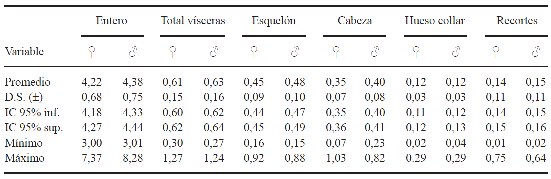
One of the main problems in salmon production, among others, is the premature maturation of the fish. Various technological strategies have been adopted to minimize losses. One such strategy involves raising salmon separated by sex, which has opened new management possibilities. This study was conducted at the AquaChile processing plant (Quellón) during the 2024-2025 season to evaluate differences in meat yield between male and female coho salmon (Oncorhynchus kisutch). The salmon were raised in 30 × 30 × 15 m cages, separated by sex, and maintained under the same standard farming conditions: stocking density, feed, and an artificial photoperiod of 9 months (19-20 h of light). Fish were randomly sampled from the processing line and weighed individually at four carcass stages: WFE (whole, bled), HON (gutted), HG (gutted and headed), and TRIMD (weight of both fillets). A total of 1,699 randomly selected individuals (987 females and 712 males) were analyzed. Meat yield indices, expressed as percentages, were calculated as RHG = (HG/WFE) × 100 and RTRIMD = (TRIMD/WFE) × 100. The average yields obtained were: RHG 77.28% (females) and 76.54% (males), (p < 0.05); and RTRIMD 60.49% (females) and 59.27% (males), (p < 0.05). In conclusion, the females showed statistically higher meat yield from the HG product, a difference that increased in the TRIMD product.
Downloads
References
Alcántar JP. 2016. Fisiología de los peces triploides. Lat Am J Acuat Res. 44 (1): 1-15. DOI: http://doi.org/10.3856/vol44-issue1-fulltext-1
Balaprakash K, Aanand S, Manimekalai D, Ande MP, Lingam RSS. 2025. A sex-based growth performance, gene expression, fillet quality and fatty acid profile in GIFT tilapia cultured in field conditions. Aquaculture. 598: 741960. DOI: https://doi.org/10.1016/j.aquaculture.2024.741960
Barton JR, Baeza S, Zenteno J, Roman A. 2023. Neostructural innovation and directionality in Chilean salmon aquaculture. Mar Policy. 150: 105518. DOI: https://doi.org/10.1016/j.marpol.2023.105518
Ciani E, von Krogh K, Nourizadeh R, Mayer I, Fontaine R, Weltzien FA. 2021. Sexual maturation in Atlantic salmon male parr may be triggered both in late summer and early spring under standard farming conditions. Aquaculture. 54: 737086. DOI: https://doi.org/10.1016/j.aquaculture.2021.737086
Comolli J, Roux JP, Sánchez S, Hernández D. 2013. Engorde de bagres (Rhamdia quelen) en sistema de cultivo intensivo por sexos separados. Rev Vet. 24 (2): 113-118.
Endal HP, Taranger GL, Stefansson SO, Hansen T. 2000. Effects of continuous additional light on growth and sexual maturity in Atlantic Salmon, Salmo salar, reared in sea cages. Aquaculture. 191 (4): 337-349. DOI: https://doi.org/10.1016/S0044-8486(00)00444-0
[FAO] Food and Agriculture Organization of the United Nations. 2025. Quarterly salmon analysis. August 2025. https://www.fao.org/fishery/en/publications/query/Scutellastra%20flexuosa,Star-shaped%20limpet*,Star-shaped%20limpet*.
Fraser TWK, Hansen TJ, Remo SC, Fjelldal PG. 2022. Triploid effects growth, life history strategies, and bone health in Arctic char (Salvelinus alpinus), but does not impact cataract incidence. Aquaculture. 547: 737465. DOI: https://doi.org/10.1016/j.aquaculture.2021.737465
González E. 2002. Efecto de diferentes razones de proteínas y lípidos en las dietas sobre la respuesta productiva y características de la canal del salmón del Pacífico (Oncorhynchus kisutch) [tesis de grado]. Santiago: Universidad de Chile. 77 p.
Guerrero DA, Bromage N. 2008. Growth and maturation of Atlantic salmon (Salmo salar) populations with different grilse proportions under natural photoperiod and superimposed nighttime light. Aquaculture. 285 (1-4): 63-66.
Hvas M, Morin A, Hansen TJ. 2025. Triploid Atlantic salmon are physiologically disadvantaged at larger body sizes. Sci Rep. 16 (1): 770. DOI: https://doi.org/10.1038/s41598-025-30342-5
Kuradomi RY, Motta NC, da Costa Lima T, Santana TM, Vieira EDLP, Hata ME, de Figueiredo Neto EF, Gonçalves LU. 2024. Evaluation of growth performance, carcass yield, and proximate composition of fillets of male and female pirarucu (Arapaima gigas) during the fattening phase. Aquaculture. 586: 740822. DOI: https://doi.org/10.1016/j.aquaculture.2024.740822
Lavrutich M, Markussen J, Rystad N. 2024. The value of mono-gender production in Atlantic salmon farming. Aquaculture. 578: 740089. DOI: https://doi.org/10.1016/j.aquaculture.2023.740089
Méndez YC, Perdomo DA, Andrade de Pasquier G, García DE, Valecillo OR. 2011. Evaluación del rendimiento en el canal y del fileteado de la Cachama (Colossoma macropomum). Zootec Trop. 29 (3): 363-372.
Mora JA, Moyetones F, Jover M. 2010. Crecimiento, aprovechamiento nutritivo y rendimiento de la canal del bagre yaque, Leiarius marmoratus (Gill 1870) en jaulas flotantes. AquaTIC. 33: 10-21.
Nemova NN, Nefedova ZA, Pekkoeva SN, Voronin VP, Shulgina NS, Churova MV, Murzina SA. 2020. The effect of the photoperiod on the fatty acid profile and weight in hatchery-reared underyearlings and yearlings of Atlantic salmon Salmo salar L. Biomolecules. 10 (6): 845. DOI: https://doi.org/10.3390/biom10060845
Pino Martínez E, Balseiro P, Pedrosa C, Haugen TS, Fleming MS, Handeland SO. 2021. The effect of photoperiod manipulation on Atlantic salmon growth, smoltification and sexual maturation: a case study of a commercial RAS. Aquacult Res. 52 (6): 2593-2608. DOI: https://doi.org/10.1111/are.15107
Riseth EN, Fraser TWK, Sambraus F, Stien LH, Hvas M. 2020. Is it advantageous for Atlantic salmon to be triploid at lower temperatures? J Therm Biol. 89: 102548. DOI: https://doi.org/10.1016/j.jtherbio.2020.102548
Rojas B, Perdomo DA, García DE, González M, Corredor Z, Moratinos P, Santos O. 2011. Rendimiento en canal y fileteado de la tilapia (Oreochromis niloticus) variedad Chitralada producida en el estado Trujillo, Venezuela. Zootec Trop. 29 (1): 113-126.
[SERNAPESA] Servicio Nacional de Pesca y Acuicultura. 2025. Anuario estadístico de pesca y acuicultura: desembarque y acuicultura. https://www.sernapesca.cl/informacion-utilidad/anuarios-estadisticos-de-pesca-y-acuicultura/.
Shulgina NS, Churova MV, Mursina SA, Kupnopva M, Nemova NN. 2021. El efecto de la luz continua sobre el crecimiento y la expresión génica muscular específica en salmones del Atlántico (Salmo salar L.) de un año. Vida (Basilea). 11 (4): 328.
Soto C. 2016. Heredabilidad y correlaciones genéticas de rasgos de crecimiento, rendimiento y calidad en cepa Lochy de salmón del Atlántico (Salmo salar) [tesis de magíster]. Santiago: Universidad de Chile. 97 p.
Taranger GL, Carrillo M, Schulz RW, Fontaine P, Zanuy S, Felip A, Weltzien FA, Dufour SA, Karlsen Ø, Norberg B, et al. 2010. Control of puberty in farmed fish. Gen Comp Endocrinol. 165 (3): 483-515. DOI: https://doi.org/10.1016/j.ygcen.2009.05.004
[USDA] United States Department of Agriculture. 2022. https://www.nass.usda.gov/Publications/AgCensus/2022/index.php.
Zenteno J. 2025. Contrasting directionalities in responsible innovation, lessons from the salmon farming industry in Chile and Norway. Technol Soc. 82: 102946. DOI: https://doi.org/10.1016/j.techsoc.2025.102946
Downloads
Published
Issue
Section
License
Copyright (c) 2026 Juan Barile Sanhueza, Juan Fernández Arancibia, Patricio R. De los Ríos-Escalante

This work is licensed under a Creative Commons Attribution-NonCommercial-ShareAlike 4.0 International License.
Authors of articles published in Marine and Fishery Sciences retain copyright on their articles, except for any third-party images and other materials added by Marine and Fishery Sciences, which are subject to copyright of their respective owners. Authors are therefore free to disseminate and re-publish their articles, subject to any requirements of third-party copyright owners and subject to the original publication being fully cited. Visitors may also download and forward articles subject to the citation requirements. The ability to copy, download, forward or otherwise distribute any materials is always subject to any copyright notices displayed. Copyright notices must be displayed prominently and may not be obliterated, deleted or hidden, totally or partially.
This journal offers authors an Open Access policy. Users are allowed to read, download, copy, distribute, print, search, or link to the full texts of the articles, or use them for any other legal purpose within the Creative Commons 4.0 license (BY-NC-SA), without asking prior permission from the publisher or the author. This is in accordance with the BOAI definition of Open Access.