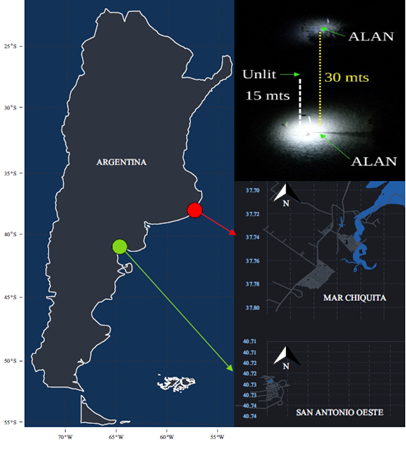
Artificial light at night and apparent predation on juvenile Neohelice granulata during two deployment periods at Mar Chiquita, Argentina
DOI:
https://doi.org/10.47193/mafis4012027010103Keywords:
predation risk, light pollution, coastal urbanisation, predator-prey interactionsAbstract
Over the past decade, artificial light at night (ALAN) has become one of the most spatially extensive anthropogenic disturbances along coastlines worldwide, yet whether its capacity to alter predation is a fixed property of illumination intensity or depends on the ecological context in which it occurs has received little attention. Here we evaluate this question using replicated tethering experiments at the microtidal lagoon of Mar Chiquita (south-western Atlantic coast of Argentina) in two deployment periods (spring and summer), quantifying apparent predation on juvenile Neohelice granulata under ALAN (cold-white LED, ≈ 38 lux) and natural-darkness controls. A Generalised Linear Mixed Model with experimental night as a random intercept revealed a significant interaction between light condition and season. In spring, ALAN significantly increased the probability of juvenile predation relative to natural darkness, whereas no detectable effect was found in summer. Placed alongside the published effect at a macrotidal, structurally simpler site, ALAN sensitivity follows an ordered gradient consistent with an amplifying-effect hypothesis, whereby ALAN would amplify predation in proportion to the underlying susceptibility state of predators and prey (adult nutritional condition, juvenile developmental vulnerability and habitat structural complexity) rather than being a fixed property of light intensity alone, although adult nutritional condition was not measured directly and is inferred from published seasonal values for this population. These results indicate that the same habitat may shift between high- and low-sensitivity states across seasons, that single-season assessments may systematically underestimate cumulative predation exposure, and that targeted light management during juvenile settlement is, in principle, a more efficient conservation approach than year-round restrictions, although we did not evaluate its costs or feasibility.
Downloads
References
Alberti J, Daleo P, Fanjul E, Escapa M, Botto F, Iribarne O. 2015. Can a single species challenge paradigms of salt marsh functioning? Estuaries Coasts. 38: 1178-1188.
Aronson RB, Heck KL. 1995. Tethering experiments and hypothesis testing in ecology. Mar Ecol Prog Ser. 121: 307-309.
Baker R, Waltham NJ. 2020. Tethering mobile aquatic organisms to measure predation: a renewed call for caution. J Exp Mar Biol Ecol. 523: 151270.
Bas C, Lancia JP, Luppi T, Méndez Casariego A, Kittlein M, Spivak E. 2014. Influence of tidal regime, diurnal phase, habitat and season on feeding of an intertidal crab. Mar Ecol. 35: 319-331.
Bas C, Nuñez JD, Spivak E, Luppi T. 2019. Inter-population differences in feeding ecology under nitrogen-limited diets: field growth and the role of cannibalism in limiting/improving reserve accumulation. Mar Ecol. 40: e12547.
Batty RS, Blaxter JHS, Richard JM. 1990. Light intensity and the feeding behaviour of herring, Clupea harengus. Mar Biol. 107: 383-388.
Becker A, Whitfield AK, Cowley PD, Järnegren J, Næsje TF. 2013. Potential effects of artificial light associated with anthropogenic infrastructure on the abundance and foraging behaviour of estuary-associated fishes. J Appl Ecol. 50: 43-50.
Bennie J, Davies TW, Cruse D, Gaston KJ. 2018. Artificial light at night alters grassland vegetation species composition and phenology. J Appl Ecol. 55: 442-450.
Bolton D, Mayer-Pinto M, Clark GF, Dafforn KA, Brassil WA, Becker A, Johnston EL. 2017. Coastal urban lighting has ecological consequences for multiple trophic levels under the sea. Sci Total Environ. 576: 1-9.
Botto F, Iribarne O. 2000. Contrasting effects of two burrowing crabs (Chasmagnathus granulata and Uca uruguayensis) on sediment composition and transport in estuarine environments. Estuar Coast Shelf Sci. 51: 141-151.
Brooks ME, Kristensen K, van Benthem KJ, Magnusson A, Berg CW, Nielsen A, Skaug HJ, Machler M, Bolker BM. 2017. glmmTMB balances speed and flexibility among packages for zero-inflated generalized linear mixed modeling. R J. 9: 378-400.
Cerri RD. 1983. The effect of light intensity on predator and prey behaviour in cyprinid fish: factors that influence prey risk. Anim Behav. 31: 736-742.
Claessen D, de Roos AM, Persson L. 2004. Population dynamic theory of size-dependent cannibalism. Proc R Soc B. 1537: 333-340.
Czarnecka M, Kakareko T, Jermacz Ł, Pawlak R, Kobak J. 2019. Combined effects of nocturnal exposure to artificial light and habitat complexity on fish foraging. Sci Total Environ. 684: 14-22.
Davies TW, Bennie J, Inger R, de Ibarra NH, Gaston KJ. 2013. Artificial light pollution: are shifting spectral signatures changing the balance of species interactions? Glob Chang Biol. 19: 1417-1423.
Davies TW, Duffy JP, Bennie J, Gaston KJ. 2014. The nature, extent, and ecological implications of marine light pollution. Front Ecol Environ. 12: 347-355.
Elgar MA, Crespi BJ, editors. 1992. Cannibalism: ecology and evolution among diverse taxa. Oxford: Oxford University Press.
Fox J, Weisberg S. 2019. An R companion to applied regression. 3rd ed. Thousand Oaks (CA): Sage.
Garratt MJ, Jenkins SR, Davies TW. 2019. Mapping the consequences of artificial light at night for intertidal ecosystems. Sci Total Environ. 691: 760-768.
Gaston KJ, Bennie J, Davies TW, Hopkins J. 2013. The ecological impacts of nighttime light pollution: a mechanistic appraisal. Biol Rev. 88: 912-927.
Gaston KJ, Visser ME, Hölker F. 2015. The biological impacts of artificial light at night: the research challenge. Philos Trans R Soc B. 370: 20140133.
Hampton SE. 2004. Habitat overlap of enemies: temporal patterns and the role of spatial complexity. Oecologia. 138: 475-484.
Hartig F. 2018. DHARMa: residual diagnostics for hierarchical (multi-level/mixed) regression models. R package version 0.2.0.
Hines AH, Kramer MA, Richie KD, Smith LD, Aguilar R, Ogburn MB, Johnson EG, Ruiz GM. 2026. Cannibalism, predation, and refuges of juvenile blue crabs from a 37-year experiment. PNAS. 123 (12): e2533461123.
Hölker F, Wolter C, Perkin EK, Tockner K. 2010. Light pollution as a biodiversity threat. Trends Ecol Evol. 25: 681-682.
Lenth R, Singmann H, Love J, Buerkner P, Herve M. 2020. Emmeans: estimated marginal means, aka least-squares means. R package version 1.5.3.
Luppi TA, Spivak ED, Anger K. 2001. Experimental studies on predation and cannibalism of the settlers of Chasmagnathus granulata and Cyrtograpsus angulatus (Brachyura: Grapsidae). J Exp Mar Biol Ecol. 265: 29-48.
Luppi TA, Bas CC, Méndez Casariego MA, Albano M, Lancia J, Kittlein M, Rosenthal A, Farías NE, Spivak ED, Iribarne OO. 2013. The influence of habitat, season and tidal regime in the activity of the intertidal crab Neohelice (Chasmagnathus) granulata. Helgol Mar Res. 67: 1-15.
Martinetto P, Montemayor DI, Alberti J, Costa CSB, Iribarne OO. 2016. Crab bioturbation and herbivory may account for variability in carbon sequestration and stocks in south west Atlantic salt marshes. Front Mar Sci. 3: 12.
McMahon O, Smyth T, Davies TW. 2022. Broad spectrum artificial light at night increases the conspicuousness of camouflaged prey. J Appl Ecol. 59: 1324-1333. DOI: https://doi.org/10.1111/1365-2664.14146
Méndez Casariego A, Alberti J, Luppi TA, Iribarne OO. 2009. Stage-dependent interactions between intertidal crabs: from facilitation to predation. J Mar Biol Assoc UK. 89: 781-788.
Méndez Casariego A, Alberti J, Luppi TA, Daleo P, Iribarne OO. 2011. Habitat shifts and spatial distribution of the intertidal crab Neohelice (Chasmagnathus) granulata Dana. J Sea Res. 66: 87-94.
Moksnes PO. 2004. Self-regulating mechanisms in cannibalistic populations of juvenile shore crabs Carcinus maenas. Ecology. 85: 1343-1354.
Moyse E, Firth LB, Smyth TJ, Tidau S, Davies TW. 2023. Artificial light at night alters predation on colour-polymorphic camouflaged prey. Basic Appl Ecol. 73: 88-93.
Nakagawa S, Schielzeth H. 2013. A general and simple method for obtaining R2 from generalized linear mixed-effects models. Methods Ecol Evol. 4: 133-142.
Nuñez JD, Bas C, Pérez García M, Ocampo EH, Ribeiro PD, Luppi TA. 2021a. Artificial light at night may increase the predation pressure in a salt marsh keystone species. Mar Environ Res. 167: 105285.
Nuñez JD, Pérez García M, Merodio CB, Luppi TA. 2025. The effect of artificial light at night on settlement patterns of a salt marshes crab. BMC Environ Sci. 2: 23.
Nuñez JD, Sbragaglia V, Spivak ED, Chiaradia NM, Luppi TA. 2021b. The magnitude of behavioural responses to artificial light at night depends on the ecological context in a coastal marine ecosystem engineer. Mar Environ Res. 165: 105238.
Perkin EK, Hölker F, Richardson JS, Sadler JP, Wolter C, Tockner K. 2011. The influence of artificial light on stream and riparian ecosystems: questions, challenges, and perspectives. Ecosphere. 2: art122.
Polis GA. 1981. The evolution and dynamics of intraspecific predation. Annu Rev Ecol Syst. 12: 225-251.
R Core Team. 2024. R: a language and environment for statistical computing. Vienna: R Foundation for Statistical Computing. https://www.R-project.org/.
Sanders D, Kehoe R, Cruse D, van Veen FFJ, Gaston KJ. 2018. Low levels of artificial light at night strengthen top-down control in insect food web. Curr Biol. 28: 2474-2478.e3.
Spivak E, Anger K, Luppi T, Bas C, Ismael D. 1994. Distribution and habitat preferences of two grapsid crab species in Mar Chiquita Lagoon (Province of Buenos Aires, Argentina). Helgol Meeresunters. 48: 59-78.
Sztarker J, Berón de Astrada M, Tomsic D. 2020. The visual system of Neohelice: from general structure to cytoarchitecture. In: Rodríguez EM, Luppi TA, editors. Neohelice granulata, a model species for studies on crustaceans. Volume II: Anatomy and physiology. Cambridge Scholars Publishing, Newcastle upon Tyne. p. 29-50.
Underwood CN, Davies TW, Queirós AM. 2017. Artificial light at night alters trophic interactions of intertidal invertebrates. J Anim Ecol. 86: 781-789.
Zapata MJ, Sullivan SMP, Gray SM. 2019. Artificial lighting at night in estuaries-implications from individuals to ecosystems. Estuaries Coasts. 42: 309-330.
Published
Issue
Section
License
Copyright (c) 2026 Jesús D. Nuñez, Ruben A. Robles, Macarena Perés García, Camila B. Merodio, M. Guadalupe Vázquez, Tomás A. Luppi

This work is licensed under a Creative Commons Attribution-NonCommercial-ShareAlike 4.0 International License.
Authors of articles published in Marine and Fishery Sciences retain copyright on their articles, except for any third-party images and other materials added by Marine and Fishery Sciences, which are subject to copyright of their respective owners. Authors are therefore free to disseminate and re-publish their articles, subject to any requirements of third-party copyright owners and subject to the original publication being fully cited. Visitors may also download and forward articles subject to the citation requirements. The ability to copy, download, forward or otherwise distribute any materials is always subject to any copyright notices displayed. Copyright notices must be displayed prominently and may not be obliterated, deleted or hidden, totally or partially.
This journal offers authors an Open Access policy. Users are allowed to read, download, copy, distribute, print, search, or link to the full texts of the articles, or use them for any other legal purpose within the Creative Commons 4.0 license (BY-NC-SA), without asking prior permission from the publisher or the author. This is in accordance with the BOAI definition of Open Access.