Fishery-dependent biological observations of the crocodile shark, Pseudocarcharias kamoharai, from the southeast coast of India
DOI:
https://doi.org/10.47193/mafis.39420260011008Keywords:
Pelagic longline, bycatch, maturity, reproductive biology, length-weight relationshipAbstract
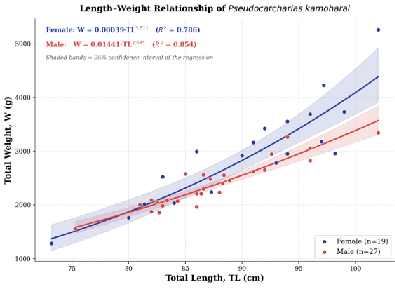
The crocodile shark, Pseudocarcharias kamoharai, is widely distributed in tropical and subtropical oceans but remains poorly documented in the northern Indian Ocean. We report fishery-dependent biological observations from 46 specimens landed as retained bycatch at Kakinada and Chennai, India, between March 2023 and February 2025. Total length ranged from 73.2 to 102.0 cm and total weight from 1,280 to 5,260 g. The overall length-weight relationship (LWR) was TW = 0.001045·TL3.280 (R2 = 0.774). Two-tailed t-tests indicated isometric growth (b = 3) for combined samples, males (b = 2.685), and females (b = 3.511). Maturity transition bounds were established at 82.0-82.5 cm TL for males and 83.0-84.0 cm TL for females. One pregnant female measuring 97.2 cm total length and weighing 4,220 g carried four advanced embryos (32.7-35.5 cm TL). Stomach observations were available for 25 specimens, of which seven contained identifiable food remains, including squid, shrimp and pufferfish. These observations expand the biological dataset available for P. kamoharai in the Bay of Bengal and support continued monitoring of fishery interactions, retention and discard mortality in the region.
Downloads
References
Akhilesh KV, Bineesh KK, Ganga U, Pillai NGK. 2013. Report of crocodile shark Pseudocarcharias kamoharai (Pseudocarchariidae) from deep waters off the south-west coast of India. Mar Biodivers Rec. 6: 1-3.
Calle-Morán MD, Hernández-Téllez AR, Tibán-Vivar ER, Intriago-Vera YE, Del Valle-Coello IG, Loor-Jama BC, Ganchozo-López ÁR. 2022. Diet composition and feeding habits of the crocodile shark, Pseudocarcharias kamoharai. Environ Biol Fish. 105 (6): 685-697. DOI: https://doi.org/10.1007/s10641-022-01277-x
Compagno LJV. 2001. Sharks of the world. An annotated and illustrated catalogue of shark species known to date. Vol. 2. Bullhead, mackerel and carpet sharks Heterodontiformes, Lamniformes and Orectolobiformes). FAO Species Catalogue for Fishery Purposes. 269 p.
Compagno LJV, Dando M, Fowler S. 2005. A Field guide to the sharks of the world. London: Collins. 368 p.
Dai XJ, Zhu JF, Chen XJ, Xu LX, Chen Y. 2012. Biological observations on the crocodile shark Pseudocarcharias kamoharai. J Fish Biol. 80: 1207-1212. DOI: https://doi.org/10.1111/j.1095-8649.2011.03177.x
Ebert DA, Fowler S, Compagno L. 2013. Sharks of the World. Wild Nature Press, Plymouth.
John S, Bijo A, Chatakonda MK, Chattopadhyay S. 2025. Landing records of elusive crocodile sharks Pseudocarcharias Kamoharai (Pseudocarchariidae) from India. Thalassas. 41: 93. DOI: https://doi.org/10.1007/s41208-025-00821-7
Kannan K, Kannapiran E, Prabhu NM. 2019. Record of “near threatened” crocodile shark Pseudocarcharias kamoharai (Pseudo-carchariidae) from Indian Exclusive Economic Zone. Thalassas. 35: 525-530.
Kizhakudan SJ, Rajapackiam S. 2013. First report of the crocodile shark Pseudocarcharias kamoharai (Matsubara, 1936) from Chennai, southeast coast of India. J Mar Biol Assoc India. 55: 86-88.
Kyne PM, Romanov E, Barreto R, Carlson J, Fernando D, Fordham S, Francis MP, Jabado RW, Liu KM, Marshall A, Pacoureau N, Sherley RB. 2019. Pseudocarcharias kamoharai (errata version published in 2020). The IUCN Red List of Threatened Species 2019: e.T39337A171964644. DOI: https://dx.doi.org/10.2305/IUCN.UK.2019-1.RLTS.T39337A171964644.en
Matsubara K. 1936. A new carcharoid shark found in Japan. Dobutsugaku Zasshi. 48 (7): 380-382.
Oliveira P, Hazin FHV, Carvalho F, Rego M, Coelho R, Piercy A, Burgess G. 2010. Reproductive biology of the crocodile shark Pseudocarcharias kamoharai. J Fish Biol. 76 (7): 1655-1670.
Pradeep HD, Swapnil SS, Ramachandran S, Pattnayak SK. 2017. Report of the crocodile shark Pseudocarcharias kamoharai (Matsubara,1936) from deep waters of the Andaman Sea. Mar Biodivers. 47 (2): 535-538.
Romanov EV, Ward P, Levesque JC, Lawrence E. 2008. Preliminary analysis of crocodile shark (Pseudocarcharias kamoharai) distribution and abundance trends in pelagic longline fisheries. IOTC Working Party on Environment and Bycatch (WPEB), 20-22 October. Bangkok, Thailand. p. 1-29.
Silambarasan Krishnan, Kar Annada Bhusan, Prasad Gummadi, Pattnayak Sujit. 2023. First record of the crocodile shark Pseudocarcharias kamoharai (Chondrichthyes: Lamniformes) in the coastal waters of Andhra Pradesh, India. Zoosyst Ross. 32: 217-222. DOI: https://doi.org/10.31610/zsr/2023.32.2.217
Stehmann MFW. 2002. Proposal of a maturity stages scales for oviparous and viviparous cartilaginous fish (Pisces, Chondrichthyes). Arch Fish Mar Res. 50: 23-48.
Walker TI, Gason AS. 2007. Shark and other chondrichthyan byproduct and bycatch estimation in the Southern and Eastern Scale fish and Shark Fishery. Final report to Fisheries and Research Development Corporation Project No. 2001/007. Queenscliff: Primary Industries Research Victoria. 182 p.
Wu F, Kindong R, Dai X, Sarr O, Zhu J, Tian S, Nsangue BTN. 2020. Aspects of the reproductive biology of two pelagic sharks in the eastern Atlantic Ocean. J Fish Biol. 97 (6): 1651-1661. DOI: https://doi.org/10.1111/jfb.14526
Published
Issue
Section
License
Copyright (c) 2026 Sweta Beura, K. K. Bineesh

This work is licensed under a Creative Commons Attribution-NonCommercial-ShareAlike 4.0 International License.
Authors of articles published in Marine and Fishery Sciences retain copyright on their articles, except for any third-party images and other materials added by Marine and Fishery Sciences, which are subject to copyright of their respective owners. Authors are therefore free to disseminate and re-publish their articles, subject to any requirements of third-party copyright owners and subject to the original publication being fully cited. Visitors may also download and forward articles subject to the citation requirements. The ability to copy, download, forward or otherwise distribute any materials is always subject to any copyright notices displayed. Copyright notices must be displayed prominently and may not be obliterated, deleted or hidden, totally or partially.
This journal offers authors an Open Access policy. Users are allowed to read, download, copy, distribute, print, search, or link to the full texts of the articles, or use them for any other legal purpose within the Creative Commons 4.0 license (BY-NC-SA), without asking prior permission from the publisher or the author. This is in accordance with the BOAI definition of Open Access.