Observaciones biológicas del tiburón cocodrilo Pseudocarcharias kamoharai, relacionadas a la pesca, en la costa sureste de la India
DOI:
https://doi.org/10.47193/mafis.39420260011008Palabras clave:
Palangre pelágico, captura incidental, madurez, biología reproductiva, relación talla-pesoResumen
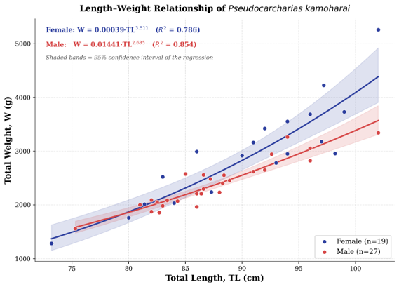
El tiburón cocodrilo, Pseudocarcharias kamoharai, está ampliamente distribuido en océanos tropicales y subtropicales, pero aún está poco documentado en el norte del Océano Índico. Presentamos observaciones biológicas dependientes de la pesca de 46 especímenes desembarcados como captura incidental retenida en Kakinada y Chennai, India, entre marzo de 2023 y febrero de 2025. La talla total osciló entre 73,2 y 102,0 cm y el peso total entre 1.280 y 5.260 g. La relación talla-peso (LWR) general fue TW = 0,001045·TL3,280 (R2 = 0,774). Las pruebas t de dos colas indicaron crecimiento isométrico (b = 3) para muestras combinadas, machos (b = 2,685) y hembras (b = 3,511). Se establecieron límites de transición a la madurez en 82,0-82,5 cm TL para los machos y 83,0-84,0 cm TL para las hembras. Una hembra preñada, con una talla total de 97,2 cm y un peso de 4.220 g, portaba cuatro embriones avanzados (32,7-35,5 cm TL). Se obtuvieron observaciones estomacales de 25 especímenes, de los cuales siete contenían restos de alimento identificables, incluyendo calamares, camarones y peces globo. Estas observaciones amplían el conjunto de datos biológicos disponibles para P. kamoharai en la Bahía de Bengala y respaldan el monitoreo continuo de las interacciones con la pesca, la retención y la mortalidad por descarte en la región.
Descargas
Referencias
Akhilesh KV, Bineesh KK, Ganga U, Pillai NGK. 2013. Report of crocodile shark Pseudocarcharias kamoharai (Pseudocarchariidae) from deep waters off the south-west coast of India. Mar Biodivers Rec. 6: 1-3.
Calle-Morán MD, Hernández-Téllez AR, Tibán-Vivar ER, Intriago-Vera YE, Del Valle-Coello IG, Loor-Jama BC, Ganchozo-López ÁR. 2022. Diet composition and feeding habits of the crocodile shark, Pseudocarcharias kamoharai. Environ Biol Fish. 105 (6): 685-697. DOI: https://doi.org/10.1007/s10641-022-01277-x
Compagno LJV. 2001. Sharks of the world. An annotated and illustrated catalogue of shark species known to date. Vol. 2. Bullhead, mackerel and carpet sharks Heterodontiformes, Lamniformes and Orectolobiformes). FAO Species Catalogue for Fishery Purposes. 269 p.
Compagno LJV, Dando M, Fowler S. 2005. A Field guide to the sharks of the world. London: Collins. 368 p.
Dai XJ, Zhu JF, Chen XJ, Xu LX, Chen Y. 2012. Biological observations on the crocodile shark Pseudocarcharias kamoharai. J Fish Biol. 80: 1207-1212. DOI: https://doi.org/10.1111/j.1095-8649.2011.03177.x
Ebert DA, Fowler S, Compagno L. 2013. Sharks of the World. Wild Nature Press, Plymouth.
John S, Bijo A, Chatakonda MK, Chattopadhyay S. 2025. Landing records of elusive crocodile sharks Pseudocarcharias Kamoharai (Pseudocarchariidae) from India. Thalassas. 41: 93. DOI: https://doi.org/10.1007/s41208-025-00821-7
Kannan K, Kannapiran E, Prabhu NM. 2019. Record of “near threatened” crocodile shark Pseudocarcharias kamoharai (Pseudo-carchariidae) from Indian Exclusive Economic Zone. Thalassas. 35: 525-530.
Kizhakudan SJ, Rajapackiam S. 2013. First report of the crocodile shark Pseudocarcharias kamoharai (Matsubara, 1936) from Chennai, southeast coast of India. J Mar Biol Assoc India. 55: 86-88.
Kyne PM, Romanov E, Barreto R, Carlson J, Fernando D, Fordham S, Francis MP, Jabado RW, Liu KM, Marshall A, Pacoureau N, Sherley RB. 2019. Pseudocarcharias kamoharai (errata version published in 2020). The IUCN Red List of Threatened Species 2019: e.T39337A171964644. DOI: https://dx.doi.org/10.2305/IUCN.UK.2019-1.RLTS.T39337A171964644.en
Matsubara K. 1936. A new carcharoid shark found in Japan. Dobutsugaku Zasshi. 48 (7): 380-382.
Oliveira P, Hazin FHV, Carvalho F, Rego M, Coelho R, Piercy A, Burgess G. 2010. Reproductive biology of the crocodile shark Pseudocarcharias kamoharai. J Fish Biol. 76 (7): 1655-1670.
Pradeep HD, Swapnil SS, Ramachandran S, Pattnayak SK. 2017. Report of the crocodile shark Pseudocarcharias kamoharai (Matsubara,1936) from deep waters of the Andaman Sea. Mar Biodivers. 47 (2): 535-538.
Romanov EV, Ward P, Levesque JC, Lawrence E. 2008. Preliminary analysis of crocodile shark (Pseudocarcharias kamoharai) distribution and abundance trends in pelagic longline fisheries. IOTC Working Party on Environment and Bycatch (WPEB), 20-22 October. Bangkok, Thailand. p. 1-29.
Silambarasan Krishnan, Kar Annada Bhusan, Prasad Gummadi, Pattnayak Sujit. 2023. First record of the crocodile shark Pseudocarcharias kamoharai (Chondrichthyes: Lamniformes) in the coastal waters of Andhra Pradesh, India. Zoosyst Ross. 32: 217-222. DOI: https://doi.org/10.31610/zsr/2023.32.2.217
Stehmann MFW. 2002. Proposal of a maturity stages scales for oviparous and viviparous cartilaginous fish (Pisces, Chondrichthyes). Arch Fish Mar Res. 50: 23-48.
Walker TI, Gason AS. 2007. Shark and other chondrichthyan byproduct and bycatch estimation in the Southern and Eastern Scale fish and Shark Fishery. Final report to Fisheries and Research Development Corporation Project No. 2001/007. Queenscliff: Primary Industries Research Victoria. 182 p.
Wu F, Kindong R, Dai X, Sarr O, Zhu J, Tian S, Nsangue BTN. 2020. Aspects of the reproductive biology of two pelagic sharks in the eastern Atlantic Ocean. J Fish Biol. 97 (6): 1651-1661. DOI: https://doi.org/10.1111/jfb.14526
Descargas
Publicado
Número
Sección
Licencia
Derechos de autor 2026 Sweta Beura, K. K. Bineesh

Esta obra está bajo una licencia internacional Creative Commons Atribución-NoComercial-CompartirIgual 4.0.
Los autores de los artículos publicados en Marine and Fishery Sciences conservan los derechos de autor de sus artículos, a excepción de las imágenes de terceros y otros materiales añadidos por Marine and Fishery Sciences, que están sujetos a los derechos de autor de sus respectivos propietarios. Por lo tanto, los autores son libres de difundir y volver a publicar sus artículos, sujeto a los requisitos de los propietarios de derechos de autor de terceros y sujeto a que la publicación original sea completamente citada. Los visitantes también pueden descargar y reenviar artículos sujetos a los requisitos de citas. La capacidad de copiar, descargar, reenviar o distribuir cualquier material siempre está sujeta a los avisos de derechos de autor que se muestran. Los avisos de copyright deben mostrarse de manera prominente y no pueden borrarse, eliminarse u ocultarse, total o parcialmente. El autoalmacenamiento en servidores y repositorios de preimpresión está permitido para todas las versiones.
Esta revista ofrece a los autores una política de acceso abierto. Los usuarios pueden leer, descargar, copiar, distribuir, imprimir, buscar o vincular los textos completos de los artículos, o usarlos para cualquier otro propósito legal dentro de la licencia Creative Commons 4.0 (BY-NC-SA), sin solicitar permiso previo del editor o del autor. Esto está de acuerdo con la definición BOAI de acceso abierto.