Effects of stocking density on the growth, meat yield, and survival of cultured Mytilus platensis in San Jorge gulf
DOI:
https://doi.org/10.47193/mafis.39420260011005Keywords:
mussel culture, Mytilus platensis, aquacultureAbstract
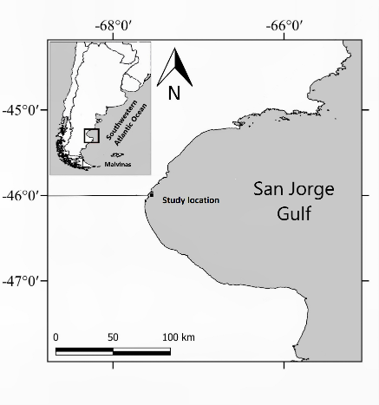
In Argentina, mussel farming is carried out on a very small scale in the southern Patagonian region. One of the most critical factors influencing mussel culture yield is the number of mussels seeded on socks, as this density has significant impact on growth and mortality. The objective of this study was to determine whether the stock density during the grow-out phase affects overall production performance in the farming of the mussel Mytilus platensis. A nine-month experimental culture socks at three densities (high: 600 mussels m-1; intermediate: 450 mussels m-1; and low: 300 mussels m-1) was conducted in San Jorge gulf at the southwestern Atlantic Ocean. Shell length, meat biomass, and survival were measured for each treatment every three months. Mussels stocked at the intermediate density showed growth rates equivalent to those of the high- and low-density groups, but achieved significantly higher survival rates, suggesting a higher harvest yield.
Downloads
References
Alunno-Bruscia M, Petraitis PS, Bourget E, Fréchette M. 2000. Body size-density relationship for Mytilus edulis in an experimental food-regulated situation. Oikos. 90 (1): 28-42.
Bayne BL, editor. 1976. Marine mussels: their ecology and physiology. International Biological Programme 10. Cambridge University Press. 506 p.
Cubillo AM, Peteiro LG, Fernández-Reiriz MJ, Labarta U. 2012. Influence of stocking density on growth of mussels (Mytilus galloprovincialis) in suspended culture. Aquaculture. 342/343: 103-111.
Filgueira R, Comeau LA, Guyondet T. 2015. Modelling carrying capacity of bivalve aquaculture: a review of definitions and methods. Fisheries and Oceans Canada, Canadian Science Advisory Secretariat (CSAS), Research Document 2015/002. 31 p.
Fréchette M, Bacher C. 1998. A modelling study of optimal stocking density of mussel populations kept in experimental tanks. J Exp Mar Biol Ecol. 219 (1): 241-255.
Fréchette M, Bergeron P, Gagnon P. 1996. On the use of self-thinning relationships in stocking experiments. Aquaculture. 145: 91-112.
Fréchette M, Lefaivre D. 1990. Discriminating between food and space limitation in benthic suspension feeders using self-thinning relationships. Mar Ecol Prog Ser. 65: 15-23. DOI: https://doi.org/10.3354/meps065015
Fréchette M, Wilson JR, Bilodeau F, Fuentes-Santos I, Cubillo AM, Fernández Rieriz JM, Labarta U. 2014. Dynamic self-thinning model for sessile animal populations with multi-layered distribution. Rev Aquacult. 6 (2): 115-127.
Fréchette M, Wilson JR, Bilodeau F, Lachance-Bernard M. 2011. Production dynamics, self-thinning and profitability of blue mussel populations reared in suspension culture in Cascapédia Bay. Proceedings of Aquaculture Canada OM 2010 and Cold Harvest TM 2010. p. 30-33.
Fuentes-Santos I, Cubillo AM, Fernández-Reiriz JM, Labarta U. 2014. Dynamic self-thinning model for sessile animal populations with multi-layered distribution. Rev Aquacult. 6 (2): 115-127. DOI: https://doi.org/10.1111/raq.12032
Gosling E, editor. 1992. The mussel Mytilus: ecology, physiology, genetics and culture. Dev Aquac Fish Sci. 25. Amsterdam: Elsevier. 589 p.
Grant J, Bacher C, Cranford PJ, Guyondet T, Carreau M. 2008. A spatially explicit ecosystem model of seston depletion in dense mussel culture. J Mar Sys. 73 (1-2): 155-168. DOI: https://doi.org/10.1016/j.jmarsys.2007.10.007
Guiñez R. 2005. Layering, the effective density of mussels and mass-density boundary curves. Oikos. 110 (1): 186-190.
Irisarri J, Fernández-Reiriz MJ, Cranford PJ, Labarta U. 2014. Effects of seasonal variations in phytoplankton on the bioenergetic responses of mussels (Mytilus galloprovincialis) held on a raft in net-pens. Aquaculture. 428-429: 41-53.
Isola T, Marques B. 2020. Efecto de la densidad sobre el crecimiento en fase de engorde del mejillón, Mytilus edulis platensis, en el golfo San Jorge, Patagonia argentina. Rev Biol Mar Oceanogr. 55 (3): 263-269.
Lauzon-Guay JS, Dionne M, Barbeau MA, Hamilton DJ. 2005. Effects of seed size and density on growth, tissue-to-shell ratio and survival of cultivated mussels (Mytilus edulis) in Prince Edward Island, Canada. Aquaculture. 250 (3-4): 652-665.
Marques BG, Isola TE, Soto G, Zaixso HE. 2020. Efectos de la densidad de siembra y el desdoble sobre el crecimiento y la supervivencia en un cultivo suspendido experimental del mejillón, Mytilus edulis platensis, en el Golfo San Jorge. Argentina. Mar Fish Sci. 33 (1): 5-19. DOI: https://doi.org/10.47193/mafis.3312020061801
National Ministry of Economy. 2023. Producción de Acuicultura en Argentina durante el año 2023. Dirección Nacional de Acuicultura, Secretaria de Ganadería, Pesca y Agricultura, Ministerio de Economía, República Argentina. 6 p.
Newell RIE. 2004. Ecosystem influences of natural and cultivated populations of suspension-feeding bivalve molluscs: a review. J Shellfish Res. 23 (1): 51-61.
Zaixso HE, Lizarralde ZI. 1998. Efecto del método de encordado sobre el crecimiento y la perdida de mejillones (Mytilus platensis D’Orb.) en cultivos suspendidos. Biol Pesq. 27: 47-62.
Zaixso HE, Lizarralde Z. 2001. Efectos del desdoble sobre la biomasa cosechable de Mytilus platensis D’Orb en cultivo. Rev Invest Desarr Pesq. 14: 109-123.
Zhong W, Lin J, Zou Q, Yamazaki H, Yang W, Yang G. 2024. Impacts of large-scale suspended mussel farm on seston depletion. Estuar Coast Shelf Sci. 300: 108710. DOI: https://doi.org/10.1016/j.ecss.2024.108710
Published
Issue
Section
License
Copyright (c) 2026 Tomás E. Isola, Francisco J. Rozzi, Bernardo G. Marques, Manuel García-Ulloa

This work is licensed under a Creative Commons Attribution-NonCommercial-ShareAlike 4.0 International License.
Authors of articles published in Marine and Fishery Sciences retain copyright on their articles, except for any third-party images and other materials added by Marine and Fishery Sciences, which are subject to copyright of their respective owners. Authors are therefore free to disseminate and re-publish their articles, subject to any requirements of third-party copyright owners and subject to the original publication being fully cited. Visitors may also download and forward articles subject to the citation requirements. The ability to copy, download, forward or otherwise distribute any materials is always subject to any copyright notices displayed. Copyright notices must be displayed prominently and may not be obliterated, deleted or hidden, totally or partially.
This journal offers authors an Open Access policy. Users are allowed to read, download, copy, distribute, print, search, or link to the full texts of the articles, or use them for any other legal purpose within the Creative Commons 4.0 license (BY-NC-SA), without asking prior permission from the publisher or the author. This is in accordance with the BOAI definition of Open Access.