From centralized control to participatory co-management: how institutional pluralism shapes stakeholders’ perceptions of the governance transition
DOI:
https://doi.org/10.47193/mafis.39420260011002Keywords:
Participatory governance, Q methodology, socioecological sustainabilityAbstract
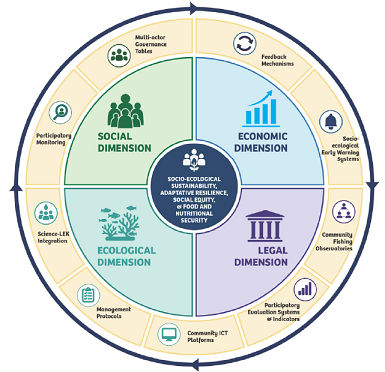
Governance frameworks for small-scale coastal fisheries have historically relied on centralized, top-down management, limiting local stakeholder participation. This study analyzed the perceptions of 72 stakeholders involved in the artisanal hake fishery (Merluccius gayi peruanus) in northern Peru regarding the implementation of an Integrated Model of Participatory Governance for Small-Scale Fisheries (IMPG-SSF). To this end, Q methodology was applied using a forced distribution of 30 statements and factor analysis with Varimax rotation, complemented by a bootstrap procedure to assess the stability of the factor solution. The results enabled the identification of three differentiated narratives. The first interpreted co-management as an opportunity to strengthen socioecological sustainability, participation, and coordination among actors. The second expressed a favorable stance, although conditioned by the need for technical capacities, operational clarity, and institutional support. The third reflected a more critical view, associated with concerns about conflict, institutional weakness, and possible difficulties in implementing the model in complex local contexts. The factor solution exhibited high levels of reliability and stability under resampling. The integration of the findings showed that the transition toward participatory governance schemes depends not only on the recognition of local knowledge, but also on institutional strengthening, coordination among actors, and the gradual building of trust, leading to the conclusion that the implementation of the IMPG-SSF requires strategies adapted to the territorial and social dynamics of the artisanal fishery.
Downloads
References
Aguado SH, Segado IS, Vidal MES, Pitcher TJ, Lam ME. 2021. The quality of fisheries governance assessed using a participatory, multi-criteria framework: a case study from Murcia, Spain. Mar Policy. 124: 104280. DOI: https://doi.org/10.1016/j.marpol.2020.104280
Banikoi H. 2024. Legal pluralism, ideology, and institutional change: the evolution of institutions for coastal resource governance in Ghana. J Institutional Econ. 20: e32. DOI: https://doi.org/10.1017/S1744137424000225
Bassett HR, Sharan S, Suri SK, Advani S, Giordano C. 2022. A comparative study of small-scale fishery supply chains’ vulnerability and resilience to COVID-19. Marit Stud. 21 (2): 173-192. DOI: https://doi.org/10.1007/s40152-021-00231-4
Bausero-Jorcin S, Gelcich S, Gianelli I, Jorge-Romero G, Lezama C, Defeo O. 2024. Assessing the performance of a participatory governance transformation in small-scale fisheries: a case study from Uruguay. Mar Policy. 160: 105964. DOI: https://doi.org/10.1016/j.marpol.2023.105964
Berkes F. 2008. Commons in a multi-level world. Int J Commons. 2 (1): 1-6. DOI: https://doi.org/10.18352/ijc.80
Bowman CA, Mangi SC, Oxenford HA. 2021. Using stakeholder’s perspectives of ‘Managed Access’ to guide management efforts in small-scale fisheries. Environ Conserv. 48 (2): 100-109. DOI: https://doi.org/10.1017/s0376892921000047
Brown SR. 1980. Political subjectivity: applications of Q methodology in political science. Yale University Press.
Calò A, Di Franco A, Dimitriadis C, Piacentini L, Ventura P, Pey A, García-Chartón JA, Charbonnel E, Decugis V, De Franco F, et al. 2023. Social-ecological features of set-net small-scale fisheries in the context of Mediterranean marine protected areas. Mediterr Mar Sci. 24 (3): 491-509. DOI: https://doi.org/10.12681/mms.33079
Cattell RB. 1966. The scree test for the number of factors. Multivar Behav Res. 1 (2): 245-276. DOI: https://doi.org/10.1207/s15327906mbr0102_10
Cinti A, Ramírez L, Castrejón M, Aburto JA, Loto L, Fulton S, Rueda M, Schiavetti A, Fernández-Rivera Melo FJ, Bravo M, et al. 2024. Small-scale fisheries in ecologically sensitive areas in Latin America and the Caribbean: Do marine protected areas benefit fisheries governance? Ambio. 54: 20-42. DOI: https://doi.org/10.1007/s13280-024-02062-z
Dudayev R, Hakim LL, Rufiati I. 2023. Participatory fisheries governance in Indonesia: Are octopus fisheries leading the way? Mar Policy. 147: 105338. DOI: https://doi.org/10.1016/j.marpol.2022.105338
Espinoza‐Tenorio A, Ehuan-Noh RG, Cuevas-Gómez GA, Narchi NE, Ramos-Muñoz DE, Fernández-Rivera Melo FJ, Saldívar-Moreno A, Zepeda-Domínguez JA, Pérez-Jiménez JC, Oliveto-Andrade A, et al. 2021. Between uncertainty and hope: young leaders as agents of change in sustainable small-scale fisheries. Ambio. 51 (5): 1287-1301. DOI: https://doi.org/10.1007/s13280-021-01639-2
[FAO] Food and Agriculture Organization of the United Nations. 2015. Voluntary guidelines for securing sustainable small-scale fisheries in the context of food security and poverty eradication. Rome: FAO. 35 p.
Farquhar S, Nirindrainy AF, Heck N, Saldarriaga MG, Xu Y. 2022. The impacts of long-term changes in weather on small-scale fishers’ available fishing hours in Nosy Barren, Madagascar. Front Mar Sci. 9: 841048. DOI: https://doi.org/10.3389/fmars.2022.841048
Furqan R, Schlüter A. 2023. Drawing on the project initiators’ perspectives to evaluate TURF implementation in the Kepulauan Seribu Marine National Park: an online Q methodology study. Front Mar Sci. 10: 1229096. DOI: https://doi.org/10.3389/fmars.2023.1229096
Galappaththi MP, Ford JD, Bennett EM, Berkes F. 2021. Adapting to climate change in small-scale fisheries: insights from indigenous communities in the global north and south. Environ Sci Policy. 116: 160-170. DOI: https://doi.org/10.1016/j.envsci.2020.11.009
González-Roca F, Pérez-Ruzafa Á, Vásquez JA, Gelcich S. 2023. Artisanal fishers’ perceptions of two co-existing kelp resource management regimes in northern Chile. Mar Policy. 153: 105610. DOI: https://doi.org/10.1016/j.marpol.2023.105610
Gray T, Korda R, Stead SM. 2023. Democracy and human rights in the management of small-scale fisheries in England. Sustainability. 15 (4): 2956. DOI: https://doi.org/10.3390/su15042956
Hair JF, Black WC, Babin BJ, Anderson RE. 2019. Multivariate data analysis. 8th ed. Cengage. 834 p. https://eli.johogo.com/Class/CCU/SEM/_Multivariate%20Data%20Analysis_Hair.pdf.
House J, Kleiber D, Steenbergen DJ, Stacey N. 2023. Participatory monitoring in community-based fisheries management through a gender lens. Ambio. 52 (2): 300-318. DOI: https://doi.org/10.1007/s13280-022-01783-3
Jara HJ, Tam J, Reguero BG, Ganoza F, Castillo G, Romero CY, Gévaudan M, Sánchez AA. 2020. Current and future socio-ecological vulnerability and adaptation of artisanal fisheries communities in Peru, the case of the Huaura province. Mar Policy. 119: 104003. DOI: https://doi.org/10.1016/j.marpol.2020.104003
Jentoft S, Chuenpagdee R. 2022. Interactive learning and governance transformation for securing blue justice for small-scale fisheries. Admin Soc. 54 (7): 1255-1282. DOI: https://doi.org/10.1177/00953997211073947
Jolliffe IT. 2002. Principal component analysis. 2nd ed. Springer.
Kaiser HF. 1960. The application of electronic computers to factor analysis. Educ Psychol Meas. 20 (1): 141-151. DOI: https://doi.org/10.1177/001316446002000116
Kerlinger FN, Lee HB, Pineda Ayala LE. 2002. Behavioral research: research methods in the social sciences. McGraw-Hill Interamericana.
Kinyua DN, Kadagi NI, Ater S, Osore M, Wamukota A. 2022. Perceptions toward governance of billfish resource use: the lens of artisanal fishers in Kenya. Front Mar Sci. 9: 1032594. DOI: https://doi.org/10.3389/fmars.2022.1032594
Kuyini Mohammed A. 2023. An evaluation of the quality of democracy in Ghana. Democr Secur. 19 (4): 347-388. DOI: https://doi.org/10.1080/17419166.2023.2220140
Lindahl T, Jarungrattanapong R. 2023. Avoiding catastrophic collapse in small-scale fisheries through inefficient cooperation: evidence from a framed field experiment. Environ Dev Econ. 28 (2): 111-129. DOI: https://doi.org/10.1017/S1355770X22000171
Ostrom E. 2010. Beyond markets and states: polycentric governance of complex economic systems. Am Econ Rev. 100 (3): 641-672. DOI: https://doi.org/10.1257/aer.100.3.641
Ouréns R, Melnychuk MC, Crowder LB, Gutiérrez NL, Hilborn R, Pita C, Defeo O. 2022. Linking small-scale fisheries performance to governance attributes: a quantitative assessment from stakeholders’ perceptions in the Americas and Europe. Mar Policy. 136: 104876. DOI: https://doi.org/10.1016/j.marpol.2021.104876
Q Method Software. 2025. Q Method Software [software]. https://qmethodsoftware.com/.
Rice ED, Gondwe E, Bennett AE, Okanga PA, Osho-Abdulgafar NF, Fakoya K, Oloko A, Harper S, Kawaye PC, Chuku EO, et al. 2024. The future of gender research in small-scale fisheries: priorities and pathways for advancing gender equity. Fish Fish. 25 (3): 401-408. DOI: https://doi.org/10.1111/faf.12814
Said A, Chuenpagdee R. 2019. Aligning the sustainable development goals with the small-scale fisheries guidelines: a case for EU fisheries governance. Mar Policy. 107: 103599. DOI: https://doi.org/10.1016/j.marpol.2019.103599
Svolkinas L, Holmes G, Dmitrieva L, Ermolin I, Suvorkov P, Goodman SJ. 2023. Stakeholder consensus suggests strategies to promote sustainability in an artisanal fishery with high rates of poaching and marine mammal bycatch. People Nat. 5: 1187-1206. DOI: https://doi.org/10.1002/pan3.10490
Torre-Castro M. 2019. Inclusive management through gender consideration in small-scale fisheries: the why and the how. Front Mar Sci. 6: 156. DOI: https://doi.org/10.3389/fmars.2019.00156
Vargas-López VG, Arreguín-Sánchez F, Gutiérrez-González JL, Seijo JC. 2023. Co-management of a high-value species with territorial use rights for fisheries: a spatial bioeconomic approach with environmental variability. Sci Mar. 87 (3): e071. DOI: https://doi.org/10.3989/scimar.05335.071
Virgili M, Petetta A, Barone G, Li Veli D, Bargione G, Lucchetti A. 2024. Engaging fishers in sea turtle conservation in the Mediterranean Sea. Mar Policy. 160: 105981. DOI: https://doi.org/10.1016/j.marpol.2023.105981
Watts S, Stenner P. 2012. Doing Q methodological research: theory, method and interpretation. Sage Publications Ltd.
Zabala A, Pascual U. 2016. Bootstrapping Q methodology to improve the understanding of human perspectives. PLoS ONE. 11 (2): e0148087. DOI: https://doi.org/10.1371/journal.pone.0148087
Zabala A, Sandbrook C, Mukherjee N. 2018. When and how to use Q methodology to understand perspectives in conservation research. Conserv Biol. 32 (5): 1185-1194. DOI: https://doi.org/10.1111/cobi.13123
Published
Issue
Section
License
Copyright (c) 2026 Carlos M. Salazar, Joe M. Macalupú, Víctor J. Morales

This work is licensed under a Creative Commons Attribution-NonCommercial-ShareAlike 4.0 International License.
Authors of articles published in Marine and Fishery Sciences retain copyright on their articles, except for any third-party images and other materials added by Marine and Fishery Sciences, which are subject to copyright of their respective owners. Authors are therefore free to disseminate and re-publish their articles, subject to any requirements of third-party copyright owners and subject to the original publication being fully cited. Visitors may also download and forward articles subject to the citation requirements. The ability to copy, download, forward or otherwise distribute any materials is always subject to any copyright notices displayed. Copyright notices must be displayed prominently and may not be obliterated, deleted or hidden, totally or partially.
This journal offers authors an Open Access policy. Users are allowed to read, download, copy, distribute, print, search, or link to the full texts of the articles, or use them for any other legal purpose within the Creative Commons 4.0 license (BY-NC-SA), without asking prior permission from the publisher or the author. This is in accordance with the BOAI definition of Open Access.