Del control centralizado a la cogestión participativa: cómo el pluralismo institucional moldea las percepciones de las partes interesadas sobre la transición de la gobernanza
DOI:
https://doi.org/10.47193/mafis.39420260011002Palabras clave:
Gobernanza participativa, metodología Q, sostenibilidad socio-ecológicaResumen
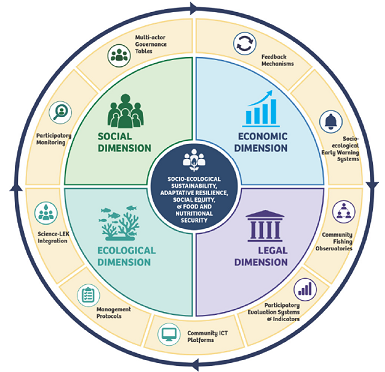
Históricamente, los marcos de gobernanza para la pesca costera a pequeña escala se han basado en una gestión centralizada y jerárquica, lo que limita la participación de las partes interesadas locales. El presente estudio analizó las percepciones de 72 actores vinculados a la pesquería artesanal de merluza (Merluccius gayi peruanus) en el norte del Perú respecto a la implementación de un Modelo Integrado de Gobernanza Participativa para Pesquerías de Pequeña Escala (IMPG-SSF). Para ello, se aplicó la metodología Q mediante una distribución forzada de 30 declaraciones y un análisis factorial con rotación Varimax, complementado con un procedimiento bootstrap para evaluar la estabilidad de la solución factorial. Los resultados permitieron identificar tres narrativas diferenciadas. La primera interpretó la cogestión como una oportunidad para fortalecer la sostenibilidad socio-ecológica, la participación y la articulación entre actores. La segunda expresó una posición favorable, aunque condicionada por la necesidad de capacidades técnicas, claridad operativa y respaldo institucional. La tercera reflejó una visión más crítica, asociada a preocupaciones sobre conflictos, debilidad institucional y posibles dificultades para implementar el modelo en contextos locales complejos. La solución factorial presentó altos niveles de confiabilidad y estabilidad frente al remuestreo. La integración de los hallazgos evidenció que la transición hacia esquemas de gobernanza participativa depende no solo del reconocimiento del conocimiento local, sino también del fortalecimiento institucional, la coordinación entre actores y la construcción progresiva de confianza, concluyendo que la implementación del IMPG-SSF requiere estrategias adaptadas a las dinámicas territoriales y sociales de la pesquería artesanal.
Descargas
Referencias
Aguado SH, Segado IS, Vidal MES, Pitcher TJ, Lam ME. 2021. The quality of fisheries governance assessed using a participatory, multi-criteria framework: a case study from Murcia, Spain. Mar Policy. 124: 104280. DOI: https://doi.org/10.1016/j.marpol.2020.104280
Banikoi H. 2024. Legal pluralism, ideology, and institutional change: the evolution of institutions for coastal resource governance in Ghana. J Institutional Econ. 20: e32. DOI: https://doi.org/10.1017/S1744137424000225
Bassett HR, Sharan S, Suri SK, Advani S, Giordano C. 2022. A comparative study of small-scale fishery supply chains’ vulnerability and resilience to COVID-19. Marit Stud. 21 (2): 173-192. DOI: https://doi.org/10.1007/s40152-021-00231-4
Bausero-Jorcin S, Gelcich S, Gianelli I, Jorge-Romero G, Lezama C, Defeo O. 2024. Assessing the performance of a participatory governance transformation in small-scale fisheries: a case study from Uruguay. Mar Policy. 160: 105964. DOI: https://doi.org/10.1016/j.marpol.2023.105964
Berkes F. 2008. Commons in a multi-level world. Int J Commons. 2 (1): 1-6. DOI: https://doi.org/10.18352/ijc.80
Bowman CA, Mangi SC, Oxenford HA. 2021. Using stakeholder’s perspectives of ‘Managed Access’ to guide management efforts in small-scale fisheries. Environ Conserv. 48 (2): 100-109. DOI: https://doi.org/10.1017/s0376892921000047
Brown SR. 1980. Political subjectivity: applications of Q methodology in political science. Yale University Press.
Calò A, Di Franco A, Dimitriadis C, Piacentini L, Ventura P, Pey A, García-Chartón JA, Charbonnel E, Decugis V, De Franco F, et al. 2023. Social-ecological features of set-net small-scale fisheries in the context of Mediterranean marine protected areas. Mediterr Mar Sci. 24 (3): 491-509. DOI: https://doi.org/10.12681/mms.33079
Cattell RB. 1966. The scree test for the number of factors. Multivar Behav Res. 1 (2): 245-276. DOI: https://doi.org/10.1207/s15327906mbr0102_10
Cinti A, Ramírez L, Castrejón M, Aburto JA, Loto L, Fulton S, Rueda M, Schiavetti A, Fernández-Rivera Melo FJ, Bravo M, et al. 2024. Small-scale fisheries in ecologically sensitive areas in Latin America and the Caribbean: Do marine protected areas benefit fisheries governance? Ambio. 54: 20-42. DOI: https://doi.org/10.1007/s13280-024-02062-z
Dudayev R, Hakim LL, Rufiati I. 2023. Participatory fisheries governance in Indonesia: Are octopus fisheries leading the way? Mar Policy. 147: 105338. DOI: https://doi.org/10.1016/j.marpol.2022.105338
Espinoza‐Tenorio A, Ehuan-Noh RG, Cuevas-Gómez GA, Narchi NE, Ramos-Muñoz DE, Fernández-Rivera Melo FJ, Saldívar-Moreno A, Zepeda-Domínguez JA, Pérez-Jiménez JC, Oliveto-Andrade A, et al. 2021. Between uncertainty and hope: young leaders as agents of change in sustainable small-scale fisheries. Ambio. 51 (5): 1287-1301. DOI: https://doi.org/10.1007/s13280-021-01639-2
[FAO] Food and Agriculture Organization of the United Nations. 2015. Voluntary guidelines for securing sustainable small-scale fisheries in the context of food security and poverty eradication. Rome: FAO. 35 p.
Farquhar S, Nirindrainy AF, Heck N, Saldarriaga MG, Xu Y. 2022. The impacts of long-term changes in weather on small-scale fishers’ available fishing hours in Nosy Barren, Madagascar. Front Mar Sci. 9: 841048. DOI: https://doi.org/10.3389/fmars.2022.841048
Furqan R, Schlüter A. 2023. Drawing on the project initiators’ perspectives to evaluate TURF implementation in the Kepulauan Seribu Marine National Park: an online Q methodology study. Front Mar Sci. 10: 1229096. DOI: https://doi.org/10.3389/fmars.2023.1229096
Galappaththi MP, Ford JD, Bennett EM, Berkes F. 2021. Adapting to climate change in small-scale fisheries: insights from indigenous communities in the global north and south. Environ Sci Policy. 116: 160-170. DOI: https://doi.org/10.1016/j.envsci.2020.11.009
González-Roca F, Pérez-Ruzafa Á, Vásquez JA, Gelcich S. 2023. Artisanal fishers’ perceptions of two co-existing kelp resource management regimes in northern Chile. Mar Policy. 153: 105610. DOI: https://doi.org/10.1016/j.marpol.2023.105610
Gray T, Korda R, Stead SM. 2023. Democracy and human rights in the management of small-scale fisheries in England. Sustainability. 15 (4): 2956. DOI: https://doi.org/10.3390/su15042956
Hair JF, Black WC, Babin BJ, Anderson RE. 2019. Multivariate data analysis. 8th ed. Cengage. 834 p. https://eli.johogo.com/Class/CCU/SEM/_Multivariate%20Data%20Analysis_Hair.pdf.
House J, Kleiber D, Steenbergen DJ, Stacey N. 2023. Participatory monitoring in community-based fisheries management through a gender lens. Ambio. 52 (2): 300-318. DOI: https://doi.org/10.1007/s13280-022-01783-3
Jara HJ, Tam J, Reguero BG, Ganoza F, Castillo G, Romero CY, Gévaudan M, Sánchez AA. 2020. Current and future socio-ecological vulnerability and adaptation of artisanal fisheries communities in Peru, the case of the Huaura province. Mar Policy. 119: 104003. DOI: https://doi.org/10.1016/j.marpol.2020.104003
Jentoft S, Chuenpagdee R. 2022. Interactive learning and governance transformation for securing blue justice for small-scale fisheries. Admin Soc. 54 (7): 1255-1282. DOI: https://doi.org/10.1177/00953997211073947
Jolliffe IT. 2002. Principal component analysis. 2nd ed. Springer.
Kaiser HF. 1960. The application of electronic computers to factor analysis. Educ Psychol Meas. 20 (1): 141-151. DOI: https://doi.org/10.1177/001316446002000116
Kerlinger FN, Lee HB, Pineda Ayala LE. 2002. Behavioral research: research methods in the social sciences. McGraw-Hill Interamericana.
Kinyua DN, Kadagi NI, Ater S, Osore M, Wamukota A. 2022. Perceptions toward governance of billfish resource use: the lens of artisanal fishers in Kenya. Front Mar Sci. 9: 1032594. DOI: https://doi.org/10.3389/fmars.2022.1032594
Kuyini Mohammed A. 2023. An evaluation of the quality of democracy in Ghana. Democr Secur. 19 (4): 347-388. DOI: https://doi.org/10.1080/17419166.2023.2220140
Lindahl T, Jarungrattanapong R. 2023. Avoiding catastrophic collapse in small-scale fisheries through inefficient cooperation: evidence from a framed field experiment. Environ Dev Econ. 28 (2): 111-129. DOI: https://doi.org/10.1017/S1355770X22000171
Ostrom E. 2010. Beyond markets and states: polycentric governance of complex economic systems. Am Econ Rev. 100 (3): 641-672. DOI: https://doi.org/10.1257/aer.100.3.641
Ouréns R, Melnychuk MC, Crowder LB, Gutiérrez NL, Hilborn R, Pita C, Defeo O. 2022. Linking small-scale fisheries performance to governance attributes: a quantitative assessment from stakeholders’ perceptions in the Americas and Europe. Mar Policy. 136: 104876. DOI: https://doi.org/10.1016/j.marpol.2021.104876
Q Method Software. 2025. Q Method Software [software]. https://qmethodsoftware.com/.
Rice ED, Gondwe E, Bennett AE, Okanga PA, Osho-Abdulgafar NF, Fakoya K, Oloko A, Harper S, Kawaye PC, Chuku EO, et al. 2024. The future of gender research in small-scale fisheries: priorities and pathways for advancing gender equity. Fish Fish. 25 (3): 401-408. DOI: https://doi.org/10.1111/faf.12814
Said A, Chuenpagdee R. 2019. Aligning the sustainable development goals with the small-scale fisheries guidelines: a case for EU fisheries governance. Mar Policy. 107: 103599. DOI: https://doi.org/10.1016/j.marpol.2019.103599
Svolkinas L, Holmes G, Dmitrieva L, Ermolin I, Suvorkov P, Goodman SJ. 2023. Stakeholder consensus suggests strategies to promote sustainability in an artisanal fishery with high rates of poaching and marine mammal bycatch. People Nat. 5: 1187-1206. DOI: https://doi.org/10.1002/pan3.10490
Torre-Castro M. 2019. Inclusive management through gender consideration in small-scale fisheries: the why and the how. Front Mar Sci. 6: 156. DOI: https://doi.org/10.3389/fmars.2019.00156
Vargas-López VG, Arreguín-Sánchez F, Gutiérrez-González JL, Seijo JC. 2023. Co-management of a high-value species with territorial use rights for fisheries: a spatial bioeconomic approach with environmental variability. Sci Mar. 87 (3): e071. DOI: https://doi.org/10.3989/scimar.05335.071
Virgili M, Petetta A, Barone G, Li Veli D, Bargione G, Lucchetti A. 2024. Engaging fishers in sea turtle conservation in the Mediterranean Sea. Mar Policy. 160: 105981. DOI: https://doi.org/10.1016/j.marpol.2023.105981
Watts S, Stenner P. 2012. Doing Q methodological research: theory, method and interpretation. Sage Publications Ltd.
Zabala A, Pascual U. 2016. Bootstrapping Q methodology to improve the understanding of human perspectives. PLoS ONE. 11 (2): e0148087. DOI: https://doi.org/10.1371/journal.pone.0148087
Zabala A, Sandbrook C, Mukherjee N. 2018. When and how to use Q methodology to understand perspectives in conservation research. Conserv Biol. 32 (5): 1185-1194. DOI: https://doi.org/10.1111/cobi.13123
Descargas
Publicado
Número
Sección
Licencia
Derechos de autor 2026 Carlos M. Salazar, Joe M. Macalupú, Víctor J. Morales

Esta obra está bajo una licencia internacional Creative Commons Atribución-NoComercial-CompartirIgual 4.0.
Los autores de los artículos publicados en Marine and Fishery Sciences conservan los derechos de autor de sus artículos, a excepción de las imágenes de terceros y otros materiales añadidos por Marine and Fishery Sciences, que están sujetos a los derechos de autor de sus respectivos propietarios. Por lo tanto, los autores son libres de difundir y volver a publicar sus artículos, sujeto a los requisitos de los propietarios de derechos de autor de terceros y sujeto a que la publicación original sea completamente citada. Los visitantes también pueden descargar y reenviar artículos sujetos a los requisitos de citas. La capacidad de copiar, descargar, reenviar o distribuir cualquier material siempre está sujeta a los avisos de derechos de autor que se muestran. Los avisos de copyright deben mostrarse de manera prominente y no pueden borrarse, eliminarse u ocultarse, total o parcialmente. El autoalmacenamiento en servidores y repositorios de preimpresión está permitido para todas las versiones.
Esta revista ofrece a los autores una política de acceso abierto. Los usuarios pueden leer, descargar, copiar, distribuir, imprimir, buscar o vincular los textos completos de los artículos, o usarlos para cualquier otro propósito legal dentro de la licencia Creative Commons 4.0 (BY-NC-SA), sin solicitar permiso previo del editor o del autor. Esto está de acuerdo con la definición BOAI de acceso abierto.