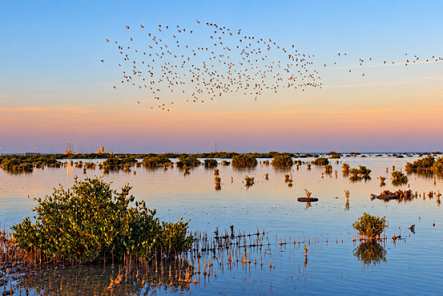
Long-term mangrove extent dynamics in Tarout Bay, Arabian Gulf, Saudi Arabia (1990-2026)
DOI:
https://doi.org/10.47193/mafis.4012027010109Keywords:
Avicennia marina, mangrove extent, temporal dynamics, remote sensing, Arabian GulfAbstract
Mangrove ecosystems in arid coastal environments experience substantial spatial and temporal changes, requiring consistent long-term monitoring. We examined mangrove extent in Tarout Bay, Arabian Gulf, Saudi Arabia, for 1990, 2000, 2010, 2020 and 2026 using Landsat surface-reflectance composites and NDVI thresholding, with Sentinel-2 imagery providing contemporary landscape context. Mapped extent increased from 15.90 to 142.44 ha (795.8%), representing a net increase of 126.54 ha. The greatest net expansion occurred during 2010-2020 (62.50 ha; 6.25 ha yr-1), followed by a slower increase during 2020-2026 (18.71 ha; 3.12 ha yr-1). These findings demonstrate substantial long-term mangrove expansion, with considerable variation in the rate of change across observation periods. However, the absence of an independent classification accuracy assessment and uncertainties associated with the spatial resolution of Landsat imagery limit quantitative interpretation. The results provide an extent-based baseline for evaluating mangrove dynamics and supporting coastal conservation, field verification and restoration monitoring in arid environments.
Downloads
References
Al-Ali AM, Del Campo AG, Rocha C. 2015. Environmental assessment of mangrove communities in Tarut Bay, Eastern Arabian Peninsula, based on multidisciplinary approach. Int Arch Photogramm Remote Sens Spatial Inf Sci. XL-7/W3. p. 269-276. DOI: https://doi.org/10.5194/isprsarchives-XL-7-W3-269-2015
Aljaddani AH. 2025. Geospatial analysis of patterns and trends of mangrove forest in Saudi Arabia: identifying at-risk zone-based land use. Sustainability. 17 (13): 5957. DOI: https://doi.org/10.3390/su17135957
Almahasheer H, Al-Taisan W, Mohamed MK. 2013. Mangrove deterioration in Tarut Bay on the Eastern Province of the Kingdom of Saudi Arabia. Pakhtunkhwa J Life Sci. 1 (2): 49-59.
Bunting P, Hilarides L, Rosenqvist A, Oakes G, Castro Brandão Vaz dos Santos P, Worthington T, Rosenqvist J, Zanaga D, Van De Kerchove R, Tadono T, et al. 2026. Global Mangrove Watch: timeseries of Mangrove Extent (Version 4.1.12) [dataset]. Zenodo. DOI: https://doi.org/10.5281/zenodo.21346457
Contessa V, Dyson K, Vivar Mulas PP, Kindgard A, Liu T, Saah D, Tenneson K, Pekkarinen A. 2023. Uncovering dynamics of global mangrove gains and losses. Remote Sens. 15 (15): 3872. DOI: https://doi.org/10.3390/rs15153872
Friis G, Burt JA. 2020. Evolution of mangrove research in an extreme environment: historical trends and future opportunities in Arabia. Ocean Coast Manag. 195: 105288. DOI: https://doi.org/10.1016/j.ocecoaman.2020.105288
Goldberg L, Lagomasino D, Thomas N, Fatoyinbo T. 2020. Global declines in human-driven mangrove loss. Glob Change Biol. 26 (10): 5844-5855. DOI: https://doi.org/10.1111/gcb.15275
Hagger V, Worthington TA, Lovelock CE, Adame MF, Amano T, Brown BM, Friess DA, Landis E, Mumby PJ, Morrison TH, et al. 2022. Drivers of global mangrove loss and gain in social-ecological systems. Nat Commun. 13: 6373. DOI: https://doi.org/10.1038/s41467-022-33962-x
Ju C, Fu D, Lyne V, Xiao H, Su F, Yu H. 2025. Global declines in mangrove area and carbon-stock from 1985 to 2020. Geophys Res Lett. 52 (8): e2025GL115303. DOI: https://doi.org/10.1029/2025GL115303
Li W, El-Askary H, Qurban MA, Li J, ManiKandan KP, Piechota T. 2019. Using multi-indices approach to quantify mangrove changes over the Western Arabian Gulf along Saudi Arabia coast. Ecol Indic. 102: 734-745. DOI: https://doi.org/10.1016/j.ecolind.2019.03.047
Mohammed Ibrahim SB, Sankaran R, Backer SJ, Al Absi R, Mohammed AV, Al-Khayat JA, Vethamony P, Al-Kuwari HA. 2026. Evaluation of mangrove ecosystem dynamics in the arid environment: for restoration on the Qatar coast using satellite data and by hyperspectral imaging. Mar Pollut Bull. 231: 119961. DOI: https://doi.org/10.1016/j.marpolbul.2026.119961
Mohan M, Dutta Roy A, Montenegro JF, Watt MS, Burt JA, Shapiro A, Ouerfelli D, Daniel R, de Miguel Magaña S, López Martínez C. 2024. Mangrove forest regeneration age map and drivers of restoration success in Gulf Cooperation Council countries from satellite imagery. Remote Sens Appl Soc Environ. 36: 101345. DOI: https://doi.org/10.1016/j.rsase.2024.101345
Tian P, Yan Y, Zhang H, Liu Y, Zhang F, Ying C, Li J. 2026. Spatiotemporal dynamics and driving forces of global mangrove change. Geogr Sustain. 7 (2): 100433. DOI: https://doi.org/10.1016/j.geosus.2026.100433
Vasquez J, Acevedo-Barrios R, Miranda-Castro W, Guerrero M, Meneses-Ospina L. 2024. Determining changes in mangrove cover using remote sensing with Landsat images: a review. Water Air Soil Pollut. 235: 18. DOI: https://doi.org/10.1007/s11270-023-06788-6
Zayid AZA. 2022. The effects of anthropogenic induced geomorphological changes on mangrove forests in Tarut Bay, on the east coast of Saudi Arabia. J Fac Arts Assiut Univ. 25 (82): 1169-1200. DOI: https://doi.org/10.21608/aakj.2022.239817
Zhang Z, Luo X, Friess DA, Wang S, Li Y, Li Y. 2024. Stronger increases but greater variability in global mangrove productivity compared to that of adjacent terrestrial forests. Nat Ecol Evol. 8: 239-250. DOI: https://doi.org/10.1038/s41559-023-02264-w
Published
Issue
Section
License
Copyright (c) 2026 Naif Alqahtani, Saleh Alzamanan, Abdullah Alotaibi, Rand AlHamzah, Sharon Mathew, Shubham Prajapati, Amal Aldaej, Mohammed Awad

This work is licensed under a Creative Commons Attribution-NonCommercial-ShareAlike 4.0 International License.
Authors of articles published in Marine and Fishery Sciences retain copyright on their articles, except for any third-party images and other materials added by Marine and Fishery Sciences, which are subject to copyright of their respective owners. Authors are therefore free to disseminate and re-publish their articles, subject to any requirements of third-party copyright owners and subject to the original publication being fully cited. Visitors may also download and forward articles subject to the citation requirements. The ability to copy, download, forward or otherwise distribute any materials is always subject to any copyright notices displayed. Copyright notices must be displayed prominently and may not be obliterated, deleted or hidden, totally or partially.
This journal offers authors an Open Access policy. Users are allowed to read, download, copy, distribute, print, search, or link to the full texts of the articles, or use them for any other legal purpose within the Creative Commons 4.0 license (BY-NC-SA), without asking prior permission from the publisher or the author. This is in accordance with the BOAI definition of Open Access.