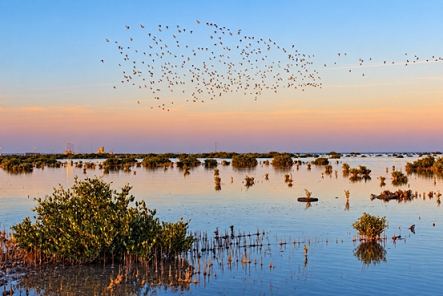
Dinámica a largo plazo de la expansión de los manglares en la bahía de Tarout, Golfo Arábigo, Arabia Saudita (1990-2026)
DOI:
https://doi.org/10.47193/mafis.4012027010109Palabras clave:
Avicennia marina, extensión de manglares, dinámica temporal, teledetección, Golfo ArábigoResumen
Los ecosistemas de manglar en entornos costeros áridos experimentan cambios espaciales y temporales sustanciales, lo que requiere un seguimiento constante a largo plazo. Analizamos la extensión de los manglares en la bahía de Tarout, en el Golfo Arábigo (Arabia Saudita), para los años 1990, 2000, 2010, 2020 y 2026, utilizando compuestos de reflectancia superficial de Landsat y umbrales del índice de vegetación de diferencia normalizada (NDVI), complementados con imágenes del satélite Sentinel-2 para proporcionar un contexto paisajístico actual. La extensión mapeada aumentó de 15,90 a 142,44 ha (795,8%), lo que representa un incremento neto de 126,54 ha. La mayor expansión neta se produjo entre 2010 y 2020 (62,50 ha; 6,25 ha año-1), seguida de un aumento más moderado entre 2020 y 2026 (18,71 ha; 3,12 ha año-1). Estos hallazgos demuestran una expansión sustancial de los manglares a largo plazo, con una variación considerable en la tasa de cambio a lo largo de los periodos observados. No obstante, la ausencia de una evaluación independiente de la precisión de la clasificación, junto con las incertidumbres asociadas a la resolución espacial de las imágenes Landsat, limitan la interpretación cuantitativa. Los resultados proporcionan una línea base, fundamentada en la extensión, para evaluar la dinámica de los manglares y apoyar la conservación costera, la verificación en campo y el seguimiento de los procesos de restauración en entornos áridos.
Descargas
Referencias
Al-Ali AM, Del Campo AG, Rocha C. 2015. Environmental assessment of mangrove communities in Tarut Bay, Eastern Arabian Peninsula, based on multidisciplinary approach. Int Arch Photogramm Remote Sens Spatial Inf Sci. XL-7/W3. p. 269-276. DOI: https://doi.org/10.5194/isprsarchives-XL-7-W3-269-2015
Aljaddani AH. 2025. Geospatial analysis of patterns and trends of mangrove forest in Saudi Arabia: identifying at-risk zone-based land use. Sustainability. 17 (13): 5957. DOI: https://doi.org/10.3390/su17135957
Almahasheer H, Al-Taisan W, Mohamed MK. 2013. Mangrove deterioration in Tarut Bay on the Eastern Province of the Kingdom of Saudi Arabia. Pakhtunkhwa J Life Sci. 1 (2): 49-59.
Bunting P, Hilarides L, Rosenqvist A, Oakes G, Castro Brandão Vaz dos Santos P, Worthington T, Rosenqvist J, Zanaga D, Van De Kerchove R, Tadono T, et al. 2026. Global Mangrove Watch: timeseries of Mangrove Extent (Version 4.1.12) [dataset]. Zenodo. DOI: https://doi.org/10.5281/zenodo.21346457
Contessa V, Dyson K, Vivar Mulas PP, Kindgard A, Liu T, Saah D, Tenneson K, Pekkarinen A. 2023. Uncovering dynamics of global mangrove gains and losses. Remote Sens. 15 (15): 3872. DOI: https://doi.org/10.3390/rs15153872
Friis G, Burt JA. 2020. Evolution of mangrove research in an extreme environment: historical trends and future opportunities in Arabia. Ocean Coast Manag. 195: 105288. DOI: https://doi.org/10.1016/j.ocecoaman.2020.105288
Goldberg L, Lagomasino D, Thomas N, Fatoyinbo T. 2020. Global declines in human-driven mangrove loss. Glob Change Biol. 26 (10): 5844-5855. DOI: https://doi.org/10.1111/gcb.15275
Hagger V, Worthington TA, Lovelock CE, Adame MF, Amano T, Brown BM, Friess DA, Landis E, Mumby PJ, Morrison TH, et al. 2022. Drivers of global mangrove loss and gain in social-ecological systems. Nat Commun. 13: 6373. DOI: https://doi.org/10.1038/s41467-022-33962-x
Ju C, Fu D, Lyne V, Xiao H, Su F, Yu H. 2025. Global declines in mangrove area and carbon-stock from 1985 to 2020. Geophys Res Lett. 52 (8): e2025GL115303. DOI: https://doi.org/10.1029/2025GL115303
Li W, El-Askary H, Qurban MA, Li J, ManiKandan KP, Piechota T. 2019. Using multi-indices approach to quantify mangrove changes over the Western Arabian Gulf along Saudi Arabia coast. Ecol Indic. 102: 734-745. DOI: https://doi.org/10.1016/j.ecolind.2019.03.047
Mohammed Ibrahim SB, Sankaran R, Backer SJ, Al Absi R, Mohammed AV, Al-Khayat JA, Vethamony P, Al-Kuwari HA. 2026. Evaluation of mangrove ecosystem dynamics in the arid environment: for restoration on the Qatar coast using satellite data and by hyperspectral imaging. Mar Pollut Bull. 231: 119961. DOI: https://doi.org/10.1016/j.marpolbul.2026.119961
Mohan M, Dutta Roy A, Montenegro JF, Watt MS, Burt JA, Shapiro A, Ouerfelli D, Daniel R, de Miguel Magaña S, López Martínez C. 2024. Mangrove forest regeneration age map and drivers of restoration success in Gulf Cooperation Council countries from satellite imagery. Remote Sens Appl Soc Environ. 36: 101345. DOI: https://doi.org/10.1016/j.rsase.2024.101345
Tian P, Yan Y, Zhang H, Liu Y, Zhang F, Ying C, Li J. 2026. Spatiotemporal dynamics and driving forces of global mangrove change. Geogr Sustain. 7 (2): 100433. DOI: https://doi.org/10.1016/j.geosus.2026.100433
Vasquez J, Acevedo-Barrios R, Miranda-Castro W, Guerrero M, Meneses-Ospina L. 2024. Determining changes in mangrove cover using remote sensing with Landsat images: a review. Water Air Soil Pollut. 235: 18. DOI: https://doi.org/10.1007/s11270-023-06788-6
Zayid AZA. 2022. The effects of anthropogenic induced geomorphological changes on mangrove forests in Tarut Bay, on the east coast of Saudi Arabia. J Fac Arts Assiut Univ. 25 (82): 1169-1200. DOI: https://doi.org/10.21608/aakj.2022.239817
Zhang Z, Luo X, Friess DA, Wang S, Li Y, Li Y. 2024. Stronger increases but greater variability in global mangrove productivity compared to that of adjacent terrestrial forests. Nat Ecol Evol. 8: 239-250. DOI: https://doi.org/10.1038/s41559-023-02264-w
Descargas
Publicado
Número
Sección
Licencia
Derechos de autor 2026 Naif Alqahtani, Saleh Alzamanan, Abdullah Alotaibi, Rand AlHamzah, Sharon Mathew, Shubham Prajapati, Amal Aldaej, Mohammed Awad

Esta obra está bajo una licencia internacional Creative Commons Atribución-NoComercial-CompartirIgual 4.0.
Los autores de los artículos publicados en Marine and Fishery Sciences conservan los derechos de autor de sus artículos, a excepción de las imágenes de terceros y otros materiales añadidos por Marine and Fishery Sciences, que están sujetos a los derechos de autor de sus respectivos propietarios. Por lo tanto, los autores son libres de difundir y volver a publicar sus artículos, sujeto a los requisitos de los propietarios de derechos de autor de terceros y sujeto a que la publicación original sea completamente citada. Los visitantes también pueden descargar y reenviar artículos sujetos a los requisitos de citas. La capacidad de copiar, descargar, reenviar o distribuir cualquier material siempre está sujeta a los avisos de derechos de autor que se muestran. Los avisos de copyright deben mostrarse de manera prominente y no pueden borrarse, eliminarse u ocultarse, total o parcialmente. El autoalmacenamiento en servidores y repositorios de preimpresión está permitido para todas las versiones.
Esta revista ofrece a los autores una política de acceso abierto. Los usuarios pueden leer, descargar, copiar, distribuir, imprimir, buscar o vincular los textos completos de los artículos, o usarlos para cualquier otro propósito legal dentro de la licencia Creative Commons 4.0 (BY-NC-SA), sin solicitar permiso previo del editor o del autor. Esto está de acuerdo con la definición BOAI de acceso abierto.