Culture-based screening of selected bacterial indicators in three freeze-dried lots of the polychaete Australonuphis sp. collected on a single date in southern Brazil
DOI:
https://doi.org/10.47193/mafis.4012027010108Keywords:
Marine annelid, feed hygiene, culture-based detectionAbstract
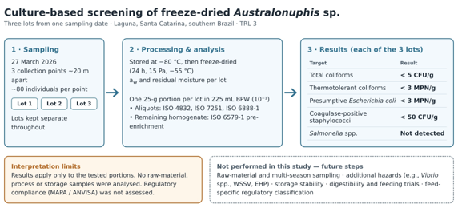
Polychaetes have been investigated as aquaculture feed ingredients because of their nutritional characteristics, particularly for broodstock diets of commercially important fish and shrimp species. However, the use of polychaetes from Latin America as feed resources for industrial aquaculture remains poorly documented, and microbiological data are an essential requirement for the development of new aquaculture ingredients. Therefore, this study screened three separately freeze-dried lots of Australonuphis sp., collected on the same date in southern Brazil, for selected bacterial indicators using culture-based ISO methods. From each lot, one 25-g test portion was homogenized in buffered peptone water; aliquots of this initial suspension were used for the enumeration of total coliforms, thermotolerant coliforms, presumptive Escherichia coli and coagulase-positive staphylococci, and the remaining homogenate was pre-enriched for the detection of Salmonella spp. No target microorganism was detected above the relevant method-specific reporting or detection limits in the tested portions. In all three lots, total coliforms were below 5 CFU g-1, thermotolerant coliforms and presumptive E. coli were below 3 MPN g-1, coagulase-positive staphylococci were below 50 CFU g-1, and Salmonella spp. was not detected. These findings provide preliminary microbiological baseline data for the tested lots of freeze-dried Australonuphis sp. only. Results should not be interpreted as evidence of animal-feed regulatory compliance, as the applicable MAPA requirements depend on the regulatory classification and intended use of the material. Further studies including raw-material and multi-season sampling, additional safety parameters, storage stability, digestibility and feeding trials, together with a formal feed-specific regulatory assessment, will be necessary to determine its suitability for future aquaculture applications.
Downloads
References
Ahmed N, Thompson S. 2019. The blue dimensions of aquaculture: a global synthesis. Sci Total Environ. 652: 851-861. DOI: https://doi.org/10.1016/j.scitotenv.2018.10.163
Akbaş Y, Gümüş E, Koçer MAT, Kurtoğlu A, Aydın I, Aktaş Ö, Pak F, Sevgili H. 2026. Impact of partial replacement of fish meal with polychaete meal (Hediste diversicolor) on growth, nutrient digestibility, fatty acid profiles, and fish-in:fish-out ratio in diets of European seabass, Dicentrarchus labrax. Fish Physiol Biochem. 52 (20). DOI: https://doi.org/10.1007/s10695-026-01634-y
Ang CY, Yong ASK, Azad SA, Lim LS, Zuldin WH, Lal MTM. 2021. Valorization of macroalgae through fermentation for aquafeed production: a review. Fermentation. 7 (4): 304. DOI: https://doi.org/10.3390/fermentation7040304
Aragão C, Gonçalves AT, Costas B, Azeredo R, Xavier MJ, Engrola S. 2022. Alternative proteins for fish diets: implications beyond growth. Animals. 12 (9): 1211. DOI: https://doi.org/10.3390/ani12091211
Argudín MÁ, Mendoza MC, Rodicio MR. 2010. Food poisoning and Staphylococcus aureus enterotoxins. Toxins. 2 (7): 1751-1773. DOI: https://doi.org/10.3390/toxins2071751
Bagordo F, Brigida S, Grassi T, Caputo MC, Apollonio F, De Carlo L, Savino AF, Triggiano F, Turturro AC, De Donno A, et al. 2024. Factors influencing microbial contamination of groundwater: a systematic review of field-scale studies. Microorganisms. 12 (5): 913. DOI: https://doi.org/10.3390/microorganisms12050913
Balqadi AA, Al-Gahwari YA, Ali HP, Awdha AF, Bakr HS, Bin Frijan SA. 2025. Effects of the partial replacing of fish meal with marine polychaetes (Nereis sp.) on the nutritional value of Macrobrachium rosenbergii shrimp. Asian J Biol Sci. 18 (2): 418-422. DOI: https://doi.org/10.3923/ajbs.2025.418.422
Carrera-Parra LF. 2021. Onuphidae Kinberg, 1865. In: De León-González JÁ, Bastida-Zavala JR, Carrera-Parra LF, García-Garza ME, Salazar-Vallejo SI, Solís-Weiss V, Tovar-Hernández MA, editors. Anélidos marinos de México y América tropical. Monterrey: Universidad Autónoma de Nuevo León. p. 513-531.
Cao W, Passot S, Irlinger F, Fonseca F. 2024. Investigation of freezing and freeze-drying for preserving and re-using a whole microbial cheese community. Foods. 13 (12): 1809. DOI: https://doi.org/10.3390/foods13121809
Chen F, Leng Y, Lu Q, Zhou W. 2021. The application of microalgae biomass and bio-products as aquafeed for aquaculture. Algal Res. 60: 102541. DOI: https://doi.org/10.1016/j.algal.2021.102541
Foster-Nyarko E, Pallen MJ. 2022. The microbial ecology of Escherichia coli in the vertebrate gut. FEMS Microbiol Rev. 46 (2): fuac008. DOI: https://doi.org/10.1093/femsre/fuac008
Glencross BD, Huyben D, Schrama JW. 2020. The application of single-cell ingredients in aquaculture feeds-a review. Fishes. 5 (3): 22. DOI: https://doi.org/10.3390/fishes5030022
González-Machado C, Alonso-Calleja C, Capita R. 2024. Prevalence and types of methicillin-resistant Staphylococcus aureus (MRSA) in meat and meat products from retail outlets and in samples of animal origin collected in farms, slaughterhouses and meat processing facilities: a review. Food Microbiology. 123: 104580. DOI: https://doi.org/10.1016/j.fm.2024.104580
Hammad AM, Eltahan A, Hassan HA, Abbas NH, Hussien H, Shimamoto T. 2022. Loads of coliforms and fecal coliforms and characterization of thermotolerant Escherichia coli in fresh raw milk cheese. Foods. 11 (3): 332. DOI: https://doi.org/10.3390/foods11030332
Herrera-Perez M. 2026. Carnadas empleadas en la pesca deportiva en el Perú. Biotempo. 23 (1): 55-62. DOI: https://doi.org/10.31381/biotempo.v1i23.8466
Herrera-Perez M, Ferrando A. 2026. Polychaetes aquaculture: global successes and opportunities for development in Latin America. Aquacult Fish Fish. 6 (2): e70208. DOI: https://doi.org/10.1002/aff2.70208
Hussain SM, Bano AA, Ali S, Rizwan M, Adrees M, Zahoor AF, Sarker PK, Hussain M, Arsalan MZU, Yong JWH, Naeem A. 2024. Substitution of fishmeal: Highlights of potential plant protein sources for aquaculture sustainability. Heliyon. 10 (4): e26573. DOI: https://doi.org/10.1016/j.heliyon.2024.e26573
[ICMSF] International Commission on Microbiological Specifications for Foods. 2018. Microorganisms in foods 7: microbiological testing in food safety management. 2nd ed. Cham: Springer. 479 p. DOI: https://doi.org/10.1007/978-3-319-68460-4
[ISO] International Organization for Standardization. 2005. ISO 7251:2005. Microbiology of food and animal feeding stuffs - horizontal method for the detection and enumeration of presumptive Escherichia coli - most probable number technique. Geneva: ISO. Amendment 1:2023 (ISO 7251:2005/Amd 1:2023). Inclusion of performance testing of culture media and reagents.
[ISO] International Organization for Standardization. 2006a. ISO 4832:2006. Microbiology of food and animal feeding stuffs - horizontal method for the enumeration of coliforms - colony-count technique. Geneva: ISO.
[ISO] International Organization for Standardization. 2006b. ISO 4831:2006. Microbiology of food and animal feeding stuffs - horizontal method for the detection and enumeration of coliforms - most probable number technique. Geneva: ISO.
[ISO] International Organization for Standardization. 2017. ISO 6579-1:2017. Microbiology of the food chain - horizontal method for the detection, enumeration and serotyping of Salmonella. Part 1: detection of Salmonella spp. Geneva: ISO. Amendment 1:2020 (ISO 6579-1:2017/Amd 1:2020). Broader range of incubation temperatures, amendment to the status of Annex D, and correction of the composition of MSRV and SC.
[ISO] International Organization for Standardization. 2021. ISO 6888-1:2021. Microbiology of the food chain - horizontal method for the enumeration of coagulase-positive staphylococci (Staphylococcus aureus and other species). Part 1: method using Baird-Parker agar medium. Geneva: ISO.
Lana PC. 1991. Onuphidae (Annelida: Polychaeta) from southeastern Brazil. Bull Mar Sci. 48 (2): 280-295.
Lee K, Koyama K, Kawai K, Koseki S. 2021. Why does Cronobacter sakazakii survive for a long time in dry environments? Contribution of the glass transition of dried bacterial cells. Microbiol Spectrum. 9 (3). DOI: https://doi.org/10.1128/spectrum.01384-21
Léguillier V, Pinamonti D, Chang CM, Mukherjee G, Himanshu, Cossetini A, Manzano M, Anba-Mondoloni J, Malet-Villemagne J, Vidic J. 2024. A review and meta-analysis of Staphylococcus aureus prevalence in foods. Microbe. 4: 100131. DOI: https://doi.org/10.1016/j.microb.2024.100131
Li Q, Dou L, Zhang Y, Luo L, Yang H, Wen K, Yu X, Shen J, Wang Z. 2024. A comprehensive review on the detection of Staphylococcus aureus enterotoxins in food samples. Compr Rev Food Sci Food Saf. 23: e13264. DOI: https://doi.org/10.1111/1541-4337.13264
Liu S, Roopesh MS, Tang J, Wu Q, Qin W. 2022. Recent development in low-moisture foods: Microbial safety and thermal process. Food Res Int. 155: 111072. DOI: https://doi.org/10.1016/j.foodres.2022.111072
Lupatsch I. 2014. Assessing the potential of polychaete meal in shrimp feeds. International Aquafeed. May-June. p. 10-12.
Ma J, Dai J, Cao C, Su L, Cao M, He Y, Li M, Zhang Z, Chen J, Cui S, Yang B. 2024. Prevalence, serotype, antimicrobial susceptibility, contamination factors, and control methods of Salmonella spp. in retail fresh fruits and vegetables: a systematic review and meta-analysis. Compr Rev Food Sci Food Saf. 23 (4): e13407. DOI: https://doi.org/10.1111/1541-4337.13407
Mahulette F. 2020. Traditionally catching and processing of Laor in Moluccas Islands. Local Wisdom. 12 (2): 99-110. DOI: https://doi.org/10.26905/lw.v12i2.4078
Majowicz SE, Musto J, Scallan E, Angulo FJ, Kirk M, O’Brien SJ, Jones TF, Fazil A, Hoekstra RM. 2010. The global burden of nontyphoidal Salmonella gastroenteritis. Clin Infect Dis. 50 (6): 882-889. DOI: https://doi.org/10.1086/650733
Martin NH, Evanowski RL, Wiedmann M. 2023. Invited review: Redefining raw milk quality-evaluation of raw milk microbiological parameters to ensure high-quality processed dairy products. J Dairy Sci. 106 (3): 1502-1517. DOI: https://doi.org/10.3168/jds.2022-22416
Martins C, Rodrigo AP, Cabrita L, Leal MC, Pinteus S, Alves C, Gaspar H, Pedrosa R. 2019. The complexity of porphyrin-like pigments in a marine annelid sheds new light on haem metabolism in aquatic invertebrates. Sci Rep. 9: 12930. DOI: https://doi.org/10.1038/s41598-019-49433-1
Milana M, van Asselt ED, van der Fels-Klerx HJ. 2024. The chemical and microbiological safety of emerging alternative protein sources and derived analogues: a review. Compr Rev Food Sci Food Saf. 23: e13377. DOI: https://doi.org/10.1111/1541-4337.13377
Monteiro M, Rimoldi S, Costa RS, Kousoulaki K, Hasan I, Valente LMP, Terova G. 2023. Polychaete (Alitta virens) meal inclusion as a dietary strategy for modulating gut microbiota of European seabass (Dicentrarchus labrax). Front Immunol. 14: 1266947. DOI: https://doi.org/10.3389/fimmu.2023.1266947
Morasi RM, Rall VLM, Dantas STA, Alonso VPPP, Silva NCCC. 2022. Salmonella spp. in low water activity food: occurrence, survival mechanisms, and thermoresistance. J Food Scie. 87 (6): 2310-2323. DOI: https://doi.org/10.1111/1750-3841.16152
Muli BM, Kihia C, Fulanda BM, Munguti J, Muthumbi A. 2016. Effects of polychaete-based diets on growth and survival of tiger shrimp juveniles. Fifth Reforum Working Document Series. 14 (2): 907-911.
Ndraha N, Lin HY, Hsiao HI, Lin HJ. 2024. Managing the microbiological safety of tilapia from farm to consumer. Compr Rev Food Sci Food Saf. 23 (5): e70023. DOI: https://doi.org/10.1111/1541-4337.70023
Rana YS, Chen L, Jiao Y, Johnson LM, Snyder AB. 2024. A meta-analysis of microbial thermal inactivation in low moisture foods. Food Microbiol. 121: 104515. DOI: https://doi.org/10.1016/j.fm.2024.104515
Rosario AILSS, Castro VS, Santos LF, Lisboa RC, Vallim DC, Silva MCA, Figueiredo EES, Conte-Junior CA, Costa MP. 2021. Shiga toxin-producing Escherichia coli isolated from pasteurized dairy products from Bahia, Brazil. J Dairy Sci. 104 (6): 6535-6547. DOI: https://doi.org/10.3168/jds.2020-19511
Serra V, Pastorelli G, Tedesco DEA, Turin L, Guerrini A. 2024. Alternative protein sources in aquafeed: current scenario and future perspectives. Vet Anim Sci. 25: 100381. DOI: https://doi.org/10.1016/j.vas.2024.100381
Silva JN, Baliza MD, Freitas F, Cruz ES, Camilo VMA, Silva IMM. 2021. Genotypical characterization of thermotolerant coliforms isolated from food produced by a solidarity economic venture of Bahia (Brazil). Braz J Bioly. 81 (1): 189-194. DOI: https://doi.org/10.1590/1519-6984.226833
Snyder AB, Martin N, Wiedmann M. 2024. Microbial food spoilage: impact, causative agents and control strategies. Nat Rev Microbiol. 22: 528-542. DOI: https://doi.org/10.1038/s41579-024-01037-x
Uwineza A, Zhang X. 2026. Application of freeze-drying technology in the food industry: a review. Foods. 15 (4): 790. DOI: https://doi.org/10.3390/foods15040790
[WHO] World Health Organization. 2015. WHO estimates of the global burden of foodborne diseases: foodborne disease burden epidemiology reference group 2007-2015. Geneva: WHO. https://apps.who.int/iris/handle/10665/199350.
[WOAH] World Organisation for Animal Health. 2024. Terrestrial animal health code. The control of hazards of animal health and public health importance in animal feed. Paris: WOAH.
Xing L, Cheng M, Wang S, Jiang J, Li T, Zhang X, Yang J, Tian Y, Liu W. 2025. Methicillin-resistant Staphylococcus aureus contamination in meat and meat products: a systematic review and meta-analysis. Front Microbiol. 16: 1636622. DOI: https://doi.org/10.3389/fmicb.2025.1636622
Zaffalon GB, Decol CM, Santos EP, Almeida Filho ES. 2025. Avaliação da qualidade microbiológica e físico-química do leite cru comercializado informalmente por rede social. Cienc Anim Bras. 26: e82514P. DOI: https://doi.org/10.1590/1809-6891v26e-82514P
Published
Issue
Section
License
Copyright (c) 2026 Melissa Herrera-Perez, Helenice Gonzalez de Lima, Natacha Deboni Cereser, Patricia da Silva Nascente, Camila dos Santos Cardozo, Ivan De Marco, Cesar Valmor Rombaldi

This work is licensed under a Creative Commons Attribution-NonCommercial-ShareAlike 4.0 International License.
Authors of articles published in Marine and Fishery Sciences retain copyright on their articles, except for any third-party images and other materials added by Marine and Fishery Sciences, which are subject to copyright of their respective owners. Authors are therefore free to disseminate and re-publish their articles, subject to any requirements of third-party copyright owners and subject to the original publication being fully cited. Visitors may also download and forward articles subject to the citation requirements. The ability to copy, download, forward or otherwise distribute any materials is always subject to any copyright notices displayed. Copyright notices must be displayed prominently and may not be obliterated, deleted or hidden, totally or partially.
This journal offers authors an Open Access policy. Users are allowed to read, download, copy, distribute, print, search, or link to the full texts of the articles, or use them for any other legal purpose within the Creative Commons 4.0 license (BY-NC-SA), without asking prior permission from the publisher or the author. This is in accordance with the BOAI definition of Open Access.