Detección de indicadores bacterianos seleccionados a partir del cultivo de tres lotes liofilizados del poliqueto Australonuphis sp., recolectados en la misma fecha en el sur de Brasil
DOI:
https://doi.org/10.47193/mafis.4012027010108Palabras clave:
Anélido marino, higiene de los alimentos, detección mediante cultivoResumen
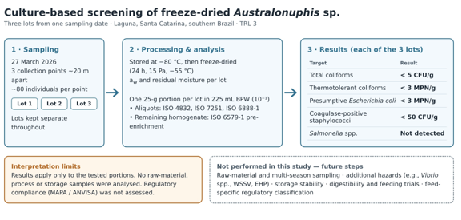
Los poliquetos han sido estudiados como ingredientes para la alimentación en acuicultura debido a sus características nutricionales, especialmente para las dietas de reproductores de especies de peces y camarones de importancia comercial. Sin embargo, el uso de poliquetos provenientes de América Latina como recursos alimenticios para la acuicultura industrial sigue estando poco documentado, y los datos microbiológicos constituyen un requisito esencial para el desarrollo de nuevos ingredientes para este sector. Por ello, en este estudio se analizaron tres lotes de Australonuphis sp. liofilizados por separado y recolectados en una misma fecha en el sur de Brasil, en búsqueda de indicadores bacterianos específicos, empleando métodos basados en cultivo conforme a las normas ISO. De cada lote, se tomó una muestra de 25 g, la cual se homogeneizó en agua peptonada tamponada. A partir de esta suspensión inicial, se realizaron recuentos de coliformes totales, coliformes termotolerantes, Escherichia coli presuntiva y estafilococos coagulasa-positivos. El resto del homogeneizado se sometió a un pre-enriquecimiento para la detección de Salmonella spp. En las muestras analizadas, no se detectaron los microorganismos objetivo por encima de los límites de detección o de informe establecidos por los métodos correspondientes. En los tres lotes, los coliformes totales se situaron por debajo de 5 UFC g-1; los coliformes termotolerantes y E. coli presuntiva por debajo de 3 NMP g-1; los estafilococos coagulasa-positivos, por debajo de 50 UFC g-1; y no se detectó Salmonella spp. Estos hallazgos proporcionan datos microbiológicos de referencia preliminares exclusivamente para los lotes analizados de Australonuphis sp. liofilizado. Los resultados no deben interpretarse como una prueba de cumplimiento de la normativa sobre alimentación animal, ya que los requisitos aplicables, establecidos por el MAPA, dependen de la clasificación reglamentaria y del uso previsto del material. Serán necesarios estudios adicionales que incluyan muestreos de la materia prima en distintas estaciones, parámetros de seguridad complementarios, análisis de estabilidad durante el almacenamiento, estudios de digestibilidad y ensayos de alimentación, junto con una evaluación normativa formal específica para el uso como alimento, a fin de determinar su idoneidad para futuras aplicaciones en acuicultura.
Descargas
Referencias
Ahmed N, Thompson S. 2019. The blue dimensions of aquaculture: a global synthesis. Sci Total Environ. 652: 851-861. DOI: https://doi.org/10.1016/j.scitotenv.2018.10.163
Akbaş Y, Gümüş E, Koçer MAT, Kurtoğlu A, Aydın I, Aktaş Ö, Pak F, Sevgili H. 2026. Impact of partial replacement of fish meal with polychaete meal (Hediste diversicolor) on growth, nutrient digestibility, fatty acid profiles, and fish-in:fish-out ratio in diets of European seabass, Dicentrarchus labrax. Fish Physiol Biochem. 52 (20). DOI: https://doi.org/10.1007/s10695-026-01634-y
Ang CY, Yong ASK, Azad SA, Lim LS, Zuldin WH, Lal MTM. 2021. Valorization of macroalgae through fermentation for aquafeed production: a review. Fermentation. 7 (4): 304. DOI: https://doi.org/10.3390/fermentation7040304
Aragão C, Gonçalves AT, Costas B, Azeredo R, Xavier MJ, Engrola S. 2022. Alternative proteins for fish diets: implications beyond growth. Animals. 12 (9): 1211. DOI: https://doi.org/10.3390/ani12091211
Argudín MÁ, Mendoza MC, Rodicio MR. 2010. Food poisoning and Staphylococcus aureus enterotoxins. Toxins. 2 (7): 1751-1773. DOI: https://doi.org/10.3390/toxins2071751
Bagordo F, Brigida S, Grassi T, Caputo MC, Apollonio F, De Carlo L, Savino AF, Triggiano F, Turturro AC, De Donno A, et al. 2024. Factors influencing microbial contamination of groundwater: a systematic review of field-scale studies. Microorganisms. 12 (5): 913. DOI: https://doi.org/10.3390/microorganisms12050913
Balqadi AA, Al-Gahwari YA, Ali HP, Awdha AF, Bakr HS, Bin Frijan SA. 2025. Effects of the partial replacing of fish meal with marine polychaetes (Nereis sp.) on the nutritional value of Macrobrachium rosenbergii shrimp. Asian J Biol Sci. 18 (2): 418-422. DOI: https://doi.org/10.3923/ajbs.2025.418.422
Carrera-Parra LF. 2021. Onuphidae Kinberg, 1865. In: De León-González JÁ, Bastida-Zavala JR, Carrera-Parra LF, García-Garza ME, Salazar-Vallejo SI, Solís-Weiss V, Tovar-Hernández MA, editors. Anélidos marinos de México y América tropical. Monterrey: Universidad Autónoma de Nuevo León. p. 513-531.
Cao W, Passot S, Irlinger F, Fonseca F. 2024. Investigation of freezing and freeze-drying for preserving and re-using a whole microbial cheese community. Foods. 13 (12): 1809. DOI: https://doi.org/10.3390/foods13121809
Chen F, Leng Y, Lu Q, Zhou W. 2021. The application of microalgae biomass and bio-products as aquafeed for aquaculture. Algal Res. 60: 102541. DOI: https://doi.org/10.1016/j.algal.2021.102541
Foster-Nyarko E, Pallen MJ. 2022. The microbial ecology of Escherichia coli in the vertebrate gut. FEMS Microbiol Rev. 46 (2): fuac008. DOI: https://doi.org/10.1093/femsre/fuac008
Glencross BD, Huyben D, Schrama JW. 2020. The application of single-cell ingredients in aquaculture feeds-a review. Fishes. 5 (3): 22. DOI: https://doi.org/10.3390/fishes5030022
González-Machado C, Alonso-Calleja C, Capita R. 2024. Prevalence and types of methicillin-resistant Staphylococcus aureus (MRSA) in meat and meat products from retail outlets and in samples of animal origin collected in farms, slaughterhouses and meat processing facilities: a review. Food Microbiology. 123: 104580. DOI: https://doi.org/10.1016/j.fm.2024.104580
Hammad AM, Eltahan A, Hassan HA, Abbas NH, Hussien H, Shimamoto T. 2022. Loads of coliforms and fecal coliforms and characterization of thermotolerant Escherichia coli in fresh raw milk cheese. Foods. 11 (3): 332. DOI: https://doi.org/10.3390/foods11030332
Herrera-Perez M. 2026. Carnadas empleadas en la pesca deportiva en el Perú. Biotempo. 23 (1): 55-62. DOI: https://doi.org/10.31381/biotempo.v1i23.8466
Herrera-Perez M, Ferrando A. 2026. Polychaetes aquaculture: global successes and opportunities for development in Latin America. Aquacult Fish Fish. 6 (2): e70208. DOI: https://doi.org/10.1002/aff2.70208
Hussain SM, Bano AA, Ali S, Rizwan M, Adrees M, Zahoor AF, Sarker PK, Hussain M, Arsalan MZU, Yong JWH, Naeem A. 2024. Substitution of fishmeal: Highlights of potential plant protein sources for aquaculture sustainability. Heliyon. 10 (4): e26573. DOI: https://doi.org/10.1016/j.heliyon.2024.e26573
[ICMSF] International Commission on Microbiological Specifications for Foods. 2018. Microorganisms in foods 7: microbiological testing in food safety management. 2nd ed. Cham: Springer. 479 p. DOI: https://doi.org/10.1007/978-3-319-68460-4
[ISO] International Organization for Standardization. 2005. ISO 7251:2005. Microbiology of food and animal feeding stuffs - horizontal method for the detection and enumeration of presumptive Escherichia coli - most probable number technique. Geneva: ISO. Amendment 1:2023 (ISO 7251:2005/Amd 1:2023). Inclusion of performance testing of culture media and reagents.
[ISO] International Organization for Standardization. 2006a. ISO 4832:2006. Microbiology of food and animal feeding stuffs - horizontal method for the enumeration of coliforms - colony-count technique. Geneva: ISO.
[ISO] International Organization for Standardization. 2006b. ISO 4831:2006. Microbiology of food and animal feeding stuffs - horizontal method for the detection and enumeration of coliforms - most probable number technique. Geneva: ISO.
[ISO] International Organization for Standardization. 2017. ISO 6579-1:2017. Microbiology of the food chain - horizontal method for the detection, enumeration and serotyping of Salmonella. Part 1: detection of Salmonella spp. Geneva: ISO. Amendment 1:2020 (ISO 6579-1:2017/Amd 1:2020). Broader range of incubation temperatures, amendment to the status of Annex D, and correction of the composition of MSRV and SC.
[ISO] International Organization for Standardization. 2021. ISO 6888-1:2021. Microbiology of the food chain - horizontal method for the enumeration of coagulase-positive staphylococci (Staphylococcus aureus and other species). Part 1: method using Baird-Parker agar medium. Geneva: ISO.
Lana PC. 1991. Onuphidae (Annelida: Polychaeta) from southeastern Brazil. Bull Mar Sci. 48 (2): 280-295.
Lee K, Koyama K, Kawai K, Koseki S. 2021. Why does Cronobacter sakazakii survive for a long time in dry environments? Contribution of the glass transition of dried bacterial cells. Microbiol Spectrum. 9 (3). DOI: https://doi.org/10.1128/spectrum.01384-21
Léguillier V, Pinamonti D, Chang CM, Mukherjee G, Himanshu, Cossetini A, Manzano M, Anba-Mondoloni J, Malet-Villemagne J, Vidic J. 2024. A review and meta-analysis of Staphylococcus aureus prevalence in foods. Microbe. 4: 100131. DOI: https://doi.org/10.1016/j.microb.2024.100131
Li Q, Dou L, Zhang Y, Luo L, Yang H, Wen K, Yu X, Shen J, Wang Z. 2024. A comprehensive review on the detection of Staphylococcus aureus enterotoxins in food samples. Compr Rev Food Sci Food Saf. 23: e13264. DOI: https://doi.org/10.1111/1541-4337.13264
Liu S, Roopesh MS, Tang J, Wu Q, Qin W. 2022. Recent development in low-moisture foods: Microbial safety and thermal process. Food Res Int. 155: 111072. DOI: https://doi.org/10.1016/j.foodres.2022.111072
Lupatsch I. 2014. Assessing the potential of polychaete meal in shrimp feeds. International Aquafeed. May-June. p. 10-12.
Ma J, Dai J, Cao C, Su L, Cao M, He Y, Li M, Zhang Z, Chen J, Cui S, Yang B. 2024. Prevalence, serotype, antimicrobial susceptibility, contamination factors, and control methods of Salmonella spp. in retail fresh fruits and vegetables: a systematic review and meta-analysis. Compr Rev Food Sci Food Saf. 23 (4): e13407. DOI: https://doi.org/10.1111/1541-4337.13407
Mahulette F. 2020. Traditionally catching and processing of Laor in Moluccas Islands. Local Wisdom. 12 (2): 99-110. DOI: https://doi.org/10.26905/lw.v12i2.4078
Majowicz SE, Musto J, Scallan E, Angulo FJ, Kirk M, O’Brien SJ, Jones TF, Fazil A, Hoekstra RM. 2010. The global burden of nontyphoidal Salmonella gastroenteritis. Clin Infect Dis. 50 (6): 882-889. DOI: https://doi.org/10.1086/650733
Martin NH, Evanowski RL, Wiedmann M. 2023. Invited review: Redefining raw milk quality-evaluation of raw milk microbiological parameters to ensure high-quality processed dairy products. J Dairy Sci. 106 (3): 1502-1517. DOI: https://doi.org/10.3168/jds.2022-22416
Martins C, Rodrigo AP, Cabrita L, Leal MC, Pinteus S, Alves C, Gaspar H, Pedrosa R. 2019. The complexity of porphyrin-like pigments in a marine annelid sheds new light on haem metabolism in aquatic invertebrates. Sci Rep. 9: 12930. DOI: https://doi.org/10.1038/s41598-019-49433-1
Milana M, van Asselt ED, van der Fels-Klerx HJ. 2024. The chemical and microbiological safety of emerging alternative protein sources and derived analogues: a review. Compr Rev Food Sci Food Saf. 23: e13377. DOI: https://doi.org/10.1111/1541-4337.13377
Monteiro M, Rimoldi S, Costa RS, Kousoulaki K, Hasan I, Valente LMP, Terova G. 2023. Polychaete (Alitta virens) meal inclusion as a dietary strategy for modulating gut microbiota of European seabass (Dicentrarchus labrax). Front Immunol. 14: 1266947. DOI: https://doi.org/10.3389/fimmu.2023.1266947
Morasi RM, Rall VLM, Dantas STA, Alonso VPPP, Silva NCCC. 2022. Salmonella spp. in low water activity food: occurrence, survival mechanisms, and thermoresistance. J Food Scie. 87 (6): 2310-2323. DOI: https://doi.org/10.1111/1750-3841.16152
Muli BM, Kihia C, Fulanda BM, Munguti J, Muthumbi A. 2016. Effects of polychaete-based diets on growth and survival of tiger shrimp juveniles. Fifth Reforum Working Document Series. 14 (2): 907-911.
Ndraha N, Lin HY, Hsiao HI, Lin HJ. 2024. Managing the microbiological safety of tilapia from farm to consumer. Compr Rev Food Sci Food Saf. 23 (5): e70023. DOI: https://doi.org/10.1111/1541-4337.70023
Rana YS, Chen L, Jiao Y, Johnson LM, Snyder AB. 2024. A meta-analysis of microbial thermal inactivation in low moisture foods. Food Microbiol. 121: 104515. DOI: https://doi.org/10.1016/j.fm.2024.104515
Rosario AILSS, Castro VS, Santos LF, Lisboa RC, Vallim DC, Silva MCA, Figueiredo EES, Conte-Junior CA, Costa MP. 2021. Shiga toxin-producing Escherichia coli isolated from pasteurized dairy products from Bahia, Brazil. J Dairy Sci. 104 (6): 6535-6547. DOI: https://doi.org/10.3168/jds.2020-19511
Serra V, Pastorelli G, Tedesco DEA, Turin L, Guerrini A. 2024. Alternative protein sources in aquafeed: current scenario and future perspectives. Vet Anim Sci. 25: 100381. DOI: https://doi.org/10.1016/j.vas.2024.100381
Silva JN, Baliza MD, Freitas F, Cruz ES, Camilo VMA, Silva IMM. 2021. Genotypical characterization of thermotolerant coliforms isolated from food produced by a solidarity economic venture of Bahia (Brazil). Braz J Bioly. 81 (1): 189-194. DOI: https://doi.org/10.1590/1519-6984.226833
Snyder AB, Martin N, Wiedmann M. 2024. Microbial food spoilage: impact, causative agents and control strategies. Nat Rev Microbiol. 22: 528-542. DOI: https://doi.org/10.1038/s41579-024-01037-x
Uwineza A, Zhang X. 2026. Application of freeze-drying technology in the food industry: a review. Foods. 15 (4): 790. DOI: https://doi.org/10.3390/foods15040790
[WHO] World Health Organization. 2015. WHO estimates of the global burden of foodborne diseases: foodborne disease burden epidemiology reference group 2007-2015. Geneva: WHO. https://apps.who.int/iris/handle/10665/199350.
[WOAH] World Organisation for Animal Health. 2024. Terrestrial animal health code. The control of hazards of animal health and public health importance in animal feed. Paris: WOAH.
Xing L, Cheng M, Wang S, Jiang J, Li T, Zhang X, Yang J, Tian Y, Liu W. 2025. Methicillin-resistant Staphylococcus aureus contamination in meat and meat products: a systematic review and meta-analysis. Front Microbiol. 16: 1636622. DOI: https://doi.org/10.3389/fmicb.2025.1636622
Zaffalon GB, Decol CM, Santos EP, Almeida Filho ES. 2025. Avaliação da qualidade microbiológica e físico-química do leite cru comercializado informalmente por rede social. Cienc Anim Bras. 26: e82514P. DOI: https://doi.org/10.1590/1809-6891v26e-82514P
Descargas
Publicado
Número
Sección
Licencia
Derechos de autor 2026 Melissa Herrera-Perez, Helenice Gonzalez de Lima, Natacha Deboni Cereser, Patricia da Silva Nascente, Camila dos Santos Cardozo, Ivan De Marco, Cesar Valmor Rombaldi

Esta obra está bajo una licencia internacional Creative Commons Atribución-NoComercial-CompartirIgual 4.0.
Los autores de los artículos publicados en Marine and Fishery Sciences conservan los derechos de autor de sus artículos, a excepción de las imágenes de terceros y otros materiales añadidos por Marine and Fishery Sciences, que están sujetos a los derechos de autor de sus respectivos propietarios. Por lo tanto, los autores son libres de difundir y volver a publicar sus artículos, sujeto a los requisitos de los propietarios de derechos de autor de terceros y sujeto a que la publicación original sea completamente citada. Los visitantes también pueden descargar y reenviar artículos sujetos a los requisitos de citas. La capacidad de copiar, descargar, reenviar o distribuir cualquier material siempre está sujeta a los avisos de derechos de autor que se muestran. Los avisos de copyright deben mostrarse de manera prominente y no pueden borrarse, eliminarse u ocultarse, total o parcialmente. El autoalmacenamiento en servidores y repositorios de preimpresión está permitido para todas las versiones.
Esta revista ofrece a los autores una política de acceso abierto. Los usuarios pueden leer, descargar, copiar, distribuir, imprimir, buscar o vincular los textos completos de los artículos, o usarlos para cualquier otro propósito legal dentro de la licencia Creative Commons 4.0 (BY-NC-SA), sin solicitar permiso previo del editor o del autor. Esto está de acuerdo con la definición BOAI de acceso abierto.