Length-weight relationships and mitochondrial COI variation of orange mud crab (Scylla olivacea) across four mangrove localities in Peninsular Malaysia
DOI:
https://doi.org/10.47193/mafis.4012027010105Keywords:
Mud crab fisheries, body-size allometry, mitochondrial haplotypes, fisheries genetics, mangrove crabAbstract
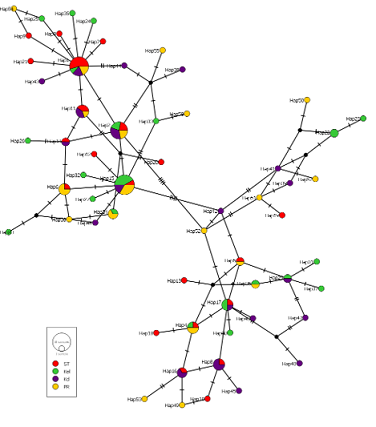
Understanding variation in body-size allometry and genetic diversity of the orange mud crab, Scylla olivacea, is important for effective fisheries management and conservation. This study evaluated length-weight relationships (LWRs) and mitochondrial cytochrome c oxidase subunit I (COI) genetic diversity among S. olivacea samples collected once from four mangrove ecosystems (four localities; 28 individuals from each locality) along the east and west coasts of Peninsular Malaysia. Carapace width and body weight data were analyzed to characterize locality-specific growth patterns, while mitochondrial (COI) sequences were used to assess the genetic diversity and population genetic structure. The allometric exponent (b) of the LWRs varied among sampling localities, ranging within 2.160-3.694, with coefficients of determination (R2) between 0.809 and 0.971. Analysis of 112 mitochondrial COI sequences revealed 58 haplotypes, with high haplotype diversity (Hd = 0.955-0.973) and relatively low nucleotide diversity (π = 0.009-0.011). Analysis of molecular variance indicated that most genetic variation was distributed within sampling localities (97.66%), while only 2.34% occurred among sampling locations. The low and non-significant fixation index (FST = 0.023, P = 0.079) suggested weak genetic differentiation based on the mitochondrial marker examined. These findings indicate that spatial variation in growth patterns occurs alongside limited mitochondrial differentiation among sampled localities; however, the observed phenotypic variation cannot be directly attributed to genetic differences without additional environmental and genomic analyses. The findings provide a descriptive baseline for the four sampled locality-dates.
Downloads
References
Avise JC. 2000. Phylogeography: the history and formation of species. Harvard University Press.
Bouckaert R, Vaughan TG, Barido-Sottani J, Duchêne S, Fourment M, Gavryushkina A, Heled J, Jones G, Kühnert D, De Maio N. 2019. Beast 2.5: an advanced software platform for Bayesian evolutionary analysis. PLoS Comput Biol. 15 (4): e1006650.
Excoffier L, Lischer HE. 2010. Arlequin suite ver 3.5: a new series of programs to perform population genetics analyses under Linux and Windows. Mol Ecol Resour. 10 (3): 564-567.
Excoffier L, Smouse PE, Quattro JM. 1992. Analysis of molecular variance inferred from metric distances among DNA haplotypes: application to human mitochondrial DNA restriction data. Genetics. 131 (2): 479-491.
Fazhan H, Azra MN, Halim SA, Naimullah M, Abualreesh MH, Shu-Chien AC, Wang Y, Fujaya Y, Syahnon M, Ma H. 2022. Species composition, abundance, size distribution, sex ratios, and movement of scylla mud crabs within the mangrove ecosystem at Setiu Wetland, Terengganu, Malaysia. Front Mar Sci. 9: 899789.
Fazhan H, Waiho K, Fujaya Y, Rukminasari N, Ma H, Ikhwanuddin M. 2021. Sexual dimorphism in mud crabs: a tale of three sympatric Scylla species. PeerJ. 9: e10936.
Felsenstein J. 1985. Confidence limits on phylogenies: an approach using the bootstrap. Evolution. 39 (4): 783-791.
Frankham R, Ballou JD, Briscoe DA. 2010. Introduction to conservation genetics. Cambridge University Press.
Froese R. 2006. Cube law, condition factor and weight-length relationships: history, meta‐analysis and recommendations. J Appl Ichthyol. 22 (4): 241-253.
Fu YX. 1997. Statistical tests of neutrality of mutations against population growth, hitchhiking and background selection. Genetics. 147 (2): 915-925.
Grant W, Bowen BW. 1998. Shallow population histories in deep evolutionary lineages of marine fishes: insights from sardines and anchovies and lessons for conservation. J Hered. 89 (5): 415-426.
Habib K, Akter S, Islam M, Sarkar S, Brishti P, Billah M, Hannan M. 2022. Genetic diversity, population structure and demographic history of orange mud crab Scylla olivacea from the bay of Bengal, Bangladesh and adjacent seas in the northern Indian ocean based on mitochondrial COI gene sequences. J Sci Technol Res. 4 (1): 101-118.
Islam MK, Rahman MM, Rahman MH, Shuchi ZJ, Nahar MS, Hasan MZ, Bari E, Islam MS. 2024. Stock assessment of the mud crab (Scylla olivacea) collected from the terrestrial edge of the sundarbans mangrove forest, Bangladesh. Heliyon. 10 (20): e39469. DOI: https://doi.org/10.1016/j.heliyon.2024.e39469
Keenan C, Davie PJ, Mann DL. 2022. A revision of the genus Scylla de Haan, 1833 (Crustacea: Decapoda: Brachyura: Portunidae). Raffles Bull Zool. 46: 217-245.
Keenan CP. 1999. The fourth species of Scylla. In ACIAR Proceedings of the Australian Centre For International Agricultural. p. 48-58.
Kumar S, Stecher G, Suleski M, Sanderford M, Sharma S, Tamura K. 2024. MEGA12: molecular evolutionary genetic analysis version 12 for adaptive and green computing. Mol Biol Evol. 41 (12): 1-9. DOI: https://doi.org/10.1093/molbev/msae263
Leigh JW, Bryant D, Nakagawa S. 2015. Popart: Full-feature software for haplotype network construction. Methods Ecol Evol. 6 (9): 1110.
Luu Q, Tkalich P, Tay T. 2015. Sea level trend and variability around peninsular Malaysia. Ocean Sci. 11 (4): 617-628.
Meirmans PG, Hedrick P. 2011. Assessing population structure. Mol Ecol Res. 11 (1): 5-18.
Mendiola MJR, Ravago‐Gotanco R. 2021. Genetic differentiation and signatures of local adaptation revealed by radseq for a highly dispersive mud crab Scylla olivacea (Herbst, 1796) in the Sulu Sea. Ecol Evol. 11 (12): 7951-7969.
Naim DM, Nor SAM, Mahboob S. 2020. Reassessment of species distribution and occurrence of mud crab (Scylla spp., Portunidae) in Malaysia through morphological and molecular identification. Saudi J Biol Sci. 27 (2): 643-652.
Rambaut A, Drummond AJ, Xie D, Baele G, Suchard MA. 2018. Posterior summarization in Bayesian phylogenetics using tracer 1.7. Syst Biol. 67 (5): 901-904.
Rogers AR, Harpending H. 1992. Population growth makes waves in the distribution of pairwise genetic differences. Mol Biol Evol. 9 (3): 552-569.
Rosly HA-AM, Nor SAM, Yahya K, Naim DM. 2013. Mitochondrial DNA diversity of mud crab Scylla olivacea (Portunidae) in Peninsular Malaysia: a preliminary assessment. Mol Biol Rep. 40 (11): 6407-6418.
Rozas J, Ferrer-Mata A, Sánchez-DelBarrio JC, Guirao-Rico S, Librado P, Ramos-Onsins SE, Sánchez-Gracia A. 2017. Dnasp 6: DNA sequence polymorphism analysis of large data sets. Mol Biol Evol. 34 (12): 3299-3302.
Schneider S, Excoffier L. 1999. Estimation of past demographic parameters from the distribution of pairwise differences when the mutation rates vary among sites: application to human mitochondrial DNA. Genetics. 152 (3): 1079-1089.
Tajima F. 1989. Statistical method for testing the neutral mutation hypothesis by DNA polymorphism. Genetics. 123 (3): 585-595.
Tamura K. 1992. Estimation of the number of nucleotide substitutions when there are strong transition-transversion and g+ c-content biases. Mol Biol Evol. 9 (4): 678-687.
von der Heyden S. 2023. Disentangling population structure in marine species. Nat Rev Genet. 24 (9): 589-589.
Waiho K, Fazhan H, Ikhwanuddin M. 2016. Size distribution, length-weight relationship and size at the onset of sexual maturity of the orange mud crab, Scylla olivacea, in Malaysian waters. Mar Biol Res. 12 (7): 726-738. DOI: https://doi.org/10.1080/17451000.2016.1200726
Waiho K, Fazhan H, Quiniti, ET, Baylon JC, Fujaya Y, Azmie G, Wu Q, Shi X, Ikhwanuddin M, Ma H. 2018. Larval rearing of mud crab (Scylla): What lies ahead. Aquaculture. 493: 37-50. DOI: https://doi.org/10.1016/j.aquaculture.2018.04.047
Wang W, Ma C, Chen W, Jin Z, Zhao M, Zhang F, Liu Z, Ma L. 2020. Population genetic diversity of mud crab (Scylla paramamosain) from southeast coastal regions of china based on mitochondrial COI gene sequence. Gene. 751: 144763.
Waples RS, Gaggiotti O. 2006. Invited review: What is a population? An empirical evaluation of some genetic methods for identifying the number of gene pools and their degree of connectivity. Mol Ecol. 15 (6): 1419-1439.
Published
Issue
Section
License
Copyright (c) 2026 Murak, Mohammad Ekramul Haque, Cher Chien Lau, Muhammad Sajjad Ahhmad, Mohammad Asmat-Ullah, Hanafiah Fazhan, Kuo-Wei Lan, Khor Waiho, Hongyu Ma, Mhd Ikhwanuddin

This work is licensed under a Creative Commons Attribution-NonCommercial-ShareAlike 4.0 International License.
Authors of articles published in Marine and Fishery Sciences retain copyright on their articles, except for any third-party images and other materials added by Marine and Fishery Sciences, which are subject to copyright of their respective owners. Authors are therefore free to disseminate and re-publish their articles, subject to any requirements of third-party copyright owners and subject to the original publication being fully cited. Visitors may also download and forward articles subject to the citation requirements. The ability to copy, download, forward or otherwise distribute any materials is always subject to any copyright notices displayed. Copyright notices must be displayed prominently and may not be obliterated, deleted or hidden, totally or partially.
This journal offers authors an Open Access policy. Users are allowed to read, download, copy, distribute, print, search, or link to the full texts of the articles, or use them for any other legal purpose within the Creative Commons 4.0 license (BY-NC-SA), without asking prior permission from the publisher or the author. This is in accordance with the BOAI definition of Open Access.