Relaciones talla-peso y variación del gen mitocondrial COI en el cangrejo naranja de fango (Scylla olivacea) en cuatro localidades de manglar de Malasia peninsular
DOI:
https://doi.org/10.47193/mafis.4012027010105Palabras clave:
Pesquerías de cangrejo de fango, alometría del tamaño corporal, haplotipos mitocondriales, genética pesquera, cangrejo de manglarResumen
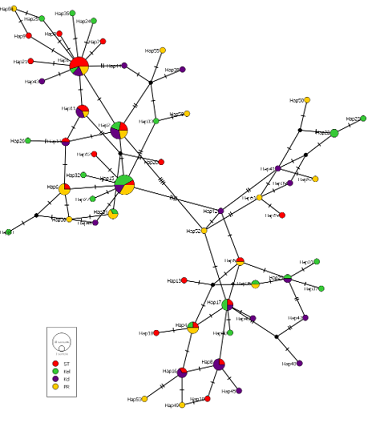
Comprender la variación en la alometría del tamaño corporal y la diversidad genética del cangrejo de fango naranja (Scylla olivacea) es importante para una gestión pesquera y una conservación eficaces. Este estudio evaluó las relaciones longitud-peso (RLP) y la diversidad genética de la subunidad I del citocromo c oxidasa mitocondrial (COI) en muestras de S. olivacea recolectadas en una única ocasión en cuatro ecosistemas de manglar (cuatro localidades; 28 individuos por localidad) a lo largo de las costas Este y Oeste de Malasia peninsular. Se analizaron datos de anchura del caparazón y peso corporal para caracterizar los patrones de crecimiento específicos de cada localidad, mientras que se utilizaron secuencias mitocondriales (COI) para evaluar la diversidad y la estructura genéticas poblacional. El exponente alométrico (b) de las RLP varió entre las localidades de muestreo, oscilando entre 2,160 y 3,694, con coeficientes de determinación (R2) de entre 0,809 y 0,971. El análisis de 112 secuencias mitocondriales COI reveló 58 haplotipos con una alta diversidad haplotípica (Hd = 0,955-0,973) y una diversidad nucleotídica relativamente baja (π = 0,009-0,011). El análisis de varianza molecular indicó que la mayor parte de la variación genética se distribuyó dentro de las localidades de muestreo (97,66%), mientras que solo el 2,34% se produjo entre las localidades. El índice de fijación bajo y no significativo (FST = 0,023; P = 0,079) sugirió una débil diferenciación genética basada en el marcador mitocondrial examinado. Estos resultados indican que existe una variación espacial en los patrones de crecimiento acompañada de una diferenciación mitocondrial limitada entre las localidades muestreadas; sin embargo, la variación fenotípica observada no puede atribuirse directamente a diferencias genéticas sin análisis ambientales y genómicos adicionales. Los hallazgos proporcionan una línea base descriptiva para las cuatro localidades y fechas de muestreo.
Descargas
Referencias
Avise JC. 2000. Phylogeography: the history and formation of species. Harvard University Press.
Bouckaert R, Vaughan TG, Barido-Sottani J, Duchêne S, Fourment M, Gavryushkina A, Heled J, Jones G, Kühnert D, De Maio N. 2019. Beast 2.5: an advanced software platform for Bayesian evolutionary analysis. PLoS Comput Biol. 15 (4): e1006650.
Excoffier L, Lischer HE. 2010. Arlequin suite ver 3.5: a new series of programs to perform population genetics analyses under Linux and Windows. Mol Ecol Resour. 10 (3): 564-567.
Excoffier L, Smouse PE, Quattro JM. 1992. Analysis of molecular variance inferred from metric distances among DNA haplotypes: application to human mitochondrial DNA restriction data. Genetics. 131 (2): 479-491.
Fazhan H, Azra MN, Halim SA, Naimullah M, Abualreesh MH, Shu-Chien AC, Wang Y, Fujaya Y, Syahnon M, Ma H. 2022. Species composition, abundance, size distribution, sex ratios, and movement of scylla mud crabs within the mangrove ecosystem at Setiu Wetland, Terengganu, Malaysia. Front Mar Sci. 9: 899789.
Fazhan H, Waiho K, Fujaya Y, Rukminasari N, Ma H, Ikhwanuddin M. 2021. Sexual dimorphism in mud crabs: a tale of three sympatric Scylla species. PeerJ. 9: e10936.
Felsenstein J. 1985. Confidence limits on phylogenies: an approach using the bootstrap. Evolution. 39 (4): 783-791.
Frankham R, Ballou JD, Briscoe DA. 2010. Introduction to conservation genetics. Cambridge University Press.
Froese R. 2006. Cube law, condition factor and weight-length relationships: history, meta‐analysis and recommendations. J Appl Ichthyol. 22 (4): 241-253.
Fu YX. 1997. Statistical tests of neutrality of mutations against population growth, hitchhiking and background selection. Genetics. 147 (2): 915-925.
Grant W, Bowen BW. 1998. Shallow population histories in deep evolutionary lineages of marine fishes: insights from sardines and anchovies and lessons for conservation. J Hered. 89 (5): 415-426.
Habib K, Akter S, Islam M, Sarkar S, Brishti P, Billah M, Hannan M. 2022. Genetic diversity, population structure and demographic history of orange mud crab Scylla olivacea from the bay of Bengal, Bangladesh and adjacent seas in the northern Indian ocean based on mitochondrial COI gene sequences. J Sci Technol Res. 4 (1): 101-118.
Islam MK, Rahman MM, Rahman MH, Shuchi ZJ, Nahar MS, Hasan MZ, Bari E, Islam MS. 2024. Stock assessment of the mud crab (Scylla olivacea) collected from the terrestrial edge of the sundarbans mangrove forest, Bangladesh. Heliyon. 10 (20): e39469. DOI: https://doi.org/10.1016/j.heliyon.2024.e39469
Keenan C, Davie PJ, Mann DL. 2022. A revision of the genus Scylla de Haan, 1833 (Crustacea: Decapoda: Brachyura: Portunidae). Raffles Bull Zool. 46: 217-245.
Keenan CP. 1999. The fourth species of Scylla. In ACIAR Proceedings of the Australian Centre For International Agricultural. p. 48-58.
Kumar S, Stecher G, Suleski M, Sanderford M, Sharma S, Tamura K. 2024. MEGA12: molecular evolutionary genetic analysis version 12 for adaptive and green computing. Mol Biol Evol. 41 (12): 1-9. DOI: https://doi.org/10.1093/molbev/msae263
Leigh JW, Bryant D, Nakagawa S. 2015. Popart: Full-feature software for haplotype network construction. Methods Ecol Evol. 6 (9): 1110.
Luu Q, Tkalich P, Tay T. 2015. Sea level trend and variability around peninsular Malaysia. Ocean Sci. 11 (4): 617-628.
Meirmans PG, Hedrick P. 2011. Assessing population structure. Mol Ecol Res. 11 (1): 5-18.
Mendiola MJR, Ravago‐Gotanco R. 2021. Genetic differentiation and signatures of local adaptation revealed by radseq for a highly dispersive mud crab Scylla olivacea (Herbst, 1796) in the Sulu Sea. Ecol Evol. 11 (12): 7951-7969.
Naim DM, Nor SAM, Mahboob S. 2020. Reassessment of species distribution and occurrence of mud crab (Scylla spp., Portunidae) in Malaysia through morphological and molecular identification. Saudi J Biol Sci. 27 (2): 643-652.
Rambaut A, Drummond AJ, Xie D, Baele G, Suchard MA. 2018. Posterior summarization in Bayesian phylogenetics using tracer 1.7. Syst Biol. 67 (5): 901-904.
Rogers AR, Harpending H. 1992. Population growth makes waves in the distribution of pairwise genetic differences. Mol Biol Evol. 9 (3): 552-569.
Rosly HA-AM, Nor SAM, Yahya K, Naim DM. 2013. Mitochondrial DNA diversity of mud crab Scylla olivacea (Portunidae) in Peninsular Malaysia: a preliminary assessment. Mol Biol Rep. 40 (11): 6407-6418.
Rozas J, Ferrer-Mata A, Sánchez-DelBarrio JC, Guirao-Rico S, Librado P, Ramos-Onsins SE, Sánchez-Gracia A. 2017. Dnasp 6: DNA sequence polymorphism analysis of large data sets. Mol Biol Evol. 34 (12): 3299-3302.
Schneider S, Excoffier L. 1999. Estimation of past demographic parameters from the distribution of pairwise differences when the mutation rates vary among sites: application to human mitochondrial DNA. Genetics. 152 (3): 1079-1089.
Tajima F. 1989. Statistical method for testing the neutral mutation hypothesis by DNA polymorphism. Genetics. 123 (3): 585-595.
Tamura K. 1992. Estimation of the number of nucleotide substitutions when there are strong transition-transversion and g+ c-content biases. Mol Biol Evol. 9 (4): 678-687.
von der Heyden S. 2023. Disentangling population structure in marine species. Nat Rev Genet. 24 (9): 589-589.
Waiho K, Fazhan H, Ikhwanuddin M. 2016. Size distribution, length-weight relationship and size at the onset of sexual maturity of the orange mud crab, Scylla olivacea, in Malaysian waters. Mar Biol Res. 12 (7): 726-738. DOI: https://doi.org/10.1080/17451000.2016.1200726
Waiho K, Fazhan H, Quiniti, ET, Baylon JC, Fujaya Y, Azmie G, Wu Q, Shi X, Ikhwanuddin M, Ma H. 2018. Larval rearing of mud crab (Scylla): What lies ahead. Aquaculture. 493: 37-50. DOI: https://doi.org/10.1016/j.aquaculture.2018.04.047
Wang W, Ma C, Chen W, Jin Z, Zhao M, Zhang F, Liu Z, Ma L. 2020. Population genetic diversity of mud crab (Scylla paramamosain) from southeast coastal regions of china based on mitochondrial COI gene sequence. Gene. 751: 144763.
Waples RS, Gaggiotti O. 2006. Invited review: What is a population? An empirical evaluation of some genetic methods for identifying the number of gene pools and their degree of connectivity. Mol Ecol. 15 (6): 1419-1439.
Descargas
Publicado
Número
Sección
Licencia
Derechos de autor 2026 Murak, Mohammad Ekramul Haque, Cher Chien Lau, Muhammad Sajjad Ahhmad, Mohammad Asmat-Ullah, Hanafiah Fazhan, Kuo-Wei Lan, Khor Waiho, Hongyu Ma, Mhd Ikhwanuddin

Esta obra está bajo una licencia internacional Creative Commons Atribución-NoComercial-CompartirIgual 4.0.
Los autores de los artículos publicados en Marine and Fishery Sciences conservan los derechos de autor de sus artículos, a excepción de las imágenes de terceros y otros materiales añadidos por Marine and Fishery Sciences, que están sujetos a los derechos de autor de sus respectivos propietarios. Por lo tanto, los autores son libres de difundir y volver a publicar sus artículos, sujeto a los requisitos de los propietarios de derechos de autor de terceros y sujeto a que la publicación original sea completamente citada. Los visitantes también pueden descargar y reenviar artículos sujetos a los requisitos de citas. La capacidad de copiar, descargar, reenviar o distribuir cualquier material siempre está sujeta a los avisos de derechos de autor que se muestran. Los avisos de copyright deben mostrarse de manera prominente y no pueden borrarse, eliminarse u ocultarse, total o parcialmente. El autoalmacenamiento en servidores y repositorios de preimpresión está permitido para todas las versiones.
Esta revista ofrece a los autores una política de acceso abierto. Los usuarios pueden leer, descargar, copiar, distribuir, imprimir, buscar o vincular los textos completos de los artículos, o usarlos para cualquier otro propósito legal dentro de la licencia Creative Commons 4.0 (BY-NC-SA), sin solicitar permiso previo del editor o del autor. Esto está de acuerdo con la definición BOAI de acceso abierto.