Effect of salinity on metabolism and growth in juvenile flounder Paralichthys adspersus
DOI:
https://doi.org/10.47193/mafis.3932026010705Keywords:
Marine aquaculture, osmoregulation, aerobic metabolism, flatfish, respirometryAbstract
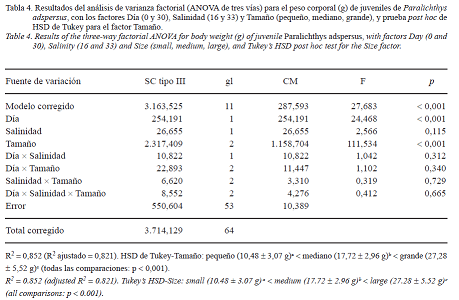
Salinity is a key environmental factor influencing osmoregulatory processes and energy metabolism in marine fish; however, in euryhaline species such as Paralichthys adspersus, the magnitude of these effects on metabolism and somatic growth during juvenile stages remains insufficiently understood. This energetic cost, essential for maintaining homeostasis, not only regulates metabolic rate but may also affect key biological functions such as growth, reproduction, and immune response. The effect of salinity (16 and 33) on aerobic metabolism and somatic growth was evaluated in juvenile P. adspersus, classified into three body size categories (small, medium, and large). Fish were cultured for 30 days under a 3 × 2 factorial design (size × salinity), and individual oxygen consumption (COI), specific oxygen consumption (CEO), weight gain (GP), specific growth rate (TCE), condition factor (K), and survival were assessed. The COI did not show significant differences between salinity levels (F1,10 = 0.844; p = 0.379), but increased significantly with body size (F2,10 = 6.906; p = 0.006). The CEO did not differ significantly as a function of salinity or size (p > 0.05), although a decreasing trend with increasing body mass was observed. Body weight was significantly influenced by culture time (p < 0.001) and size (F2,53 = 111.53; p < 0.001), while salinity had no significant effect (F1,53 = 2.566; p = 0.115). The GP and TCE showed no significant differences as a function of salinity or size (p > 0.05), although slightly higher values were observed at 16. The condition factor remained stable and survival reached 100% in all treatments. Overall, results indicate that the evaluated salinity does not significantly affect aerobic metabolism or somatic growth in juvenile P. adspersus, whereas body size represents the main determinant of individual metabolic rate and growth performance.
Downloads
References
Abdo-de la Parra MI, León-López MC, Rodríguez-Ibarra LE, Rodríguez-Montes de Oca GA, Velasco-Blanco G, Román-Reyes JC. 2016. Consumo de oxígeno del pargo flamenco Lutjanus guttatus (Perciformes: Lutjanidae) durante su cultivo larval. Rev Biol Mar Oceanogr. 51 (1): 51-59. DOI: https://doi.org/10.4067/S0718-19572016000100005
Abou Anni IS, Bianchini A, Barcarolli IF, Varela AS, Robaldo RB, Tesser MB, Sampaio LA. 2016. Salinity influence on growth, osmoregulation and energy turnover in juvenile pompano Trachinotus marginatus Cuvier 1832. Aquaculture. 455: 63-72. DOI: https://doi.org/10.1016/j.aquaculture.2016.01.010
Ackerman PA, Forsyth RB, Mazur CF, Iwama, GK. 2000. Stress hormones and the cellular stress response in salmonids. Fish Physiol Biochem. 23 (4): 327-336. DOI: https://doi.org/10.1023/A:1011107610971
Andrade de Pasquier G, Méndez Y, Perdomo DA. 2011. Engorde experimental de cachama (Colossoma macropomum) en la Estación Local El Lago, estado Zulia, Venezuela. Zootec Trop. 29 (2): 213-218. https://ve.scielo.org/scielo.php?script=sci_arttext&pid=S0798-72692011000200008.
Angeles B, Mendo J. 2005. Crecimiento, fecundidad y diferenciación sexual del lenguado Paralichthys adspersus (Steindachner) de la costa central del Perú. Ecol Appl. 4 (1-2): 105-112. DOI: https://doi.org/10.21704/rea.v4i1-2.304
Aristizabal EO. 2006. Consumo de oxígeno, crecimiento y utilización del alimento durante el desarrollo larval del besugo Pagrus pagrus (Linné, 1758) (Pisces: Sparidae). Rev Biol Mar Oceanogr. 41 (2): 209-220. DOI: https://doi.org/10.4067/S0718-19572006000200009
Arjona FJ, Vargas-Chacoff L, Ruiz-Jarabo I, Gonçalves O, Páscoa I, Martín del Río MP, Mancera JM. 2009. Tertiary stress responses in Senegalese sole (Solea senegalensis Kaup, 1858) to osmotic challenge: implications for osmoregulation, energy metabolism and growth. Aquaculture. 287 (3-4): 419-426. DOI: https://doi.org/10.1016/j.aquaculture.2008.10.047
Barreto-Curiel F, Durazo E, Viana MT. 2015. Crecimiento, excreción de amonio y consumo de oxígeno de la tilapia híbrida roja (Oreochromis mossambicus Oreochromis aureus) cultivada en agua de mar y en agua dulce. Cienc Mar. 41 (3): 247-254. DOI: https://doi.org/10.7773/cm.v41i3.2526
Bœuf G, Payan P. 2001. How should salinity influence fish growth? Comp Biochem Physiol C. 130 (4): 411-423. DOI: https://doi.org/10.1016/S1532-0456(01)00268-X
Blanco Garcia A, Partridge GJ, Flik G, Roques JAC, Abbink W. 2015. Ambient salinity and osmoregulation, energy metabolism and growth in juvenile yellowtail kingfish (Seriola lalandi Valenciennes 1833) in a recirculating aquaculture system. Aquac Res. 46 (11): 2789-2797. DOI: https://doi.org/10.1111/are.12433
Brett JR, Groves TDD. 2024. Physiological energetics. En: Randall DJ, Farrell AP, Brauner CJ, Eliason EJ, editores. Fish physiology. Vol. 40. Part B. The 50th anniversary issue of fish physiology: physiological applications. Academic Press. p. 603-676. DOI: https://doi.org/10.1016/bs.fp.2024.07.007
Calderer Reig A. 2001. Influencia de la temperatura y la salinidad sobre el consumo de oxígeno de la dorada (Sparus aurata L.) [tesis doctoral]. Barcelona: Universidad de Barcelona. https://hdl.handle.net/2445/35876.
Carrera L, Cota N, Montes M. 2013. Compendio metodológico para la reproducción de “lenguado” Paralichthys adspersus en cautiverio. Laboratorio de Cultivo de Peces Dirección General de Investigaciones en Acuicultura. Callao: Instituto del Mar del Perú. 60 p. https://hdl.handle.net/20.500.12958/2186.
Cerdà J, Manchado M. 2013. Advances in genomics for flatfish aquaculture. Genes Nutr. 8 (1): 5-17. DOI: https://doi.org/10.1007/s12263-012-0312-8
Cerezo J, García B. 2004. Influencia del peso y la temperatura sobre el consumo de oxígeno de rutina del Dentón común (Dentex dentex Linnaeus, 1758). AquaTIC. 21: 16-23. https://dialnet.unirioja.es/servlet/articulo?codigo=1065375.
Chen G, Wang Z, Wu Z, Gu B, Wang Z, Wang Z, Wu Z. 2009. Effects of salinity on growth and energy budget of juvenile cobia, Rachycentron canadum. J World Aquac Soc. 40 (3): 374-382. DOI: https://doi.org/10.1111/j.1749-7345.2009.00257.x
Cho SH, Sang-Mok L, Park BH, Sang-Min L. 2006. Effect of feeding ratio on growth and body composition of juvenile olive flounder Paralichthys olivaceus fed extruded pellets during the summer season. Aquaculture. 251 (1): 78-84. DOI: https://doi.org/10.1016/j.aquaculture.2005.05.041
Christensen EAF, Illing B, Iversen NS, Johansen JL, Domenici P, Steffensen JF. 2018. Effects of salinity on swimming performance and oxygen consumption rate of shiner perch Cymatogaster aggregata. J Exp Mar Biol Ecol. 504: 32-37. DOI: https://doi.org/10.1016/j.jembe.2018.04.002
Cifuentes R, González J, Montoya G, Jara A, Ortíz N, Piedra P, Habit E. 2012. Relación longitud-peso y factor de condición de los peces nativos del río San Pedro (cuenca del río Valdivia, Chile). Gayana Concepc. 76: 86-100. DOI: https://doi.org/10.4067/S0717-65382012000100009
De Almeida ÁJ, Sado RY, Cyrino JE. 2009. Growth and haematology of pacu, Piaractus mesopotamicus, fed diets with varying protein to energy ratio. Aquac Res. 40 (4): 486-495. DOI: https://doi.org/10.1111/j.1365-2109.2008.02120.x
De Ciechomski JD, Sánchez RP, Alespeiti G, Regidor H. 1986. Estudio sobre el crecimiento en peso y factor de condición en larvas de anchoíta, Engraulis anchoita Hubbs y Marini. Variaciones regionales, estacionales y anuales. Rev Invest Desarr Pesq. 5: 183-193. https://marabiertonew.inidep.edu.ar/server/api/core/bitstreams/36ec21bc-f4c7-4d28-9967-27123834c2fd/content.
Ern R, Esbaugh A. 2018. Effects of salinity and hypoxia-induced hyperventilation on oxygen consumption and cost of osmoregulation in the estuarine red drum (Sciaenops ocellatus). Comp Biochem Physiol A. 222: 52-59. DOI: https://doi.org/10.1016/j.cbpa.2018.04.013
Faulk CK, Holt GJ. 2006. Responses of cobia Rachycentron canadum larvae to abrupt or gradual changes in salinity. Aquaculture. 254 (1-4): 275-283. DOI: https://doi.org/10.1016/j.aquaculture.2005.10.046
Froese R. 2006. Cube law, condition factor and weight-length relationships: history, meta‐analysis and recommendations. J Appl Ichthyol. 22 (4): 241-253. DOI: https://doi.org/10.1111/j.1439-0426.2006.00805.x
Fry FEJ. 1971. The effect of environmental factors on the physiology of fish. En: Hoar WS, Randall DJ, editores. Fish physiology. Vol. 6. Environmental relations and behavior. Academic Press. p. 1-98. DOI: https://doi.org/10.1016/S1546-5098(08)60146-6
Gaumet F, Boeuf G, Severe A, Roux AL, Mayer‐Gostan N. 1995. Effects of salinity on the ionic balance and growth of juvenile turbot. J Fish Biol. 47 (5): 865-876. DOI: https://doi.org/10.1111/J.1095-8649.1995.TB06008.X
Gillikin DP, De Wachter B, Tack JF. 2004. Physiological responses of two ecologically important Kenyan mangrove crabs exposed to altered salinity regimes. J Exp Mar Biol Ecol. 301 (1): 93-109. DOI: https://doi.org/10.1016/j.jembe.2003.09.024
Jobling M. 1994. Fish bioenergetics. Chapman and Hall. https://agris.fao.org/search/en/providers/122535/records/65ddfdd34c5aef494fd832d1.
Kim KW, Wang XJ, Bai SC. 2002. Optimum dietary protein level for maximum growth of juvenile olive flounder Paralichthys olivaceus (Temminck et Schlegel). Aquac Res. 33 (9): 673-679. DOI: https://doi.org/10.1046/j.1365-2109.2002.00704.x
Laing I. 2002. Effect of salinity on growth and survival of king scallop spat (Pecten maximus). Aquaculture. 205 (1-2): 171-181. DOI: https://doi.org/10.1016/S0044-8486(01)00663-9
Laiz-Carrión R, Sangiao-Alvarellos S, Guzmán JM, Martín del Río MP, Soengas JL, Mancera JM. 2005. Growth performance of gilthead sea bream Sparus aurata in different osmotic conditions: implications for osmoregulation and energy metabolism. Aquaculture. 250 (3-4): 849-861. DOI: https://doi.org/10.1016/j.aquaculture.2005.05.021
Latorre E. 2017. Respuestas fisiológicas y bioenergéticas del pez payaso Amphiprion ocellaris (Cuvier, 1830), bajo condiciones óptimas de temperatura y salinidad [tesis de maestría]. Ensenada: Centro de Investigación Científica y de Educación Superior de Ensenada (CICESE). https://cicese.repositorioinstitucional.mx/jspui/bitstream/1007/1058/1/Tesis%20Rocio%20Latorre%20Pozos.pdf.
Leonardi M, Vera J, Tarifeño E, Puchi M, Morín V. 2010. Vitellogenin of the Chilean flounder Paralichthys adspersus as a biomarker of endocrine disruption along the marine coast of the South Pacific. Part I: induction, purification, and identification. Fish Physiol Biochem. 36 (3): 757-765. DOI: https://doi.org/10.1007/s10695-009-9350-6
Leyton S, Muñoz E, Gordillo M, Sánchez G, Muñoz L, Soto A. 2015. Estimación del factor de condición de Fulton (K) y la relación longitud-peso en tres especies ícticas presentes en un sector sometido a factores de estrés ambiental en la cuenca alta del río Cauca. Rev Asoc Col Cienc (Col.). 27: 24-31. https://revistaaccb.org/r/index.php/accb/article/view/99.
Lobo C, Tapia-Paniagua S, Moreno-Ventas X, Alarcón FJ, Rodríguez C, Balebona MC, Moriñigo MA, de La Banda IG. 2014. Benefits of probiotic administration on growth and performance along metamorphosis and weaning of Senegalese sole (Solea senegalensis). Aquaculture. 433:183-195. DOI: https://doi.org/10.1016/j.aquaculture.2014.06.011
Mendez KN, Zuloaga R, Valenzuela CA, Bastias-Molina M, Meneses C, Vizoso P, Valdés JA, Molina A. 2018. RNA-seq analysis of compensatory growth in the skeletal muscle of fine flounder (Paralichthys adspersus). Aquaculture. 490: 270-280. DOI: https://doi.org/10.1016/j.aquaculture.2018.02.048
Müller MI, Radonic M, López AV, Bambill GA. 2006. Crecimiento y rendimiento en carne del Lenguado Paralichthys orbignyanus (Valenciennes, 1839) cultivado en Argentina. CIVA. 4: 267-273. https://aquadocs.org/bitstreams/df5524e3-90cc-494f-9cb0-98db5a79e0fa/viewer?itemid=3091c0c0-02d1-476a-8434-537b6a44c859.
Nordlie FG. 2009. Environmental influences on regulation of blood plasma/serum components in teleost fishes: a review. Rev Fish Biol Fish. 19 (4): 481-564. DOI: https://doi.org/10.1007/s11160-009-9131-4
Orihuela L. 2015. Evaluación de tres microdietas en el destete de “lenguado” Paralichthys adspersus (Steindachner, 1867) Paralichthyidae, en condiciones de laboratorio [tesis de grado]. Lima: Universidad Nacional Federico Villarreal. 96 p. https://hdl.handle.net/20.500.12958/3059.
Partridge GJ, Jenkins GI. 2002. The effect of salinity on growth and survival of juvenile black bream (Acanthopagrus butcheri). Aquaculture. 210 (1): 219-230. DOI: https://doi.org/10.1016/S0044-8486(01)00817-1
Pérez J. 2010. Análisis del efecto de la salinidad constante sobre el consumo de oxígeno, excreción nitrogenada y la osmorregulación en Botete Diana (Sphoeroides annulatus, Jenyns 1842) [tesis de maestría]. Ensenada: Centro de Investigación Científica y de Educación Superior de Ensenada (CICESE). 53 p. https://cicese.repositorioinstitucional.mx/jspui/handle/1007/593.
Piaget N, Toledo P, Silva A, Veja A. 2011. Nivel óptimo de proteína dietaria para juveniles de lenguado Paralichthys adspersus (Pisces: Pleuronectiformes). Rev Biol Mar Oceanogr. 46 (1): 9-16. DOI: https://doi.org/10.4067/S0718-19572011000100002
Puente E. 2021. Efecto de diferentes densidades de cultivo en el crecimiento y comportamiento de juveniles de lenguado Paralichthys adspersus (Steindachner, 1867) bajo condiciones de laboratorio [tesis de grado]. Lima: Universidad Nacional Agraria La Molina. https://repositorio.lamolina.edu.pe/server/api/core/bitstreams/4b03dc5e-388b-4917-a4c4-d668431b186f/content.
Quintana CF. 2009. Células cloro en peces teleósteos. Rev Vet. 20 (1): 57-60. DOI: https://doi.org/10.30972/vet.2011885
Ricker WE. 1975. Computation and interpretation of biological statistics of fish populations. Bull Fish Res Bord Can. 191. 382 p. DOI: https://doi.org/10.2307/3800109
Rodríguez JL, Souto BF, Quintáns JM. 2005. Preengorde de lenguado senegalés Solea senegalensis Kaup, 1858 sometido a diferentes regímenes de alimentación. Bol Inst Esp Oceanogr. 21 (1-4): 89-93. https://dialnet.unirioja.es/servlet/articulo?codigo=2358988.
Ruiz‐Jarabo I, Herrera M, Hachero‐Cruzado I, Vargas‐Chacoff L, Mancera JM, Arjona FJ. 2014. Environmental salinity and osmoregulatory processes in cultured flatfish. Aquac Res. 46 (1): 10-29. DOI: https://doi.org/10.1111/are.12424
Salas-Leiton E, Anguís V, Rodríguez-Rúa A, Cañavate JP. 2010. Stocking homogeneous size groups does not improve growth performance of Senegalese sole (Solea senegalensis, Kaup 1858) juveniles: individual growth related to fish size. Aquac Eng. 43 (3): 108-113. DOI: https://doi.org/10.1016/j.aquaeng.2010.08.001
Salvato B, Cuomo V, Di Muro P, Beltramini M. 2001. Effects of environmental parameters on the oxygen consumption of four marine invertebrates: a comparative factorial study. Mar Biol. 138 (4): 659-668. DOI: https://doi.org/10.1007/s002270000501
Sampaio LA, Bianchini A. 2002. Salinity effects on osmoregulation and growth of the euryhaline flounder Paralichthys orbignyanus. J Exp Mar Biol Ecol. 269 (2): 187-196. DOI: https://doi.org/10.1016/S0022-0981(01)00395-1
Sánchez P, Ambrosio PP, Flos R. 2010. Stocking density and sex influence individual growth of Senegalese sole (Solea senegalensis). Aquaculture. 300 (1): 93-101. DOI: https://doi.org/10.1016/j.aquaculture.2009.12.013
Shi Y, Zhang G., Liu J, Zang W. 2010. Effects of temperature and salinity on oxygen consumption of tawny puffer Takifugu flavidus juvenile. Aquac Res. 42 (2): 301-307. DOI: https://doi.org/10.1111/j.1365-2109.2010.02638.x
Sielfeld W, Vargas M, Kong I. 2003. Primer registro de Etropus ectenes Jordan, 1889, Bothus constellatus Jordan y Goss, 1889, Achirus klunzingeri (Steindachner, 1880) y Symphurus elongatus (Günther, 1868) (Pisces, Pleuronectiformes) en Chile, con comentarios sobre la distribución de los lenguados chilenos. Investig Mar. 31 (1): 51-65. DOI: https://doi.org/10.4067/S0717-71782003000100006
Silva A. 2008. Advance in the culture research of small-eye flounder, Paralichthys microps, and Chilean flounder, P. adspersus, in Chile. J Appl Aquac. 11 (1-2): 147-164. DOI: https://doi.org/10.1300/J028v11n01_11
Silva A, Oliva M, Castelló F. 2001. Evaluación del crecimiento de juveniles de lenguado chileno (Paralichthys adspersus, Steindachner, 1867) cultivados en estanques. Biol Pesq. 29: 21-30. DOI: https://doi.org/10.21703/0067-8767.2001.29.2614
Stefánsson MÖ, Imsland AK, Jenssen MD, Jonassen TM, Stefansson SO, FitzGerald R. 2000. The effect of different initial size distributions on the growth of Atlantic halibut. J Fish Biol. 56 (4): 826-836. DOI: https://doi.org/10.1111/j.1095-8649.2000.tb00875.x
Strand HK, Oiestad V. 1997. Growth and the effect of grading, of turbot in a shallow raceway system. Aquac Int. 5 (5): 397-406. DOI: https://doi.org/10.1023/A:1018328626979
Tandler A, Anav FA, Choshniak I. 1995. The effect of salinity on growth rate, survival and swim bladder inflation in gilthead seabream, Sparus aurata, larvae. Aquaculture. 135 (4): 343-353. DOI: https://doi.org/10.1016/0044-8486(95)01029-7
Tomalá D, Chavarria J, Angeles B. 2014. Evaluación de la tasa de consumo de oxígeno de Colossoma macropomum en relación al peso corporal y temperatura del agua. Lat Am J Aquat Res. 42 (5): 971-979. DOI: https://doi.org/10.3856/vol42-issue5-fulltext-4
Torres Saldaña M, Huaranga Moreno F. 2017. Consumo de oxígeno y peso corporal en juveniles de Mugil cephalus “lisa” en condiciones de laboratorio. Sagasteguiana. 5 (2): 285-294. https://revistas.unitru.edu.pe/index.php/REVSAGAS/article/view/3100.
Tseng YC, Hwang PP. 2008. Some insights into energy metabolism for osmoregulation in fish. Comp Biochem Physiol C. 148 (4): 419-429. DOI: https://doi.org/10.1016/j.cbpc.2008.04.009
Valencia-Santana F, Valencia-Santana J. 2015. Relación longitud-peso y factor de condición de Echinometra vanbrunti (A. Agassiz 1863) en Acapulco, Guerrero, México. Rev Análisis Cuantitativo Estad. 2 (5): 402-407. https://www.ecorfan.org/bolivia/researchjournals/Analisis_Cuantitativo_y_Estadistico/vol2num5/Analisis_Cuantitativo_y_Estadistico_V2_N5-24-29.pdf.
Wu H, Liu J, Lu Z, Xu L, Ji C, Wang Q, Zhao J. 2017. Metabolite and gene expression responses in juvenile flounder Paralichthys olivaceus exposed to reduced salinities. Fish Shellfish Immunol. 63: 417-423. DOI: https://doi.org/10.1016/j.fsi.2017.02.042
Wurts WA, Durborow RM. 1992. Interactions of pH, carbon dioxide, alkalinity and hardness in fishponds. Southern Regional Aquaculture Center (SRAC). 464. 4 p. https://www.ncrac.org/files/inline-files/SRAC0464.pdf.
Zheng Z, Jin C, Li M, Bai P, Dong S. 2008. Effects of temperature and salinity on oxygen consumption and ammonia excretion of juvenile miiuy croaker, Miichthys miiuy (Basilewsky). Aquac Int. 16 (6): 581-589. DOI: https://doi.org/10.1007/s10499-008-9169-7
Downloads
Published
Issue
Section
License
Copyright (c) 2026 Andres V. Acuache-Villegas, Juan C. Francia-Quiroz

This work is licensed under a Creative Commons Attribution-NonCommercial-ShareAlike 4.0 International License.
Authors of articles published in Marine and Fishery Sciences retain copyright on their articles, except for any third-party images and other materials added by Marine and Fishery Sciences, which are subject to copyright of their respective owners. Authors are therefore free to disseminate and re-publish their articles, subject to any requirements of third-party copyright owners and subject to the original publication being fully cited. Visitors may also download and forward articles subject to the citation requirements. The ability to copy, download, forward or otherwise distribute any materials is always subject to any copyright notices displayed. Copyright notices must be displayed prominently and may not be obliterated, deleted or hidden, totally or partially.
This journal offers authors an Open Access policy. Users are allowed to read, download, copy, distribute, print, search, or link to the full texts of the articles, or use them for any other legal purpose within the Creative Commons 4.0 license (BY-NC-SA), without asking prior permission from the publisher or the author. This is in accordance with the BOAI definition of Open Access.