Closing the genomic gap: the need for coordinated fish genomics in Argentina
DOI:
https://doi.org/10.47193/mafis.3912026010111Keywords:
conservation genetics, aquaculture genomics, genetic diversity, fisheries, genomeAbstract
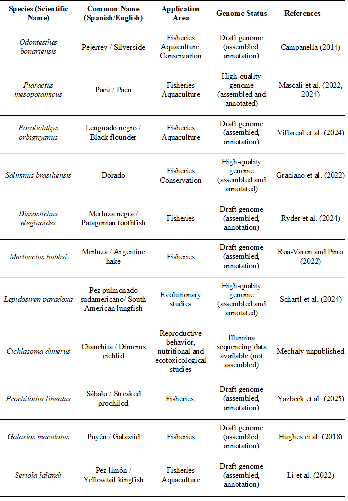
Fish genomics has become an essential tool to explore the genetic basis of biological processes, such as biodiversity, evolution, and adaptation, as well as for direct applications in conservation, aquaculture, and fisheries management. Argentina, home to more than 1,100 fish species and diverse aquatic ecosystems, holds enormous potential for genomic research. Although historically underrepresented in global databases, recent progress (including genome sequencing of commercially and ecologically important species) signals growing momentum in the field. This note provides an overview of the current state of fish genomics in Argentina, highlights notable contributions, and underscores the need for high-quality genome assemblies, national coordination, and broader taxonomic coverage to ensure that the country’s biodiversity is adequately represented and preserved.
Downloads
References
Bauni V, Bertonatti C, Giacchino A, Schivo F, Mabragaña E, Roesler I, Rosso JJ, Teta P, Williams JD, Abba AM, et al. 2022. Biodiversity of vertebrates in Argentina: patterns of richness, endemism and conservation status. ZooKeys. 1085: 101-127. DOI: https://doi.org/10.3897/zookeys.1085.76033
Bista I, McCarthy SA, Wood J, Ning Z, Detrich III HW, Desvignes T, Postlethwait J, Chow W, Howe K, Torrance J, et al. 2020. The genome sequence of the channel bull blenny, Cottoperca gobio (Günther, 1861). Wellcome Open Res. 5: 148. DOI: https://doi.org/10.12688/wellcomeopenres.16012.1
Campanella D. 2014. Evolutionary history and whole genome sequence of pejerrey (Odontesthes bonariensis): new insights into sex determination in fishes [PhD thesis]. Washington: The George Washington University. https://scholarspace.library.gwu.edu/etd/mp48sd085.
Cheng CHC, Rivera-Colón AG, Minhas BF, Wilson L, Rayamajhi N, Vargas-Chacoff L, Catchen JM. 2023. Chromosome-level genome assembly and circadian gene repertoire of the Patagonia blennie Eleginops maclovinus, the closest ancestral proxy of Antarctic Cryonotothenioids. Genes. 14: 1196. DOI: https://doi.org/10.3390/genes14061196
Fan G, Song Y, Yang L, Huang X, Zhang S, Zhang M, Yang X, Chang Y, Zhang H, Li Y, et al. 2020. Initial data release and announcement of the 10,000 Fish Genomes Project (Fish10K). Gigascience. 9 (8): 80. DOI: https://doi.org/10.1093/gigascience/giaa080
Fricke R, Eschmeyer WN, Van der Laan R, editors. 2025. Eschmeyer’s catalog of fishes: genera, species, references. http://researcharchive.calacademy.org/research/ichthyology/catalog/fishcatmain.asp.
Cardoso YP, Brancolini F, Paracampo AH, Lizarralde MS, Covain R, Montoya-Burgos JI. 2016. Hypostomus formosae, a new catfish species from the Paraguay river basin with redescription of H. boulengeri (Siluriformes: Loricariidae). Ichthyol Explor Freshw. 27: 9-23.
Cardoso YP, Brancolini F, Protogino L, Paracampo A, Bogan S, Posadas P, Montoya-Burgos JI. 2019. An integrated approach clarifies the cryptic diversity in Hypostomus Lacépède 1803 from the Lower La Plata Basin. An Acad Bras Cienc. 91 (2): e20180131. DOI: https://doi.org/10.1590/0001-3765201920180131
Graciano RCD, Oliveira RS, Santos IM, Yazbeck GM. 2022. Genomic resources for Salminus brasiliensis. Front Genet. 13: 855718. DOI: https://doi.org/10.3389/fgene.2022.855718
Hirt-Chabbert JA, Mechaly AS, Tapia C. 2024. Seafood in Argentina: marine fish species, seasonal occurrence and prices. Rev Fish Biol Fish. 34 (2): 753-774. DOI: https://doi.org/10.1007/s11160-024-09836-4
Hughes LC, Ortí G, Huang Y, Sun Y, Baldwin CC, Thompson AW, Arcila D, Betancur-R R, Li C, Becker L, et al. 2018. Comprehensive phylogeny of ray-finned fishes (Actinopterygii) based on transcriptomic and genomic data. Proc Natl Acad Sci USA. 115 (24): 6249-6254. DOI: https://doi.org/10.1073/pnas.1719358115
Li S, Liu K, Cui A, Hao X, Wang B, Wang H-Y, Jiang Y, Wang Q, Feng B, Xu Y, et al. 2022. Chromosome-level genome assembly of yellowtail kingfish (Seriola lalandi). Front Genet. 12: 825742. DOI: https://doi.org/10.3389/fgene.2021.825742
Lu G, Luo M. 2020. Genomes of major fishes in world fisheries and aquaculture: status, application and perspective. Aquac Fish. 5 (4): 163-173. DOI: https://doi.org/10.1016/j.aaf.2020.05.004
Mascali FC, Mastrochirico-Filho VA, Posner VM, Rubiolo JA, Hashimoto DT, Villanova GV. 2024. High-quality genome assembly and annotation of the pacu Piaractus mesopotamicus: an aquatic genetic resource of South American aquaculture. Aquacult Int. 32: 8981-9003. DOI: https://doi.org/10.1007/s10499-024-01601-5
Mascali FC, Posner VM, Romero Marano EA, del Pazo F, Hermida M, Sánchez S, Mazzoni TS, Martinez P, Rubiolo JA, Villanova GV. 2022. Development and validation of sex-specific markers in Piaractus mesopotamicus. Aquaculture. 558. DOI: https://doi.org/10.1016/j.aquaculture.2022.738374
Mechaly AS, Awruch C, Cabrita E, Costas B, Fernandes JMO, Gallego V, Hirt- Chabbert J, Konstantinidis I, Olivera C, Ramos-Júdez S, et al. 2024. Cutting-edge methods in teleost and chondrichthyan reproductive biology. Rev Fish Sci Aquac. 33 (1): 77-112. DOI: https://doi.org/10.1080/23308249.2024.2377999
Mechaly AS, Elizur A, Escobar-Aguirre S, Hirt-Chabbert J, Inohuye Rivera RB, Knibb W, Nocillado J, Pérez-Urbiola JC, Premachandra HKA, Somoza GM, et al. 2025. Advances in reproduction, nutrition and disease research in the yellowtail kingfish (Seriola lalandi) aquaculture. Rev Aqua. 17: e70034. DOI: https://doi.org/10.1111/raq.70034
Rhie A, McCarthy SA, Fedrigo O, Damas J, Formenti G, Koren S, Uliano-Silva M, Chow W, Fungtammasan A, Kim J, et al. 2021. Towards complete and error-free genome assemblies of all vertebrate species. Nature. 592: 737-746. DOI: https://doi.org/10.1038/s41586-021-03451-0
Roa-Varon A, Pirro S. 2022. The complete genome sequences of 18 species of Gadiformes (Actinopterygii, Chordata). Biodivers Genomes. DOI: https://doi.org/10.56179/001c.56079
Ryder D, Stone D, Minardi D, Riley A, Avant J, Cross L, Soeffker M, Davidson D, Newman A, Thomson P, et al. 2024. De novo assembly and annotation of the Patagonian toothfish (Dissostichus eleginoides) genome. BMC Genomics 25: 233. DOI: https://doi.org/10.1186/s12864-024-10141-4
Schartl M, Woltering JM, Irisarri I, Du K, Kneitz S, Pippel M, Brown T, Franchini P, Li J, Li M, et al. 2024. The genomes of all lungfish inform on genome expansion and tetrapod evolution. Nature. 634: 96-103. DOI: https://doi.org/10.1038/s41586-024-07830-1
Yazbeck GM, Santana Nascimento GA, Campos Carvalho L, Dias Graciano RC, de Paula Santos R, Oliveira RS. 2025. A fractal pattern of hierarchical genetic population structure in mixed stocks across fish segregated by dams revealed by genomic resources for curimba Prochilodus lineatus. bioRxiv 2025.03.14.643328. DOI: https://doi.org/10.1101/2025.03.14.643328
Villarreal F, Burguener GF, Sosa E, Stocchi N, Somoza GM, Turjanski A, Blanco A, Viñas J, Mechaly AS. 2024. Genome sequencing and analysis of black flounder (Paralichthys orbignyanus) reveals new insights into Pleuronectiformes genomic size and structure. BMC Genomics. 27: 297. DOI: https://doi.org/10.1186/s12864-024-10081-z
Volff JN. 2002. The compact pufferfish genome. Genome Biol. 3: 59. DOI: https://doi.org/10.1186/gb-2002-3-11-reports0059
Published
Issue
Section
License
Copyright (c) 2025 Alejandro S. Mechaly, Yamila P. Cardoso

This work is licensed under a Creative Commons Attribution-NonCommercial-ShareAlike 4.0 International License.
Authors of articles published in Marine and Fishery Sciences retain copyright on their articles, except for any third-party images and other materials added by Marine and Fishery Sciences, which are subject to copyright of their respective owners. Authors are therefore free to disseminate and re-publish their articles, subject to any requirements of third-party copyright owners and subject to the original publication being fully cited. Visitors may also download and forward articles subject to the citation requirements. The ability to copy, download, forward or otherwise distribute any materials is always subject to any copyright notices displayed. Copyright notices must be displayed prominently and may not be obliterated, deleted or hidden, totally or partially.
This journal offers authors an Open Access policy. Users are allowed to read, download, copy, distribute, print, search, or link to the full texts of the articles, or use them for any other legal purpose within the Creative Commons 4.0 license (BY-NC-SA), without asking prior permission from the publisher or the author. This is in accordance with the BOAI definition of Open Access.