Amphipoda (Crustacea, Peracarida) associated with the octocoral Carijoa riisei (Cnidaria, Anthozoa) in estuarine and reef environments of northeastern Brazil
DOI:
https://doi.org/10.47193/mafis.39420260011009Keywords:
Cnidarians, epibiosis, estuary, beach-rocks, amphipodsAbstract
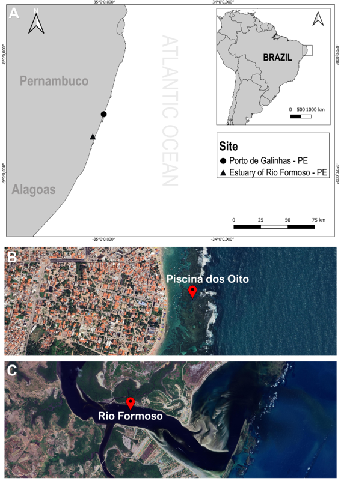
Carijoa riisei is a branching colonial octocoral widely distributed in reef and estuarine environments along the coast of Pernambuco, northeastern Brazil. Owing to the structural complexity of its colonies, it provides both habitat and substrate for a diverse assemblage of associated organisms. This study investigated the structure of the amphipod community associated with C. riisei in two contrasting environments on the southern coast of Pernambuco: Porto de Galinhas Beach and the Rio Formoso Estuary. Four sampling campaigns were carried out, two at each site, encompassing both the dry and rainy seasons. During each campaign, 12 octocoral colonies were collected, resulting in a total of 48 samples. A total of 26,683 amphipods representing 21 species were recorded. The most abundant species were Ericthonius brasiliensis (57.28%), Laticorophium baconi (10.93%), Podocerus brasiliensis (7.65%), Monocorophium acherusicum (7.54%), and Dulichiella ankeri (5.89%), which together accounted for 89.22% of all individuals collected. Amphipod abundance in the Rio Formoso Estuary was approximately six times greater than that recorded at Porto de Galinhas. Moreover, L. baconi and M. acherusicum were exclusively found in the estuarine environment. Comparisons of ecological descriptors revealed significant differences between the two sites, with the estuary exhibiting higher amphipod abundance and diversity. These findings suggest that estuarine conditions, including greater nutrient availability, higher sediment input, and the influence of water flow and reduced light penetration, promote the establishment of more diverse amphipod assemblages associated with C. riisei.
Downloads
References
Almany GR. 2004. Does increased habitat complexity reduce predation and competition in coral reef fish assemblages? Oikos. 106 (2): 275-284. DOI: https://doi.org/10.1111/j.0030-1299.2004.13193.x
Arfianti T, Costello MJ. 2020a. The biological, ecological, and ecosystem roles of marine Amphipoda. In: Goldstein MI, DellaSala DA, editors. Encyclopedia of the world’s biomes. Elsevier. DOI: https://doi.org/10.1016/B978-0-12-409548-9.11800-7
Arfianti T, Costello MJ. 2020b. Global biogeography of marine amphipod crustaceans: latitude, regionalization, and beta diversity. Mar Ecol Prog Ser. 638: 83-94. DOI: https://doi.org/10.3354/meps13272
Bayer FM. 1956. Octocorallia. In: Moore RC, editor. Treatise on invertebrate Paleontology. Part F: Coelenterata. Lawrence: Geological Society of America and University of Kansas Press. 498 p.
Boström, C, Törnroos A, Bonsdorff E. 2010. Invertebrate dispersal and habitat heterogeneity: expression of biological traits in a seagrass landscape. J Exp Mar Biol Ecol. 390 (2): 106-117. DOI: https://doi.org/10.1016/j.jembe.2010.05.008
Bousfield EL. 1973. Shallow-water gammaridean Amphipoda of New England. Ithaca [N.Y.] Comstock Pub. Associates. p. 301-306.
Bousfield EL. 1987. Amphipod parasites of fishes of Canada. Can Bull Fish Aquat Sci. 217: 1-37.
Bruno JF, Bertness MD. 2001. Habitat modification and facilitation in benthic marine communities. In: Bertness MD, Gaines SD, Hay ME, editors. Marine community ecology. Sunderland: Sinauer Associates Inc. p. 201-218.
Buhl-Mortensen L,Mortensen PB. 2005. Distribution and diversity of species associated with deep- sea gorgonian corals off Atlantic Canada. In: Freiwald A, Roberts JM, editors. Cold-water corals and ecosystems. Erlangen Earth Conference Series. Springer. p. 849-879. DOI: https://doi.org/10.1007/3-540-27673-4_44
Cantor M, Siqueira SGL, Cruvinel GT, Leite FPP. 2009. Occurrence of the amphipod (Leucothoe spinicarpa) (Abildgaard, 1789) (Amphipoda) in the ascidian (Phallusia nigra) (Urochordata, Ascidiacea) in Southeastern Brazil. KOPS Universität Konstanz.
Cárdenas-Calle M, Pérez-Correa J, Uzca-Sornoza C, Bigatti G, Diez N, Lozada M, Coronel J, Herrera I, Torres G, De la Cuadra T, et al. 2021. Invasion and current distribution of the octocoral Carijoa riisei (Duchassaing & Michelotti, 1860) in the Ecuadorian coast (eastern tropical pacific). Aquat Invasions. 16 (1): 62-76. DOI: https://doi.org/10.3391/ai.2021.16.1.05
Clarke KR, Warwick R M. 2001. A further biodiversity index applicable to species lists: variation in taxonomic distinctness. Mar Ecol Prog Ser. 216: 265-278.
Conlan KE. 1994. Amphipod crustaceans and environmental disturbance: a review. J Nat Hist. 28 (3): 519-554. DOI: https://doi.org/10.1080/00222939400770241
Concepción GT, Kahng SE, Crepeau MW, Franklin EC, Coles SL, Toonen RJ. 2010. Resolving natural ranges and marine invasions in a globally distributed octocoral (genus Carijoa). Mar Ecol Prog Ser. 401: 113-127.
[CPRH] Agência Estadual de Meio Ambiente. 2001. Diagnóstico sócio-ambiental do litoral sul de Pernambuco. Recife: Agência Estadual de Meio Ambiente e Recursos Hídricos. 122 p.
[CPRH] Agência Estadual de Meio Ambiente. 2021. APA de Guadalupe. 4 de fevereiro de 2021. [accessed: 2026 May 25]. https://www2.cprh.pe.gov.br/uc/apa-de-guadalupe/.
David LS, Stuart EGF. 2010. Ecology of freshwater shore zones. Aquat Sci. 72: 127-163 DOI: https://doi.org/10.1007/s00027-010-0128-9
Dayton PK. 1972. Toward an understanding of community resilience and the potential effects of enrichments to the benthos at McMurdo Sound, Antarctica, In: Parker BC, editor. Proceedings of the colloquium on conservation problems in Antarctica. 10-12 September 1971. Blacksburg, Virginia. p. 81-96.
de Pádua SMF, Botter-Carvalho ML, Gomes PB, de Oliveira CS, dos Santos JCP, Pérez CD. 2022. The alien octocoral Carijoa riisei is a biogenic substrate multiplier in artificial Brazilian shipwrecks. Aquat Ecol. 56: 183-200. DOI: https://doi.org/10.1007/s10452-021-09908-8
Dhivya P, Sachithanandam V, Mohan PM. 2012. New record of Carijoa riisei at Wandoor-Mahatma Gandhi Marine National Park (MGMNP), Andaman and Nicobar Islands, India. J Geo Mar Sci. 41 (3): 212-214.
Di Camillo CG, Bavestrello G, Cerrano C, Gravili C, Piraino S, Puce S, Boerp F. 2017. Hydroids (Cnidaria, Hydrozoa): a neglected component of animal forests. In: Rossi S, Bramanti L, Gori A, Orejas C, editors. Marine animal forests. Cham: Springer. p. 397-427. DOI: https://doi.org/10.1007/978-3-319-21012-4_11
Dutertre M, Hamon D, Chevalier C, Ehrhold A. 2012. The use of the relationships between environmental factors and benthic macrofaunal distribution in the establishment of a baseline for coastal management. ICES J Mar Sci. 70 (2): 294-308. DOI: https://doi.org/10.1093/icesjms/fss170
Fang X, Hou X, Li X, Hou W, Nakaoka M, Yu X. 2018. Ecological connectivity between land and sea: a review. Ecol Res. 33: 51-61. DOI: https://doi.org/10.1007/s11284-017-1549-x
Fong P, Paul VJ. 2011. Coral reef algae. In: Dubinsky Z, Stambler N, editors. Coral reefs: an ecosystem in transition. Dordrecht: Springer. p. 241-272. DOI: https://doi.org/10.1007/978-94-007-0114-4_17
Galván-Villa CM, Ríos-Jara E. 2018. First detection of the alien snowflake coral Carijoa riisei (Duchassaing and Michelotti, 1860) (Cnidaria: Alcyonacea) in the port of Manzanillo in the Mexican Pacific. BioInvasions Rec. 7 (1): 1-6. DOI: https://doi.org/10.3391/bir.2018.7.1.01
Galván-Villa CM, Tovar-Hernandez MA, Rodriguez-Zaragoza FA, Esqueda-Gonzalez MC, Sanchez-Rodrigues J, Ríos-Jara E. 2023. Effect of the alien octocoral Carijoa riisei on benthic fauna assemblages on natural and artificial substrates. Mar Ecol. 44: e12756. DOI: https://doi.org/10.1111/maec.12756
Gameiro C, Cartaxana MT, Gameiro C, Cartaxana P, Cabrita MT, Brotas V. 2004. Variability in chlorophyll and phytoplankton composition in an estuarine system. Hydrobiologia. 525: 113-124. DOI: https://doi.org/10.1023/B:HYDR.0000038858.29164.31
Goh, Nigel KC, NG Peter KL, Chou LM.1999. Notes on the shallow water gorgonian-associated fauna on coral reefs in Singapore. Bull Mar Sci. 65 (1): 259-282.
Havermans C, Smetacek V. 2018. Bottom-up and top-down triggers of diversification: a new look at the evolutionary ecology of scavenging amphipods in the deep sea. Prog Oceanogr. 164: 37-51. DOI: https://doi.org/10.1016/j.pocean.2018.04.008
Hazlitt SI, Martin TG, Sampson I, Arcese P. 2010. The effects of including marine ecological values in terrestrial reserve planning for a forestnesting seabird. Biol Conserv. 143: 1299-1303. DOI: http://doi.org/10.1016/j.biocon.2010.01.026
Htaik AA. 2023. Species composition and abundance of amphipods from seaweed and seagrasses of the southern Rakhine Coast. J Myanmar Acad Arts Sci. 21 (3): 451-458.
Jacobucci GB, Leite FP. 2006. Biologia populacional das espécies de Ampithoidae (Crustacea, Amphipoda) associadas a Sargassum filipendula (Phaeophyta, Fucales) na Praia da Fortaleza, Ubatuba, São Paulo, Brasil. Rev Bras Zool. 23: 1207-1216.
Jones CG, Lawton JH, Shachak M. 1994. Organisms as ecosystem engineers. Oikos. 69: 373-386. DOI: https://doi.org/10.2307/3545850
Kanhai A, Juman R. 2023. Seagrass loss decreases abundance, diversity and composition of macrobenthic infauna in a Caribbean Bay. DOI: https://doi.org/10.21203/rs.3.rs-2948135/v1
Karlson K, Bonsdorff E, Rosenberg R. 2007. The impact of benthic macrofauna for nutrient fluxes from Baltic Sea sediments. AMBIO J Human Env. 36 (2): 161-167. DOI: https://doi.org/10.1579/0044-7447(2007)36[161:TIOBMF]2.0.CO;2
Kovalenko KE, Thomaz SM, Warfe DM. 2012. Habitat complexity: approaches and future directions. Hydrobiologia. 685: 1-17. DOI: https://doi.org/10.1007/s10750-011-0974-z
LeCroy SE. 2004. An illustrated identification guide to the nearshore marine and estuarine gammaridean Amphipoda of Florida. Vol. 3. Families Bateidae, Biancolinidae, Cheluridae, Colomastigidae, Corophiidae, Cyproideidae and Dexaminidae. Florida Department of Environmental Protection, Tallahassee, Annual Report. Contract No. WM724. p. 411-502.
Lindsey EL, Altier AH, Witman JD. 2006. Influence of biogenic habitat on the recruitment and distribution of a subtidal xanthid crab. Mar Ecol Prog Ser. 306: 223-231. DOI: https://doi.org/10.3354/meps306223
Lira AKF, Naud JP, Gomes PB, Santos AM, Perez CD. 2009. Trophic ecology of the octocoral Carijoa riisei from littoral of Pernambuco, Brazil. I. Composition and spatio-temporal variation of the diet. J Mar Bio Assoc UK. 89 (1): 89-99. DOI: https://doi.org/10.1017/S0025315408002385
[MMA] Ministério do Meio Ambiente. 2003. Diagnóstico do turismo nos municípios do Cabo de Santo Agostinho, Ipojuca e São José da Coroa Grande. Relatório Final. Recife. 76 p.
Molina-Triana F, Bermudez-Rivas C, Parada- Gutiérrez JL, Castrillón FA. 2022. Monitoreo de un octocoral invasor (Carijoa riisei) en las dos principales zonas portuarias de la cuenca del Pacífico colombiano. Acta Oceanogr Pac. 4 (2): 21-34. DOI: https://doi.org/10.54140/raop.v4i1.56
Montano S. 2020. The extraordinary importance of coral-associated fauna. Diversity. 12: 357. DOI: https://doi.org/10.3390/d12090357
Morrison M A, Jones EG, Consalvey M, Berkenbusch K. 2014. Linking marine fisheries species to biogenic habitats in New Zealand: a review and synthesis of knowledge. N Z Aquat Environ Biodivers Rep. 130. 156 p.
Moulaert I, Hostens K, Hillewaert H, Wittoeck J. 2007. Spatial variation of the macrobenthos species and communities of the Belgian Continental Shelf and the relation to environmental variation. ICES Document CM 2007/A. 13 p.
Myers AA, McGrath D. 1984. A revision of the North-east Atlantic species of Ericthonius (Crustacea: Amphipoda). J Mar Biol Assoc UK. 64 (2): 379-400. DOI: https://doi.org/10.1017/S002531540003006X
Navarro-Mayoral S, Gouillieux B, Fernandez-Gonzalez V, Tuya F, Lecoquierre N, Bramanti L, Terrana L, Espino F, Flot JF, Haroun R, Otero-Ferrer F. 2024. “Hidden” biodiversity: a new amphipod genus dominates epifauna in association with a mesophotic black coral forest. Coral Reefs. 43: 655-672. DOI: https://doi.org/10.1007/s00338-024-02491-y
Neves BM, Lima EJB, Pérez CD. 2007. Brittle stars (Echinodermata: Ophiuroidea) associated with the octocoral Carijoa riisei (Cnidaria: Anthozoa) from the Litoral of Pernambuco, Brazil. J Mar Biol Assoc UK. 87 (5): 1263-1267. DOI: https://doi.org/10.1017/S0025315407056263
Poore AGB. 2004. Spatial association among alga affect host use in a herbivorous marine amphipod. Oecologia. 140 (1): 104-112. DOI: https://doi.org/10.1007/s00442-004-1557-8
Ribeiro MS, Omena EP, Muricy G. 2003. Macrofauna associated to Mycale microsigmatosa (Porifera, Demospongia) in Rio de Janeiro State, SE Brazil. Estuar Coast Shelf Sci. 57: 951-959. DOI: https://doi.org/10.1016/S0272-7714(02)00425-0
Sánchez JA. 2016. Diversity and evolution of octocoral animal forests at both sides of Tropical America. In: Rossi S, Bramanti L, Gori A, Orejas C, editors. Marine animal forests. Springer. p. 1-33. DOI: https://doi.org/10.1007/978-3-319-21012-4_39
Shanks AL, Grantham BA, Carr MH. 2003. Propagule dispersal distance and the size and spacing of marine reserves. Ecol Appl. 13: 159-169.
Souza JRB, Rodrigues HA, Neves BM, Pérez CD. 2007. First report of bristleworm predator of the reef octocoral Carijoa riisei. Coral Reefs. 26: 1033. DOI: https://doi.org/10.1007/s00338-007-0290-2
Soler-Hurtado MM, Megina C, López-González PJ. 2018. Structure of gorgonian epifaunal communities in Ecuador (eastern Pacific). Coral Reefs. 37: 723-736. DOI: https://doi.org/10.1007/s00338-018-1697-7
Sotka EE, Hay ME, Thomas JD. 1999. Host-plant specialization by a non-herbivorous amphipod: advantages for the amphipod and costs for the seaweed. Oecologia. 118: 471-482. DOI: https://doi.org/10.1007/s004420050750
Vargas JA, Breedy O. 2022. The snowflake soft coral Carijoa riisei (Cnidaria: Octocorallia) in Costa Rica. Cuad Investig UNED. 14 (1): e4213. DOI: http://doi.org/10.22458/urj.v14i1.4213
Wahl M. 1989. Marine epibiosis. I. Fouling and antifouling: some basic aspects. Mar Ecol Prog Ser. 58: 175-189.
Wicksten MK, Cox C. 2011. Invertebrates associated with gorgonians in the northern Gulf of Mexico. Mar Biodivers Rec. 4: e79. DOI: https://doi.org/10.1017/S1755267211000741
Wongkamhaeng K, Pholpunthin P, Azman BAR. 2012. Grandidierella halophilus a new species of the family Aoridae (Crustacea: Amphipoda) from the Saltpans of the Inner Gulf of Thailand. Raffles Bull Zool. 60 (2): 433-447.
Wongkamhaeng K, Dumrongrojwattana P, Shin MH, Boonyanusith C. 2020. Grandidierella gilesi Chilton, 1921 (Amphipoda, Aoridae), first encounter of non-indigenous amphipod in the Lam Ta Khong River, Nakhon Ratchasima Province, North-eastern Thailand. Biodivers Data J. 8: 46452. DOI: https://doi.org/10.3897/BDJ.8.e46452
Zettler ML. 2021. An example for transatlantic hitchhiking by macrozoobenthic organisms with a research vessel. Helgol Mar Res. 75 (1): 1-7. DOI: https://doi.org/10.1186/s10152-021-00549-w
Published
Issue
Section
License
Copyright (c) 2026 Stella M. F. de Pádua, Liliana do Carmo Nascimento, Jesser F. Souza-Filho, Mônica L. Botter- Carvalho, Paula Braga Gomes, Carlos D. Pérez

This work is licensed under a Creative Commons Attribution-NonCommercial-ShareAlike 4.0 International License.
Authors of articles published in Marine and Fishery Sciences retain copyright on their articles, except for any third-party images and other materials added by Marine and Fishery Sciences, which are subject to copyright of their respective owners. Authors are therefore free to disseminate and re-publish their articles, subject to any requirements of third-party copyright owners and subject to the original publication being fully cited. Visitors may also download and forward articles subject to the citation requirements. The ability to copy, download, forward or otherwise distribute any materials is always subject to any copyright notices displayed. Copyright notices must be displayed prominently and may not be obliterated, deleted or hidden, totally or partially.
This journal offers authors an Open Access policy. Users are allowed to read, download, copy, distribute, print, search, or link to the full texts of the articles, or use them for any other legal purpose within the Creative Commons 4.0 license (BY-NC-SA), without asking prior permission from the publisher or the author. This is in accordance with the BOAI definition of Open Access.