Random Forest habitat suitability modeling for Acanthurus spp. in Philippine coral reefs: environmental drivers and climate projections
DOI:
https://doi.org/10.47193/mafis.39420260011003Keywords:
Random Forest, habitat suitability, Acanthuridae, CMIP6, marine protected areasAbstract
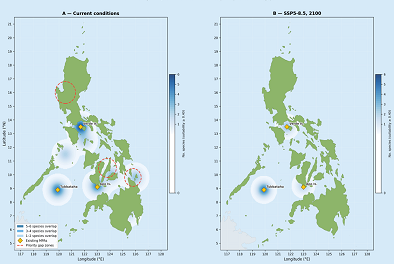
Surgeonfish of the genus Acanthurus (family Acanthuridae) are ecologically pivotal herbivores on Indo-Pacific coral reefs, yet their habitat requirements and distributional responses to environmental gradients and climate change remain poorly characterized in the Philippines. A Random Forest (RF) machine learning framework was used to model habitat suitability for six commercially and ecologically important species –A. lineatus, A. nigricans, A. olivaceus, A. triostegus, A. xanthopterus, and A. pyroferus– across Philippine coral reef systems. Geo-referenced occurrence records (n = 352-714 per species) from OBIS, GBIF, and ReefBase were paired with ten environmental predictors encompassing reef structure, oceanographic conditions, bathymetry, and physical disturbance. RF models achieved mean AUC of 0.929 and TSS of 0.805, indicating excellent predictive performance. Coral cover, depth, and rugosity were the dominant habitat predictors across species. Current suitable habitat ranged from 6,890 km2 (A. olivaceus) to 11,350 km2 (A. xanthopterus). Under SSP5-8.5 by 2100, projected habitat declined by 25.4-36.1%, driven primarily by thermally induced coral cover loss. Acanthurus triostegus was most vulnerable (-36.1%) and A. xanthopterus most resilient (-25.4%). Multi-species overlap analysis identified Verde Island Passage, Tubbataha Reef, and Apo Island as priority conservation nodes. Gap analysis revealed three unprotected high-overlap zones as candidates for new marine protected area (MPA) establishment. These findings provide a spatial evidence base for climate-adaptive reef fisheries management across the Indo-Pacific.
Downloads
References
Aiello-Lammens ME, Boria RA, Radosavljevic A, Vilela B, Anderson RP. 2015. spThin: an R package for spatial thinning of species occurrence records for use in ecological niche models. Ecography. 38 (5): 541-545. DOI: https://doi.org/10.1111/ecog.01132
Allouche O, Tsoar A, Kadmon R. 2006. Assessing the accuracy of species distribution models: prevalence, kappa and the true skill statistic (TSS). J Appl Ecol. 43 (6): 1223-1232. DOI: https://doi.org/10.1111/j.1365-2664.2006.01214.x
Bellwood DR, Hughes TP, Folke C, Nyström M. 2004. Confronting the coral reef crisis. Nature. 429 (6994): 827-833. DOI: https://doi.org/10.1038/nature02691
[BFAR] Bureau of Fisheries and Aquatic Resources. 2023. Philippine fisheries profile 2022. Quezon City (PH): BFAR.
Breiman L. 2001. Random forests. Mach Learn. 45 (1): 5-32. DOI: https://doi.org/10.1023/A:1010933404324
Burke L, Reytar K, Spalding M, Perry A. 2011. Reefs at risk revisited. Washington DC: World Resources Institute. 130 p.
Burkepile DE, Hay ME. 2008. Herbivore species richness and feeding complementarity affect community structure and function on a coral reef. Proc Natl Acad Sci USA. 105 (42): 16201-16206. DOI: https://doi.org/10.1073/pnas.0801946105
Carpenter KE, Springer VG. 2005. The center of the center of marine shore fish biodiversity: the Philippine Islands. Environ Biol Fishes. 72 (4): 467-480. DOI: https://doi.org/10.1007/s10641-004-3154-4
Cesar H, Burke L, Pet-Soede L. 2003. The economics of worldwide coral reef degradation. Arnhem (NL): Cesar Environmental Economics Consulting. 23 p.
Cheung WW, Lam VW, Sarmiento JL, Kearney K, Watson R, Zeller D, Pauly D. 2009. Projecting global marine biodiversity impacts under climate change scenarios. Fish Fish. 10 (3): 235-251. DOI: https://doi.org/10.1111/j.1467-2979.2008.00315.x
Cutler DR, Edwards TC Jr, Beard KH, Cutler A, Hess KT, Gibson J, Lawler JJ. 2007. Random forests for classification in ecology. Ecology. 88 (11): 2783-2792. DOI: https://doi.org/10.1890/07-0539.1
Emslie MJ, Logan M, Williamson DH, Ayling AM, MacNeil MA, Ceccarelli D, Cheal AJ, Evans RD, Johns KA, Jonker MJ, et al. 2018. Expectations and outcomes of reserve network performance following re-zoning of the Great Barrier Reef Marine Park. Curr Biol. 25 (8): 983-992. DOI: https://doi.org/10.1016/j.cub.2015.01.073
González-Rivero M, Beijbom O, Rodriguez-Ramirez A, Bryant DE, Ganase A, Gonzalez-Marrero Y, Herrera-Reveles A, Kennedy EV, Kim CJ, Lopez-Marcano S, et al. 2020. Monitoring of coral reefs using artificial intelligence: a feasible and cost-effective approach. Remote Sens. 12 (3): 489. DOI: https://doi.org/10.3390/rs12030489
Greenwell BM. 2017. pdp: an R package for constructing partial dependence plots. R J. 9 (1): 421-436. DOI: https://doi.org/10.32614/RJ-2017-016
Hanley JA, McNeil BJ. 1982. The meaning and use of the area under a receiver operating characteristic (ROC) curve. Radiology. 143 (1): 29-36. DOI: https://doi.org/10.1148/radiology.143.1.7063747
Hirzel AH, Le Lay G, Helfer V, Randin C, Guisan A. 2006. Evaluating the ability of habitat suitability models to predict species presences. Ecol Model. 199 (2): 142-152. DOI: https://doi.org/10.1016/j.ecolmodel.2006.05.017
Hixon MA, Beets JP. 1993. Predation, prey refuges, and the structure of coral-reef fish assemblages. Ecol Monogr. 63 (1): 77-101. DOI: https://doi.org/10.2307/2937124
Hoegh-Guldberg O, Pendleton L, Kaup A. 2019. People and the changing nature of coral reefs. Reg Stud Mar Sci. 30: 100699. DOI: https://doi.org/10.1016/j.rsma.2019.100699
Hoegh-Guldberg O, Poloczanska ES, Skirving W, Dove S. 2017. Coral reef ecosystems under climate change and ocean acidification. Front Mar Sci. 4: 158. DOI: https://doi.org/10.3389/fmars.2017.00158
Hughes TP. 1994. Catastrophes, phase shifts, and large-scale degradation of a Caribbean coral reef. Science. 265 (5178): 1547-1551. DOI: https://doi.org/10.1126/science.265.5178.1547
Hughes TP, Baird AH, Bellwood DR, Card M, Connolly SR, Folke C, Grosberg R, Hoegh-Guldberg O, Jackson JB, Kleypas J, et al. 2003. Climate change, human impacts, and the resilience of coral reefs. Science. 301 (5635): 929-933. DOI: https://doi.org/10.1126/science.1085046
Hughes TP, Graham NAJ, Jackson JBC, Mumby PJ, Steneck RS. 2010. Rising to the challenge of sustaining coral reef resilience. Trends Ecol Evol. 25 (11): 633-642. DOI: https://doi.org/10.1016/j.tree.2010.07.011
Klaassen M, Marques TA, Alves F, Fernandez M. 2025. Trends in marine species distribution models: a review of methodological advances and future challenges. Ecography. 2026: e07702. DOI: https://doi.org/10.1002/ecog.07702
Liaw A, Wiener M. 2002. Classification and regression by randomForest. R News. 2 (3): 18-22.
Liu C, Berry PM, Dawson TP, Pearson RG. 2005. Selecting thresholds of occurrence in the prediction of species distributions. Ecography. 28 (3): 385-393. DOI: https://doi.org/10.1111/j.0906-7590.2005.03957.x
Logan CA, Dunne JP, Eakin CM, Donner SD. 2014. Incorporating adaptive responses into future projections of coral bleaching. Glob Change Biol. 20 (1): 125-139. DOI: https://doi.org/10.1111/gcb.12390
Mayer M, Gaffert P, Muller K. 2023. kernelshap: Kernel SHAP for explaining predictive models. R package version 0.3.0. [accessed 2024 Jan 15]. https://CRAN.R-project.org/package=kernelshap.
Mellin C, Delean S, Caley J, Edgar G, Meekan M, Pitcher CR, Przeslawski R, Williams A, Bradshaw CJ. 2012. Effectiveness of biological surrogates for predicting patterns of marine biodiversity: a global meta-analysis. PLoS ONE. 6 (6): e20141. DOI: https://doi.org/10.1371/journal.pone.0020141
Monk J, Ierodiaconou D, Versace VL, Bellgrove A, Harvey E, Rattray A, Laurenson L, Quinn GP. 2010. Habitat suitability for marine fishes using presence-only modelling and multibeam sonar. Mar Ecol Prog Ser. 420: 157-174. DOI: https://doi.org/10.3354/meps08858
Muallil RN, Deocadez MR, Martinez RJS, Panga FM, Atrigenio MP, Aliño PM. 2020. Negative trophic relationship between parrotfish biomass and algal cover on Philippine coral reefs. Reg Stud Mar Sci. 39: 101471. DOI: https://doi.org/10.1016/j.rsma.2020.101471
Muallil RN, Mamauag SS, Cababaro JT, Arceo HO, Aliño PM. 2014. Catch trends in Philippine small-scale fisheries over the last five decades: the fishers’ perspectives. Mar Policy. 47: 110-117. DOI: https://doi.org/10.1016/j.marpol.2014.02.008
Mumby PJ, Hastings A, Edwards HJ. 2007. Thresholds and the resilience of Caribbean coral reefs. Nature. 450 (7166): 98-101. DOI: https://doi.org/10.1038/nature06252
Phillips SJ, Dudik M, Elith J, Graham CH, Lehmann A, Leathwick J, Ferrier S. 2009. Sample selection bias and presence-only distribution models: implications for background and pseudo-absence data. Ecol Appl. 19 (1): 181-197. DOI: https://doi.org/10.1890/07-2153.1
Pickens BA, Carroll R, Schirripa MJ, Forrestal F, Friedland KD, Taylor JC. 2021. A systematic review of spatial habitat associations and modeling of marine fish distribution: a guide to predictors, methods, and knowledge gaps. PLoS ONE. 16 (5): e0251818. DOI: https://doi.org/10.1371/journal.pone.0251818
Pittman SJ, Costa BM, Battista TA. 2009. Using lidar bathymetry and boosted regression trees to predict the diversity and abundance of fish and corals. J Coast Res. (10053): 27-38. DOI: https://doi.org/10.2112/SI_53_3
Prasad AM, Iverson LR, Liaw A. 2006. Newer classification and regression tree techniques: bagging and random forests for ecological prediction. Ecosystems. 9 (2): 181-199. DOI: https://doi.org/10.1007/s10021-005-0054-1
Pratchett MS, Bay LK, Gehrke PC, Koehn JD, Osborne K, Pressey RL, Sweatman HP, Wachenfeld D. 2011. Contribution of climate change to degradation and loss of critical fish habitats in Australian marine and freshwater environments. Mar Freshw Res. 62 (9): 1062-1081. DOI: https://doi.org/10.1071/MF10303
Probst P, Boulesteix AL. 2017. To tune or not to tune the number of trees in random forest? J Mach Learn Res. 18 (181): 1-18.
[RA 9522] Republic Act No. 9522. 2009. An act to amend certain provisions of Republic Act No. 3046, as amended by Republic Act No. 5446, to define the archipelagic baseline of the Philippines, and for other purposes. Manila (PH): Congress of the Philippines.
Reaka-Kudla ML. 1997. The global biodiversity of coral reefs: a comparison with rain forests. In: Reaka-Kudla ML, Wilson DE, Wilson EO, editors. Biodiversity II. Washington DC: Joseph Henry Press. p. 83-108.
Roberts DR, Bahn V, Ciuti S, Boyce MS, Elith J, Guillera-Arroita G, Hauenstein S, Lahoz-Monfort JJ, Schröder B, Thuiller W, et al. 2017. Cross-validation strategies for data with temporal, spatial, hierarchical, or phylogenetic structure. Ecography. 40 (8): 913-929. DOI: https://doi.org/10.1111/ecog.02881
Sillero N, Barbosa AM. 2021. Common mistakes in ecological niche models. Int J Geogr Inf Sci. 35 (2): 213-226. DOI: https://doi.org/10.1080/13658816.2020.1798968
Thuiller W, Lafourcade B, Engler R, Araújo MB. 2009. BIOMOD - a platform for ensemble forecasting of species distributions. Ecography. 32 (3): 369-373. DOI: https://doi.org/10.1111/j.1600-0587.2008.05742.x
Valavi R, Elith J, Lahoz-Monfort JJ, Guillera-Arroita G. 2019. blockCV: an R package for generating spatially or environmentally separated folds for k-fold cross-validation of species distribution models. Methods Ecol Evol. 10 (2): 225-232. DOI: https://doi.org/10.1111/2041-210X.13107
Warton DI, Shepherd LC. 2010. Poisson point process models solve the pseudo-absence problem for presence-only data in ecology. Ann Appl Stat. 4 (3): 1383-1402. DOI: https://doi.org/10.1214/10-AOAS331
Published
Issue
Section
License
Copyright (c) 2026 Nelson C. Perante

This work is licensed under a Creative Commons Attribution-NonCommercial-ShareAlike 4.0 International License.
Authors of articles published in Marine and Fishery Sciences retain copyright on their articles, except for any third-party images and other materials added by Marine and Fishery Sciences, which are subject to copyright of their respective owners. Authors are therefore free to disseminate and re-publish their articles, subject to any requirements of third-party copyright owners and subject to the original publication being fully cited. Visitors may also download and forward articles subject to the citation requirements. The ability to copy, download, forward or otherwise distribute any materials is always subject to any copyright notices displayed. Copyright notices must be displayed prominently and may not be obliterated, deleted or hidden, totally or partially.
This journal offers authors an Open Access policy. Users are allowed to read, download, copy, distribute, print, search, or link to the full texts of the articles, or use them for any other legal purpose within the Creative Commons 4.0 license (BY-NC-SA), without asking prior permission from the publisher or the author. This is in accordance with the BOAI definition of Open Access.