Presencia, notas taxonómicas y comparación morfométrica del pez pipa aligátor Syngnathoides biaculeatus (Bloch, 1785) de la Isla Gran Nicobar, India
DOI:
https://doi.org/10.47193/mafis.3932026010710Palabras clave:
Peces pipa, Syngnathidae, praderas marinas, diversidad de peces, islas Andamán y NicobarResumen
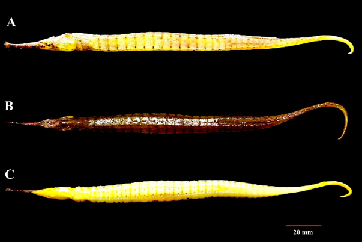
Se registró un único ejemplar hembra (195 mm de longitud total) del pez pipa caimán, Syngnathoides biaculeatus (Bloch, 1785), en los hábitats de escombros de arrecifes de coral de Gandhi Nagar, Isla Gran Nicobar. El presente estudio proporciona una descripción morfológica detallada de la especie, incluyendo mediciones morfométricas exhaustivas y recuentos merísticos. Este registro constituye información de referencia importante sobre S. biaculeatus en la región de Gran Nicobar, con detalles adicionales sobre sus preferencias de hábitat y distribución en profundidad. Los informes previos de las islas Andamán y Nicobar carecían de información taxonómica y ecológica detallada sobre la especie. Por lo tanto, el presente informe aborda estas lagunas de conocimiento al proporcionar documentación taxonómica detallada, datos morfométricos, información sobre el hábitat y registros fotográficos de S. biaculeatus, contribuyendo así con valiosa información de referencia a la diversidad ictiofaunística del archipiélago de Gran Nicobar.
Descargas
Referencias
Allen GR, Erdmann MV. 2012. Reef fishes of the East Indies. Vol. I-III. 2nd ed. Perth: University of Hawai’i Press, Tropical Reef Research.
Bijukumar A, Deepthi GR. 2009. Mean trophic index of fish fauna associated with trawl bycatch of Kerala, southwest coast of India. J Mar Biol Assoc Ind. 51 (2): 145-157.
Chandran R, Thanappan V, Satyanarayana C, Chandra K, Senthilkumaran R, Fricke R. 2020. First record of the pink pipefish, Bryx analicarens (Actinopterygii: Syngnathiformes: Syngnathidae), from Indian waters. Acta Ichthy Piscat. 50 (1): 113-120. DOI: https://doi.org/10.3750/AIEP/02766 DOI: https://doi.org/10.3750/AIEP/02766
Cho SH, Myoung JG, Kim JM, Lee JH. 2001. Fish fauna associated with drifting seaweed in the coastal area of Tongyeong, Korea. Trans Am Fish Soc. 130: 1190-1202. DOI: https://doi.org/10.1577/1548-8659(2001)130<1190:FFAWDS>2.0.CO;2
David Wells RJ, Rooker JR. 2004. Distribution, age, and growth of young-of-the-year greater amberjack (Seriola dumerili) associated with pelagic Sargassum. Fish Bull. 102: 545-554.
Dawson CE. 1985. Indo-Pacific Pipefishes (Red Sea to the Americas). Gulf Coast Research Laboratory, Ocean Springs, Mississippi.
Dawson CE. 1986. Syngnathidae. In: Smith MM, Heemstra PC, editors. Smiths’ sea fishes. Berlin: Springer-Verlag. p. 445-458.
Dhanya S, Rajagopal S, Ajmal Khan S, Balasubramanian T. 2005. Embryonic development in alligator pipefish, Syngnathoides biaculeatus (Bloch, 1785). Curr Sci. 88 (1): 178-181.
Foster SJ, Vincent ACJ. 2004. Life history and ecology of seahorses: implications for conservation and management. J Fish Biol. 65: 1-61. DOI: https://doi.org/10.1111/j.0022-1112.2004.00429.x
Fricke R, Eschmeyer WN, Van der Laan R, editors. 2025. Catalog of fishes: genera, species, references. San Francisco: California Academy of Sciences. [accessed 2026 May 17]. https://researcharchive.calacademy.org/research/ichthyology/catalog/fishcatmain.asp.
Froese R, Pauly D. 2026. FishBase. World Wide Web electronic publication. Version 02/2026.
Jagatap TG. 1991. Distribution of seagrasses along Indian coast. Aqua Bot. 40: 379-386. DOI: https://doi.org/10.1016/0304-3770(91)90082-G
Jones S. 1969. Catalogue of fishes from the Laccadive Archipelago in the reference collections of the Central Marine Fisheries Research Institute. Bull CMFRI. 8: 1-32.
Kuiter RH. 1996. Guide to sea fishes of Australia. London: New Holland Publishers.
Kuiter RH. 2009. Seahorses and their relatives. Seaford: Aquatic Photographics. 334 p.
Lourie SA, Vincent ACJ, Hall HJ. 1999. Seahorses: an identification guide to the world’s species and their conservation. London: Project Seahorse.
Murugan A, Dhanya S, Rajagopal S, Balasubramanian T. 2008. Seahorses and pipefish of the Tamil Nadu coast. Curr Sci. 95: 253-260.
Ohta I, Tachihara K. 2004. Larval development and food habits of the marbled parrotfish, Leptoscarus vaigiensis, associated with drifting algae. Ichthyol Res. 51 (1): 63-69. DOI: https://doi.org/10.1007/s10228-003-0197-z DOI: https://doi.org/10.1007/s10228-003-0197-z
Ooi BL, Lim YL, Lim ACO, Chong VC. 2017. Habitat choice and hunting behaviour of the alligator pipefish, Syngnathoides biaculeatus, in captivity. Etho Ecol Evol. 29 (6): 542-551. DOI: https://doi.org/10.1080/03949370.2016.1260060
Pollom R. 2017. Syngnathoides biaculeatus. The IUCN Red List of Threatened Species 2017: e.T40715A67622796. [accessed 2026 May 17]. DOI: https://dx.doi.org/10.2305/IUCN.UK.2017-2.RLTS.T40715A67622796.en DOI: https://doi.org/10.2305/IUCN.UK.2017-2.RLTS.T40715A67622796.en
Raghunathan C, Venkataraman K, Davidar, P. 2013. Biodiversity and biogeography of Andaman and Nicobar Islands. In: Chandra K, Raghunathan C, editors. Faunal diversity of biogeographic zones of India. Zoological Survey of India. p. 1-24.
Randall JE, Allen GR, Steene, RC. 1997. Fishes of the Great Barrier Reef and Coral Sea. 2nd ed. Bathrust: Crawford House Publishing. 557 p.
Ryer CH, Orth RJ. 1987. Feeding ecology of the northern pipefish, Syngnathus fuscus, in a seagrass community of the lower Chesapeake Bay. Estuaries. 10 (4): 330-336. DOI: https://doi.org/10.2307/1351891
Sanaye SV, Rivonker CU, Ansari ZA, Sreepada RA. 2016. A new distributional record of alligator pipefish, Syngnathoides biaculeatus along Goa, central west coast of India. Ind J Geo Mar Sci. 45 (10): 1299-1304.
Sankaran R. 1998. The ecology and biogeography of the Nicobar Islands. In: Andaman and Nicobar islands: environmental impact assessment and conservation strategies. New Delhi: Oxford University Press.
Schultz LP. 1939. Fishes of the Phoenix and Samoan islands collected in 1939 during the expedition of the U. S. S. “Bushnell”. Bull US Nat Mus. 180. p. 316. DOI: https://doi.org/10.5479/si.03629236.180.i DOI: https://doi.org/10.5479/si.03629236.180.i
Talwar PK. 1990. Fishes of the Andaman and Nicobar Islands: a synoptic analysis. J Andaman Sci Assoc. 6 (2): 71-102.
Tutman P, Burić M, Skaramuca B. 2012. First substantiated record of the black-striped pipefish, Syngnathus abaster (Actinopterygii: Syngnathiformes: Syngnathidae), in the freshwaters of Bosnia and Herzegovina. Acta Ichthy Piscat. 42 (3): 259-262. DOI: https://doi.org/10.3750/AIP2011.42.3.11 DOI: https://doi.org/10.3750/AIP2011.42.3.11
Vandendriessche S, Messiaen M, O’Flynn S, Vincx M, Degraer S. 2007. Hiding and feeding in floating seaweed: floating seaweed clumps as possible refuges or feeding grounds for fishes and crustaceans. Estuar Coast Shelf Sci. 71 (3-4): 691-703. DOI: https://doi.org/10.1016/j.ecss.2006.09.017 DOI: https://doi.org/10.1016/j.ecss.2006.09.017
Venkataraman K, Rajan PT, Raghunathan C. 2012. Marine biodiversity of Andaman and Nicobar Islands. Kolkata: Zoological Survey of India.
Descargas
Publicado
Número
Sección
Licencia
Derechos de autor 2026 Krishnan Silambarasan, Sivaperuman Chandrakasan

Esta obra está bajo una licencia internacional Creative Commons Atribución-NoComercial-CompartirIgual 4.0.
Los autores de los artículos publicados en Marine and Fishery Sciences conservan los derechos de autor de sus artículos, a excepción de las imágenes de terceros y otros materiales añadidos por Marine and Fishery Sciences, que están sujetos a los derechos de autor de sus respectivos propietarios. Por lo tanto, los autores son libres de difundir y volver a publicar sus artículos, sujeto a los requisitos de los propietarios de derechos de autor de terceros y sujeto a que la publicación original sea completamente citada. Los visitantes también pueden descargar y reenviar artículos sujetos a los requisitos de citas. La capacidad de copiar, descargar, reenviar o distribuir cualquier material siempre está sujeta a los avisos de derechos de autor que se muestran. Los avisos de copyright deben mostrarse de manera prominente y no pueden borrarse, eliminarse u ocultarse, total o parcialmente. El autoalmacenamiento en servidores y repositorios de preimpresión está permitido para todas las versiones.
Esta revista ofrece a los autores una política de acceso abierto. Los usuarios pueden leer, descargar, copiar, distribuir, imprimir, buscar o vincular los textos completos de los artículos, o usarlos para cualquier otro propósito legal dentro de la licencia Creative Commons 4.0 (BY-NC-SA), sin solicitar permiso previo del editor o del autor. Esto está de acuerdo con la definición BOAI de acceso abierto.