Patrones de conectividad y diversidad genética de una pequeña especie de tiburón demersal, Mustelus lunulatus (Carcharhiniformes: Triakidae), en el Pacífico de Panamá
DOI:
https://doi.org/10.47193/mafis.3922026010410Palabras clave:
Diversidad genética, pesquerías, ADN mitocondrial, Pacífico tropical orientalResumen
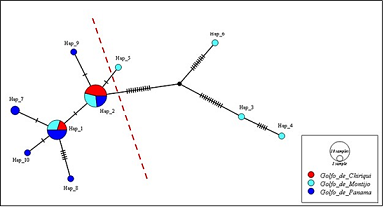
Commonly known as the sicklefin smooth-hound shark due to its characteristic molariform teeth, Mustelus lunulatus, is one of the main shark species targeted by fisheries along the Pacific coast of Panama. It is distributed from southern California to Ecuador, including Malpelo Island in Colombia. The species inhabits benthic zones on the continental shelf and nearshore coastal waters of the Pacific. This study evaluated the genetic diversity, population structure and connectivity of M. lunulatus using COI mitochondrial. Tissue samples were collected from three major Pacific Gulf systems of Panama: Gulf of Chiriqui, Gulf of Montijo, and Gulf of Panama. Genetic analysis revealed differences among regions. Among the analyzed areas, Gulf of Montijo exhibited the highest haplotypic diversity (Hd = 0.83) with a moderately negative Tajima’s D value (D = -0.42436), suggesting a population with signs of expansion and lower fishing pressure. On the other hand, Gulf of Chiriqui showed reduced haplotypic diversity (Hd = 0.42) and positive Tajima’s D (D = 0.33350), consistent with a population under demographic contraction of intense targeted fishing. Gulf of Panama showed intermediate levels of haplotypic diversity (Hd = 0.79), and a strongly negative Tajima’s D (D = -1.52793). The observed genetic structuring and different levels of genetic diversity across study sites underscore the importance of incorporating genetic data into sustainable fisheries and management. These findings support the delineation of region-specific conservation strategies to ensure the long-term sustainability of M. lunulatus populations in Panama’s Pacific coastal ecosystems, especially at the Gulf of Montijo.
Descargas
Referencias
Alghozali FA, Wijayanti DP, Sabdono A. 2019. Genetic diversity of scalloped hammerhead sharks (Sphyrna lewini) landed in muncar fishing port, Banyuwangi. Biodiversitas. 20 (4): 1154-1159. DOI: https://doi.org/10.13057/biodiv/d200430
[ANAM] Autoridad Nacional del Ambiente. 2004. Informe del estado del ambiente: GEO Panamá 2004. Balboa: ANAM. 175 p. https://bdigital.binal.ac.pa/bdp/informe%20del%20ambiente.pdf.
Barbato M, Bonanomi S, Borme D, Ćetković I, Colloca F, Di Lorenzo M, Marino IAM, Mazzoldi C, Pešić A, Sala A, et al. 2025. New findings into the genetic population structure of two commercially valuable and threatened sharks, Mustelus mustelus (Linnaeus, 1758) and M. punctulatus (Risso, 1827), allow refining management strategy in the Central Mediterranean Sea. Front Mar Sci. 12: 1520573. DOI: https://doi.org/10.3389/fmars.2025.1520573
Boomer JJ, Harcourt RG, Francis MP, Stow AJ. 2012. Genetic divergence, speciation and biogeography of Mustelus (sharks) in the central Indo-Pacific and Australasia. Mol Phylogenet Evol. 64: 697-703. DOI: https://doi.org/10.1016/j.ympev.2012.05.024
Bornatowski H, Navia AF, Braga RR, Abilhoa V, Corrêa MFM. 2014. Ecological importance of sharks and rays in a structural foodweb analysis in southern Brazil. ICES J Mar Sci. 71 (7): 1586-1592. DOI: https://doi.org/10.1093/icesjms/fsu025
Briones-Mendoza J, Pincay-Espinoza JE, Palma-Chávez J, Romero-Caicedo A. 2018. Notas sobre la biología del tiburón mamona Mustelus lunulatus (Carcharhiniformes: Triakidae) en el Pacífico Central ecuatoriano. Rev Biol Mar Oceanogr. 53 (2): 279-284. DOI: https://doi.org/10.22370/rbmo.2018.53.2.1301
Cailliet GM, Musick JA, Simpfendorfer CA, Stevens JD. 2005. Ecology and life history characteristics of chondrichthyan fish. In: Fowler SL, Cavanagh RD, Camhi M, Burgess GH, Cailliet GM, Fordham SV, Simpfendorfer CA, Musick JA, editors. Sharks, rays and chimaeras: the status of the chondrichthyan fishes, status survey. Gland: IUCN/Shark Specialist Group. p. 12-18.
Cardeñosa D, Shea SK, Zhang H, Fischer GA, Simpfendorfer CA, Chapman DD. 2022. Two thirds of species in a global shark fin trade hub are threatened with extinction: conservation potential of international trade regulations for coastal sharks. Conserv Lett. 15: e12910. DOI: https://doi.org/10.1111/conl.12910
Ceccarelli D, Ayling T. 2010. Role, importance and vulnerability of top predators on the Great Barrier Reef - a review. Research Publication. 105. Townsville: Great Barrier Reef Marine Park Authority. 150 p.
Chapman DD, Feldheim KA, Papastamatiou YP, Hueter RE. 2015. There and back again: a review of residency and return migrations in sharks, with implications for population structure and management. Annu Rev of Mar Sci. 7: 547-570. DOI: https://doi.org/10.1146/annurev-marine-010814-015730
Clarke SC, Milner-Gulland EJ, Bjørndal T. 2007. Social, economic, and regulatory drivers of the shark fin trade. Mar Resour Econ. 22 (3): 305-327.
Clarke TM, Espinoza M, Wehrtmann IS. 2014. Reproductive ecology of demersal elasmobranchs from a data-deficient fishery, Pacific of Costa Rica, Central America. Fish Res. 157: 96-105. DOI: https://doi.org/10.1016/j.fishres.2014.04.003
Compagno LJV. 1984. FAO species catalogue. Vol. 4. Sharks of the world. Part 2. Carcharhiniformes. FAO Fish Synop. 125: 251-633.
Crawford G, Mepstead M, Díaz-Ferguson E. 2023. Characterizing oceanographic conditions near Coiba Island and Pacific Panama using 20 years of satellite-based wind stress, SST and chlorophyll-a measurements. Mar Fish Sci. 37 (3): 391-411. DOI: https://doi.org/10.47193/mafis.37X2024010112
D’Croz L, O’Dea A. 2007. Variability in upwelling along the Pacific shelf of Panama and implications for the distribution of nutrients and chlorophyll. Estuar Coast Shelf Sci. 73: 325-340. DOI: https://doi.org/10.1016/j.ecss.2007.01.013
Díaz-Ferguson E. 2012. Introducción a la ecología molecular marina: aplicaciones y perspectivas. 1st ed. Panama: Universal Books. 212 p.
Díaz-Ferguson E, Chial M, Gonzalez M, Muñoz E, Chen O, Dúran O, Vega A, Ramos Delgado C. 2023. Building a teleost fish traceability program based on genetic data from Pacific Panama fish markets. Animals. 13 (14): 2272. DOI: https://doi.org/10.3390/ani13142272
Díaz-Ferguson E, Haney R, Wares J, Silliman B. 2010. Population genetics of a trochid gastropod broadens picture of Caribbean Sea connectivity. PLoS ONE. 5: e12675. DOI: https://doi.org/10.1371/journal.pone.0012675
Díaz-Ferguson E, Justo-Riverol S, Barreiros P. 2026. Genetic and taxonomic data corroborates the first report of lemon sharks, Negaprion brevirostris, in estuarine waters of Coiba National Park, Panama. DOI: https://doi.org/10.21203/rs.3.rs-8183344/v1
Díaz-Ferguson E, Justo SC, Del Cid V, Posada J. 2023. Fishery and conservation implications of molecular characterization and traceability of ceviche samples from Pacific Panama. Mar Fish Sci. 37 (3): 379-390. DOI: https://doi.org/10.47193/mafis.37X2024010101
DiBattista JD. 2008. Patterns of genetic variation in anthropogenically impacted populations. Conserv Genet. 9: 141-156. DOI: https://doi.org/10.1007/s10592-007-9317-z
Domingues RR, Hilsdorf AWS, Gadig OBF. 2018. The importance of considering genetic diversity in shark and ray conservation policies. Conserv Genet. 19: 501-525. DOI: https://doi.org/10.1007/s10592-017-1038-3
Dudgeon CL, Blower DC, Broderick D, Giles JL, Holmes BJ, Kashiwagi T, Krück NC, Morgan JAT, Tillett BJ, Ovenden JR. 2012. A review of the application of molecular genetics for fisheries management and conservation of sharks and rays. J Fish Biol. 80 (5): 1789-1843. DOI: https://doi.org/10.1111/j.1095-8649.2012.03265.x
Dulvy NK, Fowler SL, Musick JA, Cavanagh RD, Kyne PM, Harrison LR, Carlson JK, Davidson LNK, Fordham SV, Francis MP, et al. 2014. Extinction risk and conservation of the world’s sharks and rays. Elife. 3: e00590. DOI: https://doi.org/10.7554/elife.00590
Elizondo-Sancho M, Rodríguez-Arriatti Y, Albertazzi FJ, Bonilla-Salazar A, Arauz-Naranjo D, Arauz R, Areano E, Avalos-Castillo CG, Brenes Ó, Chávez EJ, et al. 2022. Population structure and genetic connectivity of the scalloped hammerhead shark (Sphyrna lewini) across nursery grounds from the Eastern Tropical Pacific: implications for management and conservation. PLoS ONE. 17: e0264879. DOI: https://doi.org/10.1371/journal.pone.0264879
[FAO] Food and Agriculture Organization of the United Nations. 2020. The state of food and agriculture 2020. Overcoming water challenges in agriculture. Rome: FAO. 210 p. DOI: https://doi.org/10.4060/cb1447en
Farrell ED, Clarke MW, Mariani S. 2009. A simple genetic identification method for Northeast Atlantic smoothhound sharks (Mustelus spp.). ICES J Mar Sci. 66 (3): 561-565. DOI: https://doi.org/10.1093/icesjms/fsn218
Feitosa LM, Martins APB, Giarrizzo T, Macedo W, Monteiro IL, Gemaque R, Nunes JLS, Gomes F, Schneider H, Sampaio I, Souza R, et al. 2018. DNA-based identification reveals illegal trade of threatened shark species in a global elasmobranch conservation hotspot. Sci Rep. 8: 21683. DOI: https://doi.org/10.1038/s41598-018-21683-5
Ferretti F, Worm B, Britten GL, Heithaus MR, Lotze HK. 2010. Patterns and ecosystem consequences of shark declines in the ocean. Ecol Lett. 13: 1055-1071. DOI: https://doi.org/10.1111/j.1461-0248.2010.01489.x
Fu YX, Li WH. 1993. Statistical tests of neutrality of mutations. Genetics. 133 (3): 693-709. DOI: https://doi.org/10.1093/genetics/133.3.693
Geneious Prime. 2022. Geneious Version 7.04. Biomatters. https://www.geneious.com/.
Giresi MM, Grubbs RD, Portnoy DS, Gold JR. 2013. A morphological key to distinguish among smooth-hound sharks (Genus Mustelus) in the Gulf of Mexico. Gulf and Caribb Res. 65: 143-146.
Gómez GO, Zapata LA, Franke R, Ramos GE. 2003. Hábitos alimentarios de Mustelus lunulatus y M. henlei (Pisces: Triakidae) colectados en el Parque Nacional Natural Gorgona, Pacífico colombiano. Bol Invest Mar Cost. 32: 219-229.
Guzmán HM, Beaver CE, Díaz-Ferguson E. 2021. Novel insights into the genetic population connectivity of transient whale sharks (Rhincodon typus) in Pacific Panama provide crucial data for conservation efforts. Front Mar Sci. 8: 744109. DOI: https://doi.org/10.3389/fmars.2021.744109
Guzmán HM, Cipriani R, Vega AJ, MoralesSaldaña JM. 2020. Fisheries and conservation assessment of sharks in Pacific Panama. Aquat Conserv Mar Freshwat Ecosyst. 30: 315-330. DOI: https://doi.org/10.1002/aqc.3245
Heemstra PC. 1997. A review of the smooth-hound sharks (Genus Mustelus, Family Triakidae) of the western Atlantic Ocean, with descriptions of two new species and a new subspecies. Bull Mar Sci. 60: 894-928.
Hoelzel AR, Shivji MS, Magnussen J, Francis MP. 2006. Low worldwide genetic diversity in the basking shark (Cetorhinus maximus). Biol Lett. 2 (4): 639-642. DOI: https://doi.org/10.1098/rsbl.2006.0513
[IUCN] International Union for Conservation of Nature. 2024. Carcharhinus leucas. Red List of Threatened Species. DOI: https://doi.org/10.2305/IUCN.UK.2021-2.RLTS.T39372A2910670.en
Jardas I, Šantić M, Nerlović V, Pallaoro A. 2007. Diet composition of blackspotted smooth-hound, Mustelus punctulatus (Risso, 1826), in the eastern Adriatic Sea. J Appl Ichthyol. 23: 72-77. DOI: https://doi.org/10.1111/j.1439-0426.2006.00826.x
Justo S. 2022. Estructura y variabilidad genética de tiburones del género Mustelus spp. en el golfo de Chiriquí y Montijo como áreas de influencia del Parque Nacional Coiba [thesis]. Panamá: International Maritime University of Panama.
Karl SA, Castro ALF, Garla RC. 2012. Population genetics of the nurse shark (Ginglymostoma cirratum) in the western Atlantic. Mar Biol. 159: 489-498. DOI: https://doi.org/10.1007/s00227-011-1828-y
Karl SA, Castro ALF, Lopez JA, Charvet P, Burgess GH. 2011. Phylogeography and conservation of the bull shark (Carcharhinus leucas) inferred from mitochondrial and microsatellite DNA. Conserv Genet. 12: 371-382. DOI: https://doi.org/10.1007/s10592-010-0145-1
Kitchell JF, Essington TE, Boggs CH, Schindler DE, Walters CJ. 2002. The role of sharks and longline fisheries in a pelagic ecosystem of the Central Pacific. Ecosystems. 5: 202-216. DOI: https://doi.org/10.1007/s10021-001-0065-5
Kottillil S, Rao C, Bowen BW, Shanker K. 2023. Phylogeography of sharks and rays: a global review based on life history traits and biogeographic partitions. PeerJ. 11: e15396. DOI: https://doi.org/10.7717/peerj.15396
Leigh J, Bryant D. 2015. PopART: Full-feature software for haplotype network construction. Methods Ecol Evol. 6 (9): 1110-1116. DOI: https://doi.org/10.1111/2041-210X.12410
Lewallen EA, Anderson TW, Bohonak AJ. 2007. Genetic structure of leopard shark (Triakis semifasciata) populations in California waters. Mar Biol. 152: 599-609. DOI: https://doi.org/10.1007/s00227-007-0714-0
Librado P, Rozas J. 2009. DnaSP v5: a software for comprehensive analysis of DNA polymorphism data. Bioinformatics. 25 (11): 1451-1452. DOI: https://doi.org/10.1093/bioinformatics/btp187
Llerena Y, Espinoza E, Peñaherrera C. 2012. Manual para el monitoreo y marcaje en tiburones juveniles de las zonas de manglar de la Reserva Marina de Galápagos. Puerto Ayora: Dirección del Parque Nacional Galápagos y Fundación Charles Darwin.
López JA, Ryburn JA, Fedrigo O, Naylor GJP. 2006. Phylogeny of sharks of the family Triakidae (Carcharhiniformes) and its implications for the evolution of carcharhiniform placental viviparity. Mol Phylogenet Evol. 40 (1): 50-60. DOI: https://doi.org/10.1016/j.ympev.2006.02.011
Marino IM, Riginella E, Cariani A, Tinti F, Farrell E, Mazzoldi C, Zane L. 2014. New molecular tools for the identification of 2 endangered smooth-hound sharks, Mustelus mustelus and Mustelus punctulatus. J Hered. 106 (1): 123-130. DOI: https://doi.org/10.1093/jhered/esu064
Martínez-Ortíz J, Garcia-Dominguez M. 2013. Guía de campo condrictios del Ecuador: quimeras, tiburones y rayas. Quito: Ministerio de Agricultura, Ganadería, Acuacultura y Pesca. 246 p.
Maté JL. 2005. Análisis de la situación de la pesca en los golfos de Chiriquí y Montijo. Panama: STRI and the Nature Conservancy. http://hdl.handle.net/10088/6679.
Musick JA. 2005. Introduction: management of sharks and their relatives (Elasmobranchii). In: Musick JA, Bonfil R, editors. Management techniques for elasmobranch fisheries. FAO Fish Tech Pap. 474. https://www.fao.org/4/a0212e/a0212e05.htm.
Nance HA, Klimley P, Galván-Magaña F, Martínez-Ortíz J, Marko PB. 2011. Demographic processes underlying subtle patterns of population structure in the scalloped hammerhead shark, Sphyrna lewini. PLoS ONE. 6: e21459. DOI: https://doi.org/10.1371/journal.pone.0021459
Navia AF, Giraldo A, Mejía-Falla PA. 2006. Notas sobre la biología y dieta del toyo vieja (Mustelus lunulatus) en la zona central de pesca del Pacífico colombiano. Invest Mar. 34 (2): 217-222. DOI: https://doi.org/10.4067/S0717-71782006000200024
Naylor GJP, Caira JN, Jensen K, Rosana KAM, White WT, Last PR. 2012. A DNA sequence-based approach to the identification of shark and ray species and its implications for global elasmobranch diversity and parasitology. Bull Am Mus Nat Hist. 367: 1-262. DOI: https://doi.org/10.1206/754.1
Pereyra S, García G, Miller P, Oviedo S, Domingo A. 2010. Low genetic diversity and population structure of the narrownose shark (Mustelus schmitti). Fish Res. 106: 468-473. DOI: https://doi.org/10.1016/j.fishres.2010.09.022
Pérez-Jiménez JC, Sosa-Nishizaki O. 2010. Determining reproductive parameters for population assessments of two smoothhounds (Mustelus californicus and Mustelus lunulatus) from the northern Gulf of California, Mexico. Bull Mar Sci. 86 (1): 3-13.
Petrolo E, Boomer J, O’Hare J, Bilgmann K, Stow A. 2021. Stock structure and effective population size of the commercially exploited gummy shark Mustelus antarcticus. Mar Ecol Prog Ser. 678: 109-124.
Portnoy DS, Heist EJ. 2012. Molecular markers: progress and prospects for understanding reproductive ecology in elasmobranchs. J Fish Biol. 80: 2031-2054. DOI: https://doi.org/10.1111/j.1095-8649.2011.03206.x
Ramírez-Amaro S, Picornell A, Arenas M, Castro JA, Massutí E, Ramon MM, Terrasa B. 2018. Contrasting evolutionary patterns in populations of demersal sharks throughout the western Mediterranean. Mar Biol. 165: 3. DOI: https://doi.org/10.1007/s00227-017-3254-2
Robertson DR, Allen GR. 2015. Peces costeros del Pacífico Oriental Tropical: sistema de información en línea. Versión 2.0. Balboa: Smithsonian Tropical Research Institute. https://biogeodb.stri.si.edu/sftep/en/pages.
Rodríguez-Arriatti YN. 2021. Assessment of the artisanal shark fishery in the Pacific coast of Panama highlights a high proportion of immature and threatened species. Pan Am J Aquat Sci. 16 (2): 189-195.
Roff G, Brown CJ, Priest MA, Mumby PJ. 2018. Decline of coastal apex shark populations over the past half century. Commun Biol. 1: 223. DOI: https://doi.org/10.1038/s42003-018-0233-1
Rosa MR, Gadig OBF. 2010. Taxonomic comments and an identification key to species for the smooth-hound sharks genus Mustelus Link, 1790 (Chondrichthyes: Triakidae) from the western South Atlantic. Pan Am J Aquat Sci. 5: 401-413.
Sandoval-Castillo J, Beheregaray LB. 2015. Metapopulation structure informs conservation management in a heavily exploited coastal shark (Carcharhinus obscurus). Ecol Evol. 5 (22): 5427-5439. DOI: https://doi.org/10.1002/ece3.1792
Smith PJ. 1994. Genetic diversity of marine fisheries resources: possible impacts of fishing. FAO Fish Tech Pap. 344. 50 p.
Soto-López K, Ochoa-Báez RI, Tovar-Ávila J, Galván-Magaña F. 2018. Reproductive biology of the brown smooth-hound shark, Mustelus henlei (Chondrichthyes: Triakidae), off northwestern Mexico based on macroscopic and histological analyses. Cienc Mar. 44: 125-139. DOI: https://doi.org/10.7773/cm.v44i2.2805
Stevens JD, Bonfil R, Dulvy NK, Walker PA. 2000. The effects of fishing on sharks, rays, and chimaeras (Chondrichthyans), and the implications for marine ecosystems. ICES J Mar Sci. 57 (3): 476-494. DOI: https://doi.org/10.1006/jmsc.2000.0724
Tajima F. 1989. Statistical method for testing the neutral mutation hypothesis by DNA polymorphism. Genetics. 123: 585-595.
Veríssimo A, McDowell JR, Graves JE. 2010. Global population structure of the spiny dogfish Squalus acanthias, a temperate shark with an antitropical distribution. Mol Ecol. 19: 1651-1662.
Ward RD, Zemlak TS, Innes BH, Last PR, Hebert PDN. 2005. DNA barcoding Australia’s fish species. Philos Trans R Soc Lond B Biol Sci. 360: 1847-1857. DOI: https://doi.org/10.1098/rstb.2005.1716
Whitney NM, Robbins WD, Schultz JK, Bowen BW, Holland KN. 2011. Oceanic dispersal in a sedentary reef shark (Triaenodon obesus): genetic evidence for extensive connectivity without a pelagic larval stage. J Biogeogr. 39 (6): 1144-1156. DOI: https://doi.org/10.1111/j.1365-2699.2011.02660.x
Worm B, Davis B, Kettemer L, Ward-Paige CA, Chapman D, Heithaus MR, Kessel ST, Gruber SH. 2013. Global catches, exploitation rates, and rebuilding options for sharks. Mar Policy. 40: 194-204. DOI: https://doi.org/10.1016/j.marpol.2012.12.034
Descargas
Publicado
Número
Sección
Licencia
Derechos de autor 2026 Sara C. Justo-Riverol, Edgardo E. Díaz-Ferguson

Esta obra está bajo una licencia internacional Creative Commons Atribución-NoComercial-CompartirIgual 4.0.
Los autores de los artículos publicados en Marine and Fishery Sciences conservan los derechos de autor de sus artículos, a excepción de las imágenes de terceros y otros materiales añadidos por Marine and Fishery Sciences, que están sujetos a los derechos de autor de sus respectivos propietarios. Por lo tanto, los autores son libres de difundir y volver a publicar sus artículos, sujeto a los requisitos de los propietarios de derechos de autor de terceros y sujeto a que la publicación original sea completamente citada. Los visitantes también pueden descargar y reenviar artículos sujetos a los requisitos de citas. La capacidad de copiar, descargar, reenviar o distribuir cualquier material siempre está sujeta a los avisos de derechos de autor que se muestran. Los avisos de copyright deben mostrarse de manera prominente y no pueden borrarse, eliminarse u ocultarse, total o parcialmente. El autoalmacenamiento en servidores y repositorios de preimpresión está permitido para todas las versiones.
Esta revista ofrece a los autores una política de acceso abierto. Los usuarios pueden leer, descargar, copiar, distribuir, imprimir, buscar o vincular los textos completos de los artículos, o usarlos para cualquier otro propósito legal dentro de la licencia Creative Commons 4.0 (BY-NC-SA), sin solicitar permiso previo del editor o del autor. Esto está de acuerdo con la definición BOAI de acceso abierto.