Factores ambientales determinantes de las reservas de carbono y la biomasa de pastos marinos en un ecosistema indonesio amenazado
DOI:
https://doi.org/10.47193/mafis.3922026010407Palabras clave:
Carbono azul, ecosistema costero, monitoreo ambiental, ecología de pastos marinos, impacto del turismoResumen
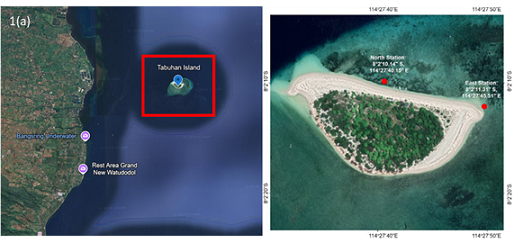
Las praderas de pastos marinos desempeñan un papel crucial en el secuestro de carbono azul costero, sin embargo, están cada vez más amenazadas por actividades antropogénicas, especialmente en islas con un turismo intensivo. Este estudio tuvo como objetivo estimar la biomasa y el stock de carbono de los pastos marinos, y evaluar la influencia de parámetros ambientales sobre estos indicadores ecológicos en la Isla Tabuhan, Banyuwangi, Java Oriental. La investigación de campo se llevó a cabo entre agosto y septiembre de 2023 en dos estaciones (Norte y Este). La recolección de datos incluyó transectas con cuadrantes de 50 × 50 cm para el muestreo de pastos marinos, mediciones in situ de parámetros ambientales (temperatura, salinidad, pH, oxígeno disuelto, transparencia, corriente y sustrato), y análisis de laboratorio de la biomasa y el contenido de carbono orgánico mediante el método de Pérdida por Ignición. Se identificaron cuatro especies de pastos marinos: Cymodocea rotundata, Halophila ovalis, Enhalus acoroides y Thalassia hemprichii. El ecosistema de pastos marinos se encontró en mal estado, con una cobertura muy baja (0.46% y 0.45%) y una densidad baja (< 0.02 brotes m-2). La biomasa total promedio fue de 0.017 g PS m-2, dominando la biomasa subterránea. El stock de carbono estimado fue de 0.0035 g C m-2, almacenada principalmente en los tejidos subterráneos. La salinidad y el pH fueron los principales factores ambientales que diferenciaron las dos estaciones y mostraron una fuerte asociación con los valores de biomasa y stocks de carbono de los pastos marinos. A pesar de su estado degradado, la pradera de pastos marinos de la Isla Tabuhan conserva un reservorio de carbono almacenado principalmente en los tejidos subterráneos. Este estudio subraya la necesidad urgente de estrategias integradas de gestión costera y conservación para proteger y restaurar estos ecosistemas vulnerables, particularmente en destinos turísticos en desarrollo, a fin de mantener las Contribuciones de la Naturaleza a las Personas (CNP), incluida la mitigación del cambio climático.
Descargas
Referencias
Adams MP, Hovey RK, Hipsey MR, Bruce LC, Ghisalberti M, Lowe RJ, Gruber RK, Ruiz-Montoya L, Maxwell PS, Callaghan DP, et al. 2016. Feedback between sediment and light for seagrass: Where is it important? Limnol Oceanogr. 61 (6): 1937-1955. DOI: https://doi.org/10.1002/lno.10319
Ambo-Rappe R, La Nafie YA, Marimba AA, Cullen-Unsworth LC, Unsworth RK. 2019. Perspectives on seagrass ecosystem services from a coastal community. IOP Conf Ser Earth and Environ Sci. 370: 012022. DOI: https://doi.org/10.1088/1755-1315/370/1/012022
Baltranaitė E, Inácio M, Valença Pinto L, Bogdziewicz K, Rocha J, Gomes E, Pereira P. 2025. Tourism impacts on marine and coastal ecosystem services: a systematic review. Geogr Sustain. 6 (2): 100277. DOI: https://doi.org/10.1016/j.geosus.2025.100277
Barbier EB. 2017. Marine ecosystem services. Curr Biol. 2: 507-510. DOI: https://doi.org/10.1016/j.cub.2017.03.020
Creed JC, Amado GM, Filhô F. 1999. Disturbance and recovery of the macroflora of a seagrass (Halodule wrightii Ascherson) meadow in the Abrolhos Marine National Park, Brazil: an experimental evaluation of anchor damage. J Exp Mar Bio Ecol. 235: 285-306.
Cullen-Unsworth LC, Nordlund LM, Paddock J, Baker S, McKenzie LJ, Unsworth RKF. 2014. Seagrass meadows globally as a coupled social-ecological system: implications for human wellbeing. Mar Pollut Bull. 83 (2): 387-397. DOI: https://doi.org/10.1016/j.marpolbul.2013.06.001
Den Hartog C, Kuo J. 2001. Taxonomy and biogeography of seagrasses. In: Larkum AWD, Orth RJ, Duarte CM, editors. Seagrasses: biology, ecology and conservation. Dordrecht: Springer. p. 1-23. DOI: https://doi.org/10.1007/978-1-4020-2983-7_1
Di Franco A, Baiata P, Milazzo M. 2013. Effects of recreational scuba diving on Mediterranean fishes: evidence of involuntary feeding? Mediterr Mar Sci. 14 (1): 15-18. DOI: https://doi.org/10.12681/mms.321
Duarte CM, Chiscano CL. 1999. Seagrass biomass and production: a reassessment. Aquat Bot. 65 (1-4): 159-174. DOI: https://doi.org/10.1016/S0304-3770(99)00038-8
Duarte CM, Kirkman HA. 2001. Methods for the measurement of seagrass abundance and depth distribution. In: Short FT, Coles RG, editors. Global seagrass research methods. Elsevier. p. 141-153. DOI: https://doi.org/10.1016/B978-044450891-1/50008-6
Duarte CM, Losada IJ, Hendriks IE, Mazarrasa I, Marbà N. 2013. The role of coastal plant communities for climate change mitigation and adaptation. Nat Clim Change. 3 (11): 961-968. DOI: https://doi.org/10.1038/nclimate1970
Dunic JC, Brown CJ, Connolly RM, Turschwell MP, Côté IM. 2021. Long-term declines and recovery of meadow area across the world’s seagrass bioregions. Global Change Biol. 27 (17): 4096-4109. DOI: https://doi.org/10.1111/gcb.15684
Erftemeijer P. 1993. Factors limiting growth and production of tropical seagrasses: nutrient dynamics in Indonesian Seagrass Beds [PhD thesis]. The Netherlands: University of Nijmegen.
Erftemeijer PLA, Robin Lewis RR. 2006. Environmental impacts of dredging on seagrasses: a review. Mar Poll Bull. 52 (12): 1553-1572. DOI: https://doi.org/10.1016/j.marpolbul.2006.09.006
Fonseca MS, Bell SS. 1998. Influence of physical setting on seagrass landscapes near Beaufort, North Carolina, USA. Mar Ecol Prog Ser. 171: 109-121.
Fourqurean JW, Duarte CM, Kennedy H, Marbà N, Holmer M, Mateo MA, Apostolaki ET, Kendrick GA, Krause-Jensen D, McGlathery KJ, et al. 2012. Seagrass ecosystems as a globally significant carbon stock. Nat Geosci. 5 (7): 505-509. DOI: https://doi.org/10.1038/ngeo1477
Ganguly D, Singh G, Ramachandran P, Selvam AP, Banerjee K, Ramachandran R. 2017. Seagrass metabolism and carbon dynamics in a tropical coastal embayment. Ambio. 46 (6): 667-679. DOI: https://doi.org/10.1007/s13280-017-0916-8
Garrard SL, Beaumont NJ. 2014. The effect of ocean acidification on carbon storage and sequestration in seagrass beds; a global and UK context. Mar Pollut Bull. 86 (1-2): 138-146. DOI: https://doi.org/10.1016/j.marpolbul.2014.07.032
Government of Indonesia. 2021. Government regulation No. 22/2021 concerning the implementation of environmental protection and management. [accessed 2025 Dec 3]. https://www.ecolex.org/details/legislation/government-regulation-no-22-of-2021-on-environmental-protection-organisation-and-management-lex-faoc209753/?
Grech A, Chartrand-Miller K, Erftemeijer P, Fonseca M, McKenzie L, Rasheed M, Taylor H, Coles R. 2012. A comparison of threats, vulnerabilities and management approaches in global seagrass bioregions. Environ Res Lett. 7 (2): 024006. DOI: https://doi.org/10.1088/1748-9326/7/2/024006
Heiri O, Lotter AF, Lemcke G. 2001. Loss on ignition as a method for estimating organic and carbonate content in sediments: reproducibility and comparability of results. J Paleolimnol. 25: 101-110.
Helrich K. 1990. Official methods of analysis of the Association of official analytical chemists. 15th ed. Arlington, VA Association of Official Analytical Chemists United States.
Hemminga MA, Duarte CM. 2000. Seagrass ecology. Cambridge: Cambridge University Press. 298 p. DOI: https://doi.org/10.1017/CBO9780511525551
Hernawan UE, Rahmawati S, Ambo-Rappe R, Sjafrie NDM, Hadiyanto H, Yusup DS, Nugraha AH, La Nafie YA, Adi W, Prayudha B, et al. 2021. The first nation-wide assessment identifies valuable bluecarbon seagrass habitat in Indonesia is in moderate condition. Sci Total Environ. 782: 146818. DOI: https://doi.org/10.1016/j.scitotenv.2021.146818
Howard J, Hoyt S, Isensee K, Telszewski M, Pidgeon E. 2014. Coastal Blue Carbon methods for assessing carbon stocks and emissions factors in mangroves, tidal salt marshes, and seagrass meadows. In: Howard J, Hoyt S, Isensee K, Pidgeon E, Telszewski M, editors. Conservation International, Intergovernmental Oceanographic Commission of UNESCO, International Union for Conservation of Nature, Arlington. https://www.ioc.unesco.org.
Howard J, Sutton-Grier A, Herr D, Kleypas J, Landis E, Mcleod E, Pidgeon E, Simpson S. 2017. Clarifying the role of coastal and marine systems in climate mitigation. Front Ecol Environ. 15 (1): 42-50. DOI: https://doi.org/10.1002/fee.1451
Jackson DA. 1993. Stopping rules in principal components analysis: a comparison of heuristical and statistical approaches. Ecology. 74 (8): 2204-2214. DOI: https://doi.org/10.2307/1939574
Jones BLH, Unsworth RKF, Nordlund LM, Ambo-Rappe R, La Nafie YA, Lopez MR, Udagedara S, Cullen-Unsworth LC. 2022. Local ecological knowledge reveals change in seagrass social-ecological systems. Oceans. 3 (3): 419-430. DOI: https://doi.org/10.3390/oceans3030028
Kirk JTO. 2011. Light and photosynthesis in aquatic ecosystems. 3rd ed. Cambridge: Cambridge University Press. https://assets.cambridge.org/97805211/51757/frontmatter/9780521151757_frontmatter.pdf.
Klemas V. 2012. Remote sensing of coastal and ocean currents: an overview. J Coast Res. 28 (3): 576-586. DOI: https://doi.org/10.2112/JCOASTRES-D-11-00197.1
Koch EW, Ackerman JD, Verduin J, van Keulen M. 2006. Fluid dynamics in seagrass ecology-from molecules to ecosystems. In: Larkum AWD, Orth RJ, Duarte CM, editors. Seagrasses: biology, ecology and conservation. Dordrecht: Springer. p. 193-225. DOI: https://doi.org/10.1007/978-1-4020-2983-7_8
Koch MS, Schopmeyer SA, Kyhn-Hansen C, Madden CJ, Peters JS. 2007. Tropical seagrass species tolerance to hypersalinity stress. Aquat Bot. 86 (1): 14-24. DOI: https://doi.org/10.1016/j.aquabot.2006.08.003
Legendre P. 2019. Numerical ecology. In: Fath B, editor. Developments in environmental modelling. 3rd ed. Elsevier. p. 487-493. DOI: https://doi.org/10.1016/B978-0-12-409548-9.10595-0
Lovelock CE, Duarte CM. 2019. Dimensions of blue carbon and emerging perspectives. Biol Lett. 15 (3): 20180781. DOI: https://doi.org/10.1098/rsbl.2018.0781
Macreadie PI, Costa MDP, Atwood TB, Friess DA, Kelleway JJ, Kennedy H, Lovelock CE, Serrano O, Duarte CM. 2021. Blue carbon as a natural climate solution. Nat Rev Earth Environ. 2 (12): 826-839. DOI: https://doi.org/10.1038/s43017-021-00224-1
Marbà N, Arias-Ortiz A, Masqué P, Kendrick GA, Mazarrasa I, Bastyan GR, Garcia-Orellana J, Duarte CM. 2015. Impact of seagrass loss and subsequent revegetation on carbon sequestration and stocks. J Ecol. 103 (2): 296-302. DOI: https://doi.org/10.1111/1365-2745.12370
Maxwell PS, Eklöf JS, van Katwijk MM, O’Brien KR, de la Torre-Castro M, Boström C, Bouma TJ, Krause-Jensen D, Unsworth RKF, van Tussenbroek BI, et al. 2017. The fundamental role of ecological feedback mechanisms for the adaptive management of seagrass ecosystems - a review. Biol Rev. 92 (3): 1521-1538. DOI: https://doi.org/10.1111/brv.12294
McKenzie LJ. 2003. Guidelines for the rapid assessment of seagrass habitats in the western Pacific. Cairns: Northern Fisheries Centre. 43 p. https://www.seagrasswatch.org/wp-content/uploads/Methods/manuals/PDF/SeagrassWatch_Rapid_Assessment_Manual.pdf.
McKenzie LJ, Nordlund LM, Jones BL, Cullen-Unsworth LC, Roelfsema C, Unsworth RKF. 2020. The global distribution of seagrass meadows. Environ Res Lett. 15 (7): 074041. DOI: https://doi.org/10.1088/1748-9326/ab7d06
Ministry of Environment. 2004. Decree of the Minister of Environment No. 200 of 2004 concerning standard criteria and guidelines for determining seagrass damage. [accessed 2025 Nov 10]. https://faolex.fao.org/docs/pdf/tan61491.pdf.
Mira M, Kurniawan T. 2020. Carriying capacity of small island for tourism development. IOP Conf Ser Earth and Environ Sci. 584 (1). DOI: https://doi.org/10.1088/1755-1315/584/1/012060
Nordlund LM, Jackson EL, Nakaoka M, Samper-Villarreal J, Beca-Carretero P, Creed JC. 2018. Seagrass ecosystem services. What’s next? Mar Pollut Bull. 134: 145-151. DOI: https://doi.org/10.1016/j.marpolbul.2017.09.014
Olsen YS, Sánchez-Camacho M, Marbà N, Duarte CM. 2012. Mediterranean seagrass growth and demography responses to experimental warming. Estuar Coast. 35 (5): 1205-1213. DOI: https://doi.org/10.1007/s12237-012-9521-z
Orth RJ, Lefcheck JS, Mcglathery KS, Aoki L, Luckenbach MW, Moore KA, Oreska MPJ, Snyder R, Wilcox DJ, Lusk B. 2020. Restoration of seagrass habitat leads to rapid recovery of coastal ecosystem services. Sci Adv. 6: eabc6434.
Pendleton L, Donato DC, Murray BC, Crooks S, Jenkins WA, Sifleet S, Craft C, Fourqurean JW, Kauffman JB, Marbà N, et al. 2012. Estimating global “Blue Carbon” emissions from conversion and degradation of vegetated coastal ecosystems. PLoS ONE. 7 (9): e43542. DOI: https://doi.org/10.1371/journal.pone.0043542
Peralta G, Pérez-Lloréns JL, Hernández I, Brun F, Vergara JJ, Bartual A, Gálvez JA, García CM. 2000. Morphological and physiological differences between two morphotypes of Zostera noltii Hornem. from the south-western Iberian Peninsula. Helgol Mar Res. 54: 80-86. DOI: https://doi.org/10.1007/s101520050005
Rahadiarta IKVS, Putra IDNN, Suteja Y. 2019. Carbon storage in seagrass beds in the Mengiat Beach Area, Nusa Dua Bali. J Mar Aquat Sci. 5 (1): 1-10. DOI: https://doi.org/10.24843/jmas.2019.v05.i01.p01
Roca G, Alcoverro T, Krause-Jensen D, Balsby TJS, Van Katwijk MM, Marbà N, Santos R, Arthur R, Mascaró O, Fernández-Torquemada Y, et al. 2016. Response of seagrass indicators to shifts in environmental stressors: a global review and management synthesis. Ecol Indic. 63: 310-323. DOI: https://doi.org/10.1016/j.ecolind.2015.12.007
Röhr ME. 2019. Environmental drivers influencing the carbon sink capacity of eelgrass (Zostera marina) [doctoral thesis]. Åbo Akademi University. http://urn.fi/URN:NBN:fi-fe2020100882957.
Schindler Murray L, Milligan B. 2023. The blue carbon handbook: blue carbon as a nature-based solution for climate action and sustainable development. London: High Level Panel for a Sustainable Ocean Economy. 79 p. DOI: https://doi.org/10.69902/566a16de
Short F, Carruthers T, Dennison W, Waycott M. 2007. Global seagrass distribution and diversity: a bioregional model. J Exp Mar Biol Ecol. 350 (1-2): 3-20. DOI: https://doi.org/10.1016/j.jembe.2007.06.012
Supriadi S, Kaswadji RF, Bengen DG, Hutomo M. 2014. Carbon stock of seagrass community in Barranglompo Island, Makassar. Indones J Mar Sci. 19 (1): 1-10. DOI: https://doi.org/10.14710/ik.ijms.19.1.1-10
Supriyadi IH, Iswari MY, Rahmawati S, Riniatsih I, Suyarso, Hafizt M. 2024. Seagrass ecosystems in Eastern Indonesia: status, diversity, and management challenges. Indones J Mar Sci. 29 (4): 503-518. DOI: https://doi.org/10.14710/ik.ijms.29.4.503-518
Unsworth RKF, McKenzie LJ, Collier CJ, Cullen-Unsworth LC, Duarte CM, Eklöf JS, Jarvis JC, Jones BL, Nordlund LM. 2019. Global challenges for seagrass conservation. Ambio. 48 (8): 801-815. DOI: https://doi.org/10.1007/s13280-018-1115-y
Wang Q, Li Y, Wang Y. 2011. Optimizing the weight loss-on-ignition methodology to quantify organic and carbonate carbon of sediments from diverse sources. Environ Monit Assess. 174 (1-4): 241-257. DOI: https://doi.org/10.1007/s10661-010-1454-z
Waycott M, Duarte CM, Carruthers TJB, Orth RJ, Dennison WC, Olyarnik S, Calladine A, Fourqurean JW, Heck KL, Hughes AR, et al. 2009. Accelerating loss of seagrasses across the globe threatens coastal ecosystems. Proc Natl Acad Sci. 106 (30): 12377-12381. DOI: https://doi.org/10.1073/pnas.0905620106
Descargas
Publicado
Número
Sección
Licencia
Derechos de autor 2026 Faiz Ni'matul Haq, Medy Ardianto Wijaya

Esta obra está bajo una licencia internacional Creative Commons Atribución-NoComercial-CompartirIgual 4.0.
Los autores de los artículos publicados en Marine and Fishery Sciences conservan los derechos de autor de sus artículos, a excepción de las imágenes de terceros y otros materiales añadidos por Marine and Fishery Sciences, que están sujetos a los derechos de autor de sus respectivos propietarios. Por lo tanto, los autores son libres de difundir y volver a publicar sus artículos, sujeto a los requisitos de los propietarios de derechos de autor de terceros y sujeto a que la publicación original sea completamente citada. Los visitantes también pueden descargar y reenviar artículos sujetos a los requisitos de citas. La capacidad de copiar, descargar, reenviar o distribuir cualquier material siempre está sujeta a los avisos de derechos de autor que se muestran. Los avisos de copyright deben mostrarse de manera prominente y no pueden borrarse, eliminarse u ocultarse, total o parcialmente. El autoalmacenamiento en servidores y repositorios de preimpresión está permitido para todas las versiones.
Esta revista ofrece a los autores una política de acceso abierto. Los usuarios pueden leer, descargar, copiar, distribuir, imprimir, buscar o vincular los textos completos de los artículos, o usarlos para cualquier otro propósito legal dentro de la licencia Creative Commons 4.0 (BY-NC-SA), sin solicitar permiso previo del editor o del autor. Esto está de acuerdo con la definición BOAI de acceso abierto.