Trophic relationships of the angel shark (Squatina guggenheim) in the San Matías Gulf, Río Negro, Argentina
DOI:
https://doi.org/10.47193/mafis.3922026010405Keywords:
Elasmobranchii, feeding ecology, bycatch, stomach content, trophic levelAbstract
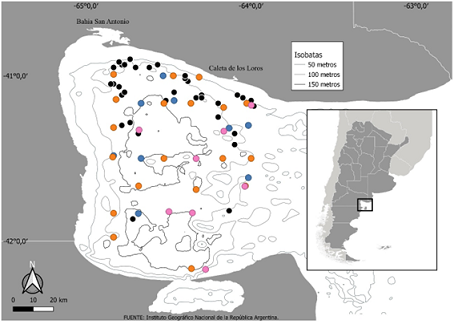
The angel shark Squatina guggenheim has been historically caught as bycatch and landed in the Argentine hake Merluccius hubbsi fishery, and since 2013, in the Argentine red shrimp Pleoticus muelleri fishery in the San Matías Gulf (SMG). The aim was to evaluate the feeding habits of the angel shark in the SMG during period 1 (P1, 2005-2010) and period 2 (P2, 2015-2022). Stomach contents of 334 individuals were analyzed, 152 from P1 and 182 from P2. The incidence of prey species in the diet was calculated using frequency of occurrence (%FO), numerical percentage (%N), percentage by weight (%P), the relative importance index IRI, %IRI, and specific %PSIRI. Results from P1 indicate a diet dominated by hake (84.3%IRI). In P2, the diet was mainly hake (42.5%IRI), with an increase in malacostracan invertebrates, including shrimp (22.6%IRI), squat lobster (14.6%IRI), and stomatopods (8.9%IRI). This dietary shift is reflected in the calculated trophic level (TL) through the standardized index of diet composition according to Cortés (1999); in P1, sharks were tertiary predators, with TL = 4.22 in adults and TL = 4.16 in juveniles. Based on prey and their trophic levels, P2 showed TL = 3.77 in adults and TL = 3.81 in juveniles, placing angel sharks as secondary predators. The results highlight the species’ feeding plasticity, shifting its diet according to prey availability and showing a feeding strategy with strong individual specialization during both periods.
Downloads
References
Alonso RB, Romero MA, Ocampo Reinaldo M, Bustelo PE, Medina AI, González R. 2019. The opportunistic sense: the diet of Argentine hake Merluccius hubbsi reflects changes in prey availability. Reg Stud Mar Sci. 27: 100540.
Amundsen PA, Gabler HM, Staldvik FJ. 1996. A new approach to graphical analysis of feeding strategy from stomach contents data-modification of the Costello (1990) method. J Fish Bio. 48 (4): 607-614.
Awruch CA, Lo Nostro FL, Somoza GM, Di Giacomo E. 2008. Reproductive biology of the angular angel shark Squatina guggenheim (Chondrichthyes: Squatinidae) off Patagonia (Argentina, southwestern Atlantic). Cienc Mar. 34 (1): 17-28.
Bax NJ. 1998. The significance and prediction of predation in marine fisheries. ICES J Mar Sci. 55 (6): 991-1030.
Bovcon ND, Góngora ME, Marinao C, González Zeballos D. 2013. Composición de las capturas y descartes generados en la pesca de merluza común Merluccius hubbsi y langostino patagónico Pleoticus muelleri: un caso de estudio en la flota fresquera de altura del Golfo San Jorge, Chubut, Argentina. Rev Biol Mar Oceanogr. 48 (2): 303-319.
Braccini JM. 2008. Feeding ecology of two high-order predators from south-eastern Australia: the coastal broadnose and the deepwater sharpnose sevengill sharks. Mar Ecol Prog Ser. 371: 273-284.
Brown SC, Bizzarro JJ, Cailliet GM, Ebert DA. 2012. Breaking with tradition: redefining measures for diet description with a case study of the Aleutian skate Bathyraja aleutica (Gilbert 1896). Environ Biol Fish. 95 (1): 3-20.
Bruno JF, O’Connor MI. 2005. Cascading effects of predator diversity and omnivory in a marine food web. Ecol Lett. 8 (10): 1048-1056.
Casselberry GA, Carlson JK. 2015. Endangered species act status review of the spiny angel shark (Squatina guggenheim). Report to the National Marine Fisheries Service, Office of Protected Resources. SFD Contribution PCB-15-10.
Chiaramonte GE. 1998. Shark fisheries in Argentina. Mar Freshw Res. 49 (1): 601-609.
Collins AB, Heupel MR, Hueter RE, Motta PJ. 2007. Hard prey specialists or opportunistic generalists? An examination of the diet of the cownose ray, Rhinoptera bonasus. Mar Freshw Res. 58 (1): 135-144.
Colonello JH. 2005. Ecología reproductiva y hábitos alimentarios del pez ángel, Squatina guggenheim (Chondrichthyes: Squatinidae), en el Distrito Biogeográfico Bonaerense, entre 34° y 42° S [tesis de licenciatura]. Mar del Plata: Facultad de Ciencias Exactas y Naturales, Universidad Nacional de Mar del Plata. 183 p.
Colonello JH, Lucifora LO, Massa AM. 2007. Reproduction of the angular angel shark (Squatina guggenheim): geographic differences, reproductive cycle, and sexual dimorphism. J Mar Sci. 64 (1): 131-140.
Cortés E. 1997. A critical review of methods of studying fish feeding based on analysis of stomach contents: application to elasmobranch fishes. Can J Fish Aquat Sci. 54 (3): 726-738.
Cortés E. 1999. Standardized diet compositions and trophic levels of sharks. ICES J Mar Sci. 56 (5): 707-717.
Csardi G, Nepusz T. 2006. The igraph software. Complex Syst. 16: 1-9.
Cuesta Núñez JC, Romero MA, Ocampo Reinaldo M, González R, Magurran A, Svendsen GM. 2023. Species turnover drives functional turnover with balanced functional nestedness in a Patagonian demersal assemblage. J Sea Res. 196: 102452.
Di Giácomo EE, Perier MR. 1991. Evaluación de la biomasa y explotación comercial del pez gallo (Callorhynchus callorhynchus) en el Golfo San Matías, Argentina. Frente Marít. 9 (A): 7-13.
Ebert DA, Bizzarro JJ. 2007. Standardized diet compositions and trophic levels of skates (Chondrichthyes: Rajiformes: Rajoidei). Environ Biol Fish. 80 (2): 221-237.
Escobar Condor EW, Izquierdo Villasante Y, Macedo Riva A, Remuzgo Panduro G, Huiman Cruz A. 2019. Impacto de la ingesta de residuos plásticos en peces. Rev Kawsaypacha Soc Medio Ambiente. (4): 79-92.
Gagliardini DA, Rivas AL. 2004. Environmental characteristics of San Matías Gulf obtained from LANDSAT-TM and ETM+ data. Gayana. 68 (2): 186-193.
Góngora ME. 2011. Dinámica y manejo de la captura incidental de peces en la pesquería del langostino patagónico (Pleoticus muelleri) [tesis doctoral]. Bariloche: Centro Regional Universitario Bariloche, Universidad Nacional del Comahue. 214 p.
Heithaus MR. 2001. The biology of tiger sharks, Galeocerdo cuvier, in Shark Bay, Western Australia: sex ratio, size distribution, diet, and seasonal changes in catch rates. Environ Biol Fish. 61 (1): 25-36.
Hsieh TC, Ma KH, Chao A. 2016. iNEXT: An R package for interpolation and extrapolation of species diversity (Hill numbers). Methods Ecol Evol. 7 (12): 1451-1456.
Hureau JC. 1970. Biologie comparée de quelques poissons antarctiques (Nothothenidae). Bull Inst Oceanogr. 68: 224.
Krebs CJ .1989. Ecological methodology. Nueva York: Harper and Row.
Lucifora LO. 2003. Ecología y conservación de los grandes tiburones costeros de Bahía Anegada, Provincia de Buenos Aires, Argentina [tesis doctoral]. Mar del Plata: Facultad de Ciencias Exactas y Naturales, Universidad Nacional de Mar del Plata. 406 p.
Milessi A, Vögler R, Bazzino G. 2001. Identification of three species of genus squatina (Chondrichthyes, Squatinidae) in the Argentine-Uruguayan common fishing zone (AUCFZ). Gayana. 65 (2): 167-172.
Muñoz Molina M. 2019. Estudio del comportamiento de caza y ecología trófica del angelote Squatina squatina (Linneaus 1758) en áreas de crías [máster]. Santa Cruz de Tenerife: Universidad la Laguna. 34 p.
Motta PJ, Wilga CD. 2001. Advances in the study of feeding behaviors, mechanisms, and mechanics of sharks. Environ Biol Fish. 60 (1): 131-156.
Myers RA, Baum JK, Shepherd TD, Powers SP, Peterson CH. 2007. Cascading effects of the loss of apex predatory sharks from a coastal ocean. Science. 315 (5820): 1846-1850.
Narvarte M, Firstater F, Ocampo Reinaldo M, Camarero M, Osovnikar FP, González R. 2013. Resultados preliminares del monitoreo de las actividades de pesca comercial y experimental de langostino Pleoticus muelleri en el Golfo San Matías. Inf Téc IBMPAS Nº 7/2013. 13 p.
Ocampo Reinaldo M, González R, Romero MA. 2011. Feeding strategy and cannibalism of the Argentine hake Merluccius hubbsi. J Fish Biol. 79 (7): 1795-1814.
Ocampo Reinaldo M, Svendsen GM, Romero MA, Flores L, Cuesta Nuñez JC, González R. 2023. Resultados preliminares sobre biomasa y estructura poblacional de la merluza común. Programa de Asistencia Técnica para el Monitoreo y la Formulación de Planes de Manejo de las Pesquerías del Golfo San Matías. Inf Téc CIMAS Nº 1/2023. 17 p.
Oddone M, Awruch CA, Barreto R, Charvet P, Chiaramonte GE, Cuevas JM, Vooren CM. 2019. Squatina guggenheim, angular angelshark. The IUCN Red List of Threatened Species 2019. 13 p.
Perier MR, Di Giácomo EE. 2002. El savorín seriolella porosa como un recurso estacional en el Golfo San Matías, República Argentina. Rev Invest Desarr Pesq. 15: 15-26.
Perier MR, Estalles M, Coller NM, Suarez MN, Mora GJ, Di Giácomo EE. 2011. Chondrichthyans of the San Matías Gulf, Patagonia, Argentina. Rev Mus Argent Cienc Nat. 13 (2): 213-220.
Piola AR, Rivas AL. 1997. Corrientes en la plataforma continental. En: Boschi EE, editor. El Mar Argentino y sus recursos pesqueros. Tomo 1. Antecedentes históricos de las exploraciones en el mar y las características ambientales. Mar del Plata: Instituto Nacional de Investigación y Desarrollo Pesquero (INIDEP). p. 119-132.
Piola AR, Scasso LM. 1988. Circulación en el Golfo San Matías. Geoacta. 15: 33-51.
R Core Team. 2023. R: A language and environment for statistical computing. Vienna: R Foundation for Statistical Computing. https://www.R-project.org/.
Rincón-Díaz MP, Funes M, Bovcon ND, Belleggia M, Cochia PD, Jacobi KJ, Galván DE. 2024. From gaps to consideration: a framework for prioritizing trophic studies in marine fishes. Hydrobiologia. 851 (16): 3943-3961.
Romero MA, González R, Ocampo Reinaldo M. 2008. Análisis histórico de la composición por especie de los desembarcos de la pesquería de arrastre demersal del Golfo San Matías: identificación y caracterización de ciclos productivos. IBMPAS serie publicaciones 1-25. 13 p.
Romero MA, Ocampo Reinaldo M, Williams G, Narvarte M, Gafliardini DA, González R. 2013. Understanding the dynamics of an enclosed trawl demersal fishery in Patagonia (Argentina): a holistic approach combining multiple data sources. Fish Res. 140: 73-82.
Sepúlveda L. 2018. Distribución y caracterización de la fauna acompañante en la pesquería del langostino Pleoticus muelleri (Bate 1888) del Golfo San Matías, Río Negro, Argentina [tesis de licenciatura]. San Antonio Oeste: Escuela Superior de Ciencias Marinas, Universidad Nacional del Comahue. 62 p.
Simpfendorfer CA, Goodreid A, McAuley RB. 2001. Diet of three commercially important shark species from Western Australian waters. Mar Freshw Rres. 52 (7): 975-985.
Standora EA, Nelson DR. 1977. A telemetric study of the behavior of free-swimming Pacific angel sharks, Squatina californica. Bull South Calif Acad Sci. 76 (3): 193-201.
Tiktak GP, Butcher D, Lawrence PJ, Norrey J, Bradley L, Shaw K, Preziosi R, Megson, D. 2020. Are concentrations of pollutants in sharks, rays and skates (Elasmobranchii) a cause for concern? A systematic review. Mar Pollut Bull. 160: 111701.
Vögler R, Milessi AC, Duarte LO. 2009. Changes in trophic level of Squatina guggenheim with increasing body length: relationships with type, size and trophic level of its prey. Environ Biol Fish. 84 (1): 41-52.
Vögler R, Milessi AC, Quiñones RA. 2003. Trophic ecology of Squatina guggenheim on the continental shelf off Uruguay and northern Argentina. J Fish Biol. 62 (6): 1254-1267.
Vooren CM, Klippel S. 2005. Biologia e status conservação dos caçōes-anjo Squatina Guggenheim, S. occulta e S. argentina. En: Vooren CM, Klippel S, editores. Ações para a conservação de tubarões e raias no sul do Brasil. Porto Alegre: Igaré. 262 p.
Wetherbee BM, Gruber SH, Cortés E. 1990. Diet feeding habits, digestion and consumption in sharks, with special reference to the lemon shark, Negraprion brevirostris. NOAA Tech Rep NMFS. 90 (1): 29-47.
Downloads
Published
Issue
Section
License
Copyright (c) 2026 Florencia N. Fernández Chert, Matías Ocampo Reinaldo, Matías N. Suarez, Marina N. Coller

This work is licensed under a Creative Commons Attribution-NonCommercial-ShareAlike 4.0 International License.
Authors of articles published in Marine and Fishery Sciences retain copyright on their articles, except for any third-party images and other materials added by Marine and Fishery Sciences, which are subject to copyright of their respective owners. Authors are therefore free to disseminate and re-publish their articles, subject to any requirements of third-party copyright owners and subject to the original publication being fully cited. Visitors may also download and forward articles subject to the citation requirements. The ability to copy, download, forward or otherwise distribute any materials is always subject to any copyright notices displayed. Copyright notices must be displayed prominently and may not be obliterated, deleted or hidden, totally or partially.
This journal offers authors an Open Access policy. Users are allowed to read, download, copy, distribute, print, search, or link to the full texts of the articles, or use them for any other legal purpose within the Creative Commons 4.0 license (BY-NC-SA), without asking prior permission from the publisher or the author. This is in accordance with the BOAI definition of Open Access.