Improvements in length structure, reproductive indices, and spawning biomass following strengthened fisheries management: evidence from the common sardine (Strangomera bentincki) off central-southern Chile
DOI:
https://doi.org/10.47193/mafis.39420260011001Keywords:
Fisheries management, small pelagic fish, reproductive dynamics, length-based indicatorsAbstract
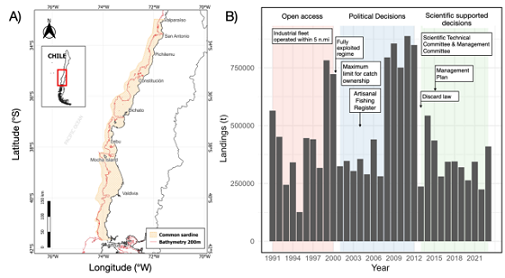
Fisheries management measures are expected to enhance the demographic structure and reproductive capacity of exploited fish populations, particularly in short-lived, fast-growing small pelagic species. We evaluated long-term changes in key demographic traits of common sardine (Strangomera bentincki) off central-southern Chile in relation to major regulatory milestones implemented between 1991 and 2023. Biological data from fishery monitoring programs were analyzed across three management periods (1991-2000: open access, 2001-2012: political decisions, and 2013-2023: scientifically supported decisions), focusing on length-structure, spawning biomass (SSB), fishing mortality (F), reproductive activity, condition factor, and length-based indicators. Significant differences were observed among the three periods. The second period was characterized by a reduced median length, delayed reproductive peak, high F, and low SSB, consistent with overfishing. In contrast, the most recent period exhibited consistently lower fishing mortality, increased spawning biomass, improved length-structure with a higher proportion of large and repeat spawners, and an earlier and more intense winter reproductive peak. Length-based indicators showed improved conservation of immature and large individuals and improved alignment with optimal yield benchmarks. Results demonstrate that strengthened, science-based fisheries management has positively influenced the demographic structure and reproductive dynamics of common sardine, underscoring the importance of sustained low fishing mortality in short-lived pelagic fisheries in the region.
Downloads
References
Aedo G, Garcés C, Niklitschek E, Musleh S, Cubillos LA, Quiñones RA. 2020. Spatial distribution of small pelagic fishes: implications for fishing quota allocations. Mar Policy. 120: 104147. DOI: https://doi.org/10.1016/j.marpol.2020.104147
Akaike H. 1973. Information theory and an extension of the maximum likelihood principle. In: Petrov BN, Csáki F, editors. Second International Symposium on Information Theory. Akadémiai Kiadó. p. 267-281.
Aranis A, Caballlero L, Böhm G, Martinez C, Nilo M, Palta E, Cerna F, Vera C, Bocic V, Gómez A, et al. 2006. Informe Final Programa de Seguimiento del Estado de Situación de las Principales Pesquerías Nacionales. Investigación Situación Pesquería Pelágica Zona Centro-Sur 2005. IFOP. https://www.ifop.cl/laboratorioedadycrecimiento/informes-tecnicos/.
Araya A, Bernal C, Gertosio A, Palta E, Tapia-Jopia C, Trejo P. 2022. La ley de descarte en Chile. Revisión comparada y análisis de su implementación. Nuevo Mundo Mundos Nuevos. DOI: https://doi.org/10.4000/nuevomundo.86961
Arcos DF, Cubillos LA, Núñez S. 2001. The jack mackerel fishery and El Niño 1997-98 effects off Chile. Prog Oceanogr. 49 (1-4): 597-617. DOI: https://doi.org/10.1016/S0079-6611(01)00043-X
Arteaga M, Ernst B, Vásquez S, Gatica C. 2014. Conceptual bases for implementing a management strategy evaluation (MSE) for common sardine (Strangomera bentincki) and anchovy (Engraulis ringens) in south-central zone of Chile. Lat Am J Aquat Res. 42 (3): 445-467. DOI: https://doi.org/10.3856/vol42-issue3-fulltext-6
Arteaga M, Vásquez SI, Neira S, Cubillos L. 2024. Effect of wind variability on the recruitment of anchovy Engraulis ringens in the southern Humboldt upwelling ecosystem. Fish Oceanogr. 33 (5): e12677.
Beamish RJ, McFarlane GA, Benson A. 2006. Longevity overfishing. Prog Oceanogr. 68 (2): 289-302. DOI: https://doi.org/10.1016/j.pocean.2006.02.005
Ben‐Hasan A, Walters C, Hordyk A, Christensen V, Al‐Husaini M. 2021. Alleviating growth and recruitment overfishing through simple management changes: insights from an overexploited long‐lived fish. Mar Coast Fish. 13 (2): 87-98. DOI: https://doi.org/10.1002/mcf2.10140
Berkeley SA, Chapman C, Sogard SM. 2004. Maternal age as a determinant of larval growth and survival in a marine fish, Sebastes melanops. Ecology. 85 (5): 1258-1264. DOI: https://doi.org/10.1890/03-0706
Bobko SJ, Berkeley SA. 2004. Maturity, ovarian cycle, fecundity, and age-specific parturition of black rockfish (Sebastes melanops). Fish Bull. 102 (3): 418-429. http://hdl.handle.net/1834/30917.
Box GEP, Jenkins GM, Reinsel GC, Ljung GM. 2015. Time series analysis: forecasting and control. 5th ed. Wiley. 720 p.
Brooks ME, Kristensen K, van Benthem KJ, Magnusson A, Berg CW, Nielsen A, Skaug HJ, Mächler M, Bolker BM. 2017. glmmTMB balances speed and flexibility among packages for zero-inflated data. The R Journal. 9 (2): 378-400.
Burnham KP, Anderson DR, editors. 2002. Model selection and multimodel inference: a practical information-theoretic approach. 2nd ed. New York: Springer. 488 p.
Bustos B, Cubillos LA. 2016. Cambios interanuales en la talla de madurez de sardina común, Strangomera bentincki, en la zona centro-sur de Chile (2007-2012). Rev Biol Mar Oceanogr. 51 (2): 317-325. DOI: https:// doi.org/10.4067/S0718-19572016000200009
Chávez Estrada GA, Quiroga Suazo MÁ, Dresdner Cid JD. 2018. The effect of collective rights-based management on technical efficiency: the case of Chile’s common sardine and anchovy fishery. Mar Resour Econ. 33 (1): 87-112. DOI: https://doi.org/10.1086/696130
Claramunt G, Serra R, Castro LR, Cubillos L. 2007. Is the spawning frequency dependent on female size? Empirical evidence in Sardinops sagax and Engraulis ringens off northern Chile. Fish Res. 85 (3): 248-257. DOI: https://doi.org/10.1016/j.fishres.2007.01.009
Cousido-Rocha M, Cerviño S, Alonso-Fernández A, Gil J, Herraiz IG, Rincón MM, Ramos F, Rodríguez-Cabello C, Sampedro P, Vila Y, et al. 2022. Applying length-based assessment methods to fishery resources in the Bay of Biscay and Iberian Coast ecoregion: stock status and parameter sensitivity. Fish Res. 248: 106197. DOI: https://doi.org/10.1016/j.fishres.2021.106197
Cubillos LA, Arcos DF, Bucarey DA, Canales MT. 2001. Seasonal growth of small pelagic fish off Talcahuano, Chile (37°S, 73°W): a consequence of their reproductive strategy to seasonal upwelling? Aquat Living Resour. 14 (2): 115-124.
Cubillos LA, Bucarey DA, Canales MT. 2002. Monthly abundance estimation for common sardine Strangomera bentincki and anchovy Engraulis ringens in the central-southern area off Chile (34-40°S). Fish Res. 57 (2): 117-130. DOI: https://doi.org/10.1016/S0165-7836(01)00340-X
Cubillos LA, Canales M, Bucarey D, Rojas A, Alarcon R. 1999. Época reproductiva y talla media de primera madurez sexual de Strangomera bentincki y Engraulis ringens en el período 1993-1997, en la zona centro-sur de Chile. Invest Mar. 27: 73-85. DOI: https://doi.org/10.4067/S0717-71781999002700008
Cubillos LA, Claramunt G. 2009. Length-structured analysis of the reproductive season of anchovy and common sardine off central southern Chile. Mar Biol. 156 (8): 1673-1680. DOI: https://doi.org/10.1007/s00227-009-1202-5
Cubillos LA, Claramunt G, Castro LR. 2014. Simulation of fishery-induced changes on the reproductive cycle of common sardine, Strangomera bentincki, off central southern Chile. Fish Res. 160: 103-111. DOI: https://doi.org/10.1016/j.fishres.2013.12.003
Cury P, Roy C. 1989. Optimal environmental window and pelagic fish recruitment success in upwelling areas. Can J Fish Aquat Sci. 46 (4): 670-680. DOI: https://doi.org/10.1139/f89-086
Dresdner J, Campos N, Chávez C. 2010. The impact of individual quotas on technical efficiency: does quality matter? Environ Develop Econ. 15 (5): 585-607. DOI: https://doi.org/10.1017/S1355770X10000215
Feltrim M, Ernst B. 2010. Inter-cohort growth variability and its implication for fishery management of the common sardine (Strangomera bentincki) stock off the coast of south-central Chile. Fish Res. 106 (3): 368-377. DOI: https://doi.org/10.1016/j.fishres.2010.09.006
Fulton TW. 1904. The rate of growth of fishes. Fisheries board of Scotland. Annual Report 22. Part 3. p. 141-241.
Gomez F, Montecinos A, Hormazabal S, Cubillos LA, Correa-Ramirez M, Chavez FP. 2012. Impact of spring upwelling variability off southern-central Chile on common sardine (Strangomera bentincki) recruitment. Fish Oceanogr. 21 (6): 405-414. DOI: https://doi.org/10.1111/j.1365-2419.2012.00632.x
Hsieh CH, Yamauchi A, Nakazawa T, Wang WF. 2010. Fishing effects on age and spatial structures undermine population stability of fishes. Aquat Sci. 72 (2): 165-178.
Hilborn R, Amoroso RO, Anderson CM, Baum JK, Branch TA, Costello C, De Moor CL, Faraj A, Hively D, Jensen OP, et al. 2020. Effective fisheries management instrumental in improving fish stock status. Proc Natl Acad Sci. 117 (4): 2218-2224. DOI: https://doi.org/10.1073/pnas.1909726116
Hilborn R, Buratti CC, Acuña ED, Hively D, Kolding J, Kurota H, Baker N, Mace PM, Muko S, Osio GC, et al. 2022. Recent trends in abundance and fishing pressure of agency-assessed small pelagic fish stocks. Fish Fish. 23 (6): 1313-1331. DOI: https://doi.org/10.1111/faf.12690
Hixon MA, Johnson DW, Sogard SM. 2014. BOFFFFs: on the importance of conserving old-growth age structure in fishery populations. ICES J Mar Sci. 71 (8): 2171-2185. DOI: https://doi.org/10.1093/icesjms/fst200
Hountcheme C, Montcho-Simon A. 2024. Understanding overfishing: a literature review. Asian J Fish Aquat Res. 26 (1): 61-71. DOI: https://doi.org/10.9734/ajfar/2024/v26i1727
[ICES] International Council for the Exploration of the Sea. 2018. ICES reference points for stocks in categories 3 and 4. ICES Technical Guidelines. Copenhagen: ICES. 50 p. DOI: https://doi.org/10.17895/ices.pub.4128
Jardim E, Azevedo M, Brites NM. 2015. Harvest control rules for data limited stocks using length-based reference points and survey biomass indices. Fish Res. 171: 12-19. DOI: https://doi.org/10.1016/j.fishres.2014.11.013
Koenigbauer ST, Höök TO. 2023. Increased offspring provisioning by large female fish and consequences for reproductive efficiency. Ecol Evol. 13 (10): e10555. DOI: https://doi.org/10.1002/ece3.10555
Kristensen K, Nielsen A, Berg CW, Skaug H, Bell BM. 2016. TMB: automatic differentiation and Laplace approximation. J Stat Softw. 70 (5): 1-21.
Kurota H, Szuwalski CS, Ichinokawa M. 2020. Drivers of recruitment dynamics in Japanese major fisheries resources: effects of environmental conditions and spawner abundance. Fish Res. 221: 105353. DOI: https://doi.org/10.1016/j.fishres.2019.105353
Lambert TC. 1987. Duration and intensity of spawning in nerring Clupea harengus as related to the age structure of the mature population. Mar Ecol Progr Ser. 39: 209-220.
Leal CP, Quiñones RA, Chávez C. 2010. What factors affect the decision-making process when setting TACs?: The case of Chilean fisheries. Mar Policy. 34 (6): 1183-1195. DOI: https://doi.org/10.1016/j.marpol.2010.04.002
Melvin GD, Stephenson RL. 2007. The dynamics of a recovering fish stock: Georges Bank herring. ICES J Mar Sci. 64 (1): 69-82. DOI: https://doi.org/10.1093/icesjms/fsl018
Millán M. 1999. Reproductive characteristics and condition status of anchovy Engraulis encrasicolus L. from the Bay of Cadiz (SW Spain). Fish Res. 41 (1): 73-86. DOI: https://doi.org/10.1016/S0165-7836(99)00010-7
Muñoz R, Vergara OA, Figueroa PA, Mardones P, Sobarzo M, Saldías GS. 2023. On the phenology of coastal upwelling off central-southern Chile. Dyn Atmos Oceans. 104: 101405. DOI: https://doi.org/10.1016/j.dynatmoce.2023.101405
Myers RA, Rosenberg AA, Mace PM, Barrowman N, Restrepo VR. 1994. In search of thresholds for recruitment overfishing. ICES J Mar Sci. 51: 191-205.
Pennino MG, Cousido-Rocha M, Maia C, Rocha A, Figueiredo I, Alonso-Fernández A, Silva C, Izquierdo F, Castro J, Teruel Gomez J, et al. 2022. This is what we know: assessing the stock status of the data-poor common sole on the Iberian coast. Estuar Coast Shelf Sci. 266: 107747. DOI: https://doi.org/10.1016/j.ecss.2022.107747
Peck MA, Alheit J, Bertrand A, Catalán IA, Garrido S, Moyano M, Rykaczewski RR, Takasuka A, Van der Lingen CD. 2021. Small pelagic fish in the new millennium: a bottom-up view of global research effort. Prog Oceanogr. 191: 102494. DOI: https://doi.org/10.1016/j.pocean.2020.102494
Peck MA, Catalán IA, Garrido S, Rykaczewski RR, Asch RG, McDowell JR, Hazen EL, Kaplan IC. 2024. Small pelagic fish: new frontiers in ecological research. Mar Ecol Progr Ser. 741: 1-6. DOI: https://doi.org/10.3354/meps14648
Porobic J, Fulton EA, Frusher S, Parada C, Haward M, Ernst B, Stram D. 2018. Implementing ecosystem-based fisheries management: lessons from Chile’s experience. Mar Policy. 97: 82-90. DOI: https://doi.org/10.1016/j.marpol.2018.08.037
Pinsky ML, Byler D. 2015. Fishing, fast growth and climate variability increase the risk of collapse. Proc Biol Sci B. 282 (1813): 20151053. DOI: https://doi.org/10.1098/rspb.2015.1053
R Core Team. 2024. R: A language and environment for statistical computing. R Foundation for Statistical Computing. https://www.R-project.org.
Sellinger EL, Szuwalski C, Punt AE. 2024. The robustness of our assumptions about recruitment: a re-examination of marine recruitment dynamics with additional data and novel methods. Fish Res. 269: 106862. DOI: https://doi.org/10.1016/j.fishres.2023.106862
Szuwalski CS, Vert-Pre KA, Punt AE, Branch TA, Hilborn R. 2015. Examining common assumptions about recruitment: a meta-analysis of recruitment dynamics for worldwide marine fisheries. Fish Fish. 16 (4): 633-648. DOI: https://doi.org/10.1111/faf.12083
Scott BE, Marteinsdottir G, Begg GA, Wright PJ, Kjesbu OS. 2006. Effects of population size/age structure, condition and temporal dynamics of spawning on reproductive output in Atlantic cod (Gadus morhua). Ecol Model. 191 (3): 383-415. DOI: https://doi.org/10.1016/j.ecolmodel.2005.05.015
Tommasi D, Stock CA, Pegion K, Vecchi GA, Methot RD, Alexander MA, Checkley DM. 2017. Improved management of small pelagic fisheries through seasonal climate prediction. Ecol Appl. 27 (2): 378-388. DOI: https://doi.org/10.1002/eap.1458
Trippel EA, Kjesbu OS, Solemdal P. 1997. Effects of adult age and size structure on reproductive output in marine fishes. In: Chambers RC, Trippel EA, editors. Early life history and recruitment in fish populations. Netherlands: Springer. p. 31-62. DOI: https://doi.org/10.1007/978-94-009-1439-1_2
Uriarte A, Ibaibarriaga L, Sánchez-Maroño S, Abaunza P, Andrés M, Duhamel E, Jardim E, Pawlowski L, Prellezo R, Roel BA. 2023. Lessons learnt on the management of short-lived fish from the Bay of Biscay anchovy case study: satisfying fishery needs and sustainability under recruitment uncertainty. Mar Policy. 150: 105512. DOI: https://doi.org/10.1016/j.marpol.2023.105512
Wood S. 2017. Generalized additive models: an introduction with R. Boca Raton: Chapman and Hall/CRC. 410 p.
Wright PJ, Trippel EA. 2009. Fishery-induced demographic changes in the timing of spawning: consequences for reproductive success. Fish Fish. 10 (3): 283-304. DOI: https://doi.org/10.1111/j.1467-2979.2008.00322.x
Zuñiga MJ, Bucarey D. 2024. Estatus y posibilidades de explotación biológicamente sustentables de sardina común, Región de Valparaíso a la Región de Los Lagos, año 2024. https://www.ifop.cl/wp-content/contenidos/uploads/RepositorioIfop/InformeFinal/2024/P-483272.pdf.
Zuur AF, Ieno EN, Smith GM. 2007. Analyzing ecological data. Statistics for biology and health. Springer: New York. 672 p. https://link.springer.com/content/pdf/10.1007/978-0-387-45972-1.pdf.
Published
Issue
Section
License
Copyright (c) 2026 Eveling Monsalve Tequén, Luis A. Cubillos, Sebastián I. Vásquez

This work is licensed under a Creative Commons Attribution-NonCommercial-ShareAlike 4.0 International License.
Authors of articles published in Marine and Fishery Sciences retain copyright on their articles, except for any third-party images and other materials added by Marine and Fishery Sciences, which are subject to copyright of their respective owners. Authors are therefore free to disseminate and re-publish their articles, subject to any requirements of third-party copyright owners and subject to the original publication being fully cited. Visitors may also download and forward articles subject to the citation requirements. The ability to copy, download, forward or otherwise distribute any materials is always subject to any copyright notices displayed. Copyright notices must be displayed prominently and may not be obliterated, deleted or hidden, totally or partially.
This journal offers authors an Open Access policy. Users are allowed to read, download, copy, distribute, print, search, or link to the full texts of the articles, or use them for any other legal purpose within the Creative Commons 4.0 license (BY-NC-SA), without asking prior permission from the publisher or the author. This is in accordance with the BOAI definition of Open Access.